Engineering and Project Management
 

Offshore Container Design for Hazardous Areas: ATEX, IECEx, and DNV 2.7-1

Deploying a standard offshore container in a Zone 1 or Zone 2 area is one of those errors that looks acceptable on a datasheet and becomes a serious problem at the certification stage — or worse, after it is installed. This article covers what hazardous area classification actually requires of …

Why Offshore Containers Fail Third-Party Certification — and How to Avoid It

Offshore container certification failures are more common than most project teams expect, and more often than not, they are not structural failures. The container is structurally sound. The failure is a documentation failure — the evidence presented to the certification body does not demonstrate compliance with the standard’s requirements, or …

What DNV 2.7-1 Certification Involves and How Long It Takes

Project managers who have not managed offshore container procurement before often assume that DNV 2.7-1 certification is a final-step approval — submit the container, receive a certificate. That assumption causes problems. Certification is a process, not a step, and it runs parallel to the engineering and fabrication. Understanding how it …

Bespoke vs Standard Offshore Containers: Why Custom Engineering Wins on Cost

The cost argument for standard offshore containers is real. They are cheaper upfront and available faster. For a project with genuinely standard requirements — a storage container, a workshop unit, a laydown area with no unusual payload or interface constraints — a modified standard unit can be the right answer. …

How to Write a Technical Specification for an Offshore Container

A weak specification is the most common source of problems in offshore container procurement. The container arrives at the certification body and the engineering firm is handed a one-page description of what the container should carry, with no information about how it will be lifted, what deck it will sit …

DNV 2.7-1 vs EN 12079 vs ISO 10855 — What’s the Difference and Why It Matters

Offshore containers operate under multiple overlapping standards, and the confusion costs time. Projects get held up in certification because the specification referenced one standard while the contract required another. Engineers spend days reconciling conflicting requirements that a clear understanding of the offshore container standards landscape would have avoided from the …

Offshore Containers

Need an offshore container engineering proposal? We design and engineer offshore containers to DNV 2.7-1, EN 12079, and ISO 10855 standards. Offshore containers are specialized units designed for use in marine environments, particularly on offshore platforms, drilling rigs, and ships. Their primary purpose is to safely transport equipment, supplies, and …

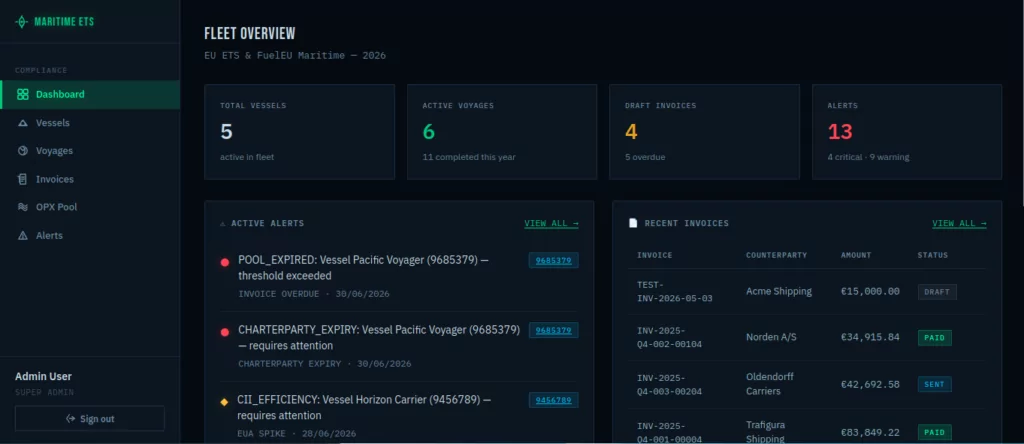
MARITIME ETS v1.0 Compliance Platform

Spun off from NAUTILUS codebase, a real-time compliance management tool for shipowners and fleet managers operating under the EU Emissions Trading System (EU ETS) and FuelEU Maritime regulation.

Live at https://compliance.ingeniat.eu · Backend API at port 8000 · Built with FastAPI + React/Vite

(Note: some features cut down on this demo version, contact us for access to a fully featured version)

Getting Started
Demo accounts (frontend login):


What it does

Emissions calculations, done for you
The platform computes EU ETS obligations automatically from your voyage and fuel data. Load a voyage, attach the fuel records (BDN data), pick the compliance year and the current EUA price — the system spits out the exact tCO2 and the cost in euros. No spreadsheets, no back-of-envelope estimates.

FuelEU Maritime works the same way: the system calculates your GHG intensity against the regulatory baseline, flags whether you’re in deficit, and tells you how much the penalty will be (and whether you can borrow from next year’s allocation instead).

CII ratings without the lookup tables
Enter your vessel’s total CO2 and distance for the year and the platform returns the CII rating — A through E — with the reference value for your vessel type and size. If you’re sitting at D or E, it also generates a corrective action plan blurb you can paste into your SEEMP.

UK ETS, tracked separately
The UK operates its own ETS with different rules (domestic routes are 100%, UK-EEA is 50%, everything else is out of scope). The platform keeps a completely separate ledger for UK obligations so nothing bleeds into your EU numbers.

THETIS-MRV export
Generate a THETIS-MRV XML file for any vessel-year directly from the platform. Upload it to the EMSA portal and you’re done with that part of the reporting cycle.

Invoicing that follows the chain
When a voyage falls under a charterparty, the platform allocates the ETS cost between owner and charterer according to the BIMCO SHORTNM or SHIPMAN clause. Then it generates the invoice — line items per voyage, total in euros — ready to send. Record payments as they come in and the status advances automatically from Draft to Sent to Paid.

OPX Pool — buying and selling surplus EUAs
If you’ve over-allocated EUAs relative to actual emissions, you can list the surplus on the platform’s internal marketplace. Other tenants on the platform can browse listings and agree a price. When a match is made, the platform records the EUA purchase and sale as a transaction in your ledger.

Alerts that actually surface
The system watches for things that need attention: surrender deadlines approaching, ETS positions running low, C ratings turning into D, invoices going overdue, fuel records missing for completed voyages. You configure which alerts fire and who receives them. The dashboard shows a live unacknowledged count so nothing slips through.

ERP connectivity
If your company runs SAP, Oracle, or Dynamics, the platform can pull vessel data, voyages, and fuel consumption directly from your ERP — no manual re-entry. Configure the connection once and trigger a sync whenever you need fresh data.
Maritime ETS

Continue reading"MARITIME ETS v1.0 Compliance Platform"

NAUTILUS v2.1.0 – Feature Overview & Implementation Notes

Nautilus is a fleet management and regulatory compliance platform designed for shipping companies, shipowners, and maritime consultants operating under IMO and EU environmental regulations. It centralizes vessel data, voyage records, and emissions calculations into a single backend, providing accurate, audit-ready compliance documentation for regulatory submissions.

The platform addresses the growing complexity of maritime environmental legislation — a landscape that has shifted dramatically with the introduction of the EU Emissions Trading System (ETS) for shipping in 2024, the IMO’s Carbon Intensity Indicator (CII) rating framework, FuelEU Maritime penalties, and theEnergy Efficiency Existing Ship Index (EEXI) certification requirements.

Try it now on https://nautilus.ingeniat.eu or check the specification here.

(Note: some features cut down on this demo version, contact us for access to a fully featured version)

Getting Started

Log in with the pre-filled credentials:
[email protected] / admin123

What Nautilus Does

Nautilus serves as the system of record for a fleet’s compliance posture. It tracks every vessel in a company’s register, records each voyage with cargo and consumption data, and calculates the resulting emissions, CII ratings, and EU ETS allowances automatically. The backend exposes a REST API consumed by a React frontend, with role-based access for fleet managers, company admins, and regulatory auditors.

Regulatory Calculations

The platform implements four interlocking compliance calculations:

EEXI (Energy Efficiency Existing Ship Index) — A theoretical maximum efficiency threshold calculated from a vessel’s technical design parameters (installed power, TTEW, DWT, design speed). Unlike operational ratings, EEXI is a design certification that vessels must meet through engine power limitations (EPL) or other technical upgrades. Nautilus stores the EEXI certificate reference and tracks compliance status per vessel.

CII (Carbon Intensity Indicator) — An operational rating expressed in grams of CO2 per cargo-carrying capacity per nautical mile (gCO2/t·nm). Vessels are assigned a rating from A (best) through E (worst) based on their annual operational performance. Ratings below D for three consecutive years trigger a corrective action requirement (CAP). Nautilus calculates the CII per voyage leg and aggregates it into a rolling annual rating per vessel.

EU ETS (European Union Emissions Trading System) — Shipping companies operating within EU ports must surrender EU Allowances (EUAs) covering 100% of CO2 emissions from intra-EU voyages and 50% from voyages arriving from or departing to non-EU ports (phased in through 2026). Nautilus tracks total verified emissions per voyage, converts to EUA requirements, and maintains an allowance ledger per company.

FuelEU Maritime — In effect from 2025, this regulation imposes a greenhouse gas (GHG) intensity limit on energy used on board vessels. The limit tightens progressively (‑2% in 2025, reaching ‑80% by 2050). Vessels exceeding the limit face penalties. Nautilus flags non-compliant voyages by comparing fuel energy content against the GHG intensity target.

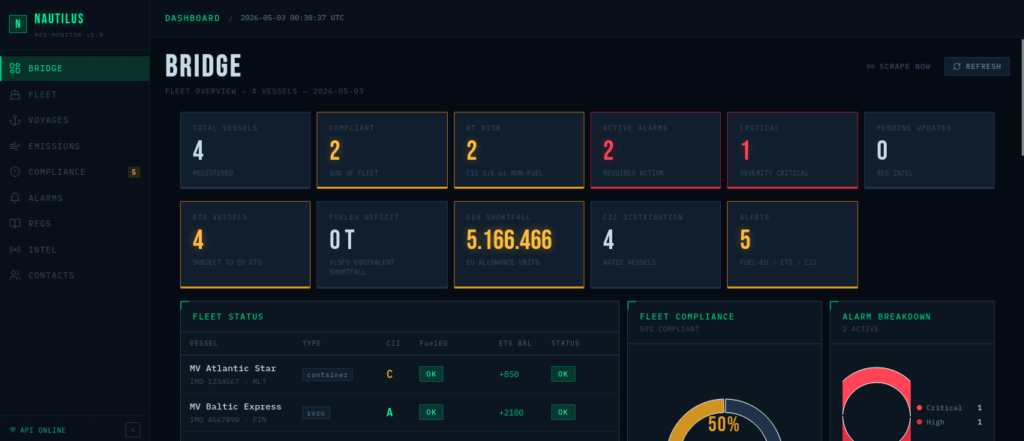
Nautilus Dashboard
Nautilus Dashboard

Continue reading"NAUTILUS v2.1.0 – Feature Overview & Implementation Notes"

An Underexamined Challenge in the EUA Framework

Walk into most shipping offices and ask how they’re handling EU ETS. You’ll hear the same thing: “We’ll buy what we need in September and move on.” It’s treated like a tax — an irritating compliance cost to settle at the deadline.

That’s not just sub-optimal. Over a three-year phase-in, it’s the most expensive way to do it. And yet, almost nobody is talking about the alternative. Let’s walk through what a disciplined EUA procurement strategy actually looks like — and what it saves.

The phased surrender schedule isn’t just a political concession. It’s a pricing gift.

– 2024 emissions → surrender 40% by September 2025
– 2025 emissions → surrender 70% by September 2026
– 2026 emissions → surrender 100% by September 2027 onwards

That ramp (40/70/100) creates nearly three full years between the first real cash-out and the moment you face the full obligation. You don’t need all your allowances on Day 1. You have time. Time to average in, position on pullbacks, and exploit the single biggest driver of EUA prices that shipping analysts rarely mention: gas market dynamics.

Continue reading"An Underexamined Challenge in the EUA Framework"

The Rising Compliance Challenge for Small Shipping Companies

EU ETS and FuelEU Maritime were written with large shipping companies in mind. The monitoring plans, carbon registries, allowance procurement cycles, and annual verification requirements all assume you have people whose full-time job is exactly this. Most small operators don’t. And the regulation offers no simpler version for those who don’t.

Since January 2024, every ship above 5,000 GT calling at EU or EEA ports has been required to purchase and surrender EU Emissions Trading System allowances — real money, real deadlines, real penalties for getting it wrong. The phase-in is steep: 40% coverage in 2024, 70% in 2025, 100% from 2026. For a single tanker or bulk carrier with significant EU trading exposure, that translates to an allowance bill of €100,000 to €500,000 per year — a cost that needs to be procured, tracked, and surrendered by 30 September each year without exception.

FuelEU Maritime, which entered into force in January 2025, adds a parallel framework on top. Where ETS charges you for what you emit, FuelEU sets targets for how clean your fuel needs to be — on a well-to-wake basis that captures the full lifecycle of every tonne of bunker consumed. Miss the GHG intensity target and the penalty is €2,400 per gigajoule of shortfall. The two regimes run independently of each other and require separate monitoring, separate reporting, and separate compliance strategies.

Since 2025 the net has widened further. General cargo ships and offshore vessels above 400 GT came into full MRV monitoring scope under the amended regulation — pulling thousands of smaller operators into a system they had little time to prepare for. For these vessels there are no ETS allowances to buy yet, but the monitoring obligation is real: approved monitoring plans, voyage-level fuel data collection, annual verified emission reports, and the Document of Compliance consequences that follow if any of it is missing.

Continue reading"The Rising Compliance Challenge for Small Shipping Companies"

Ballast Water Management Suite

Every ship over 400 GT is now required to meet the IMO Ballast Water Management Convention D-2 standard. The deadline passed in September 2024 — and Port State Control is checking.

Ballast Water Management Suite gives vessel operators, ship managers, and maritime compliance officers a practical, browser-based toolkit to stay ahead of inspection, plan BWMS investments, and maintain compliant record keeping — without expensive software subscriptions or class society retainers.

Features

D-2 Compliance Calculator

Know your status before you discharge.

Enter your ballast volume, BWMS system type, and source water quality. Get an instant estimated compliance assessment against D-2 discharge limits — including organism counts for organisms ≥50μm, 10–50μm, E. coli, Enterococci, and V. cholerae.

– Validated 7-digit IMO lookup from fleet registry
– Estimated treatment time based on system capacity
– Color-coded pass/fail against every D-2 parameter
– Works offline — no internet required on board

Exchange vs Treatment Decision Tool

Never second-guess a D-1 vs D-2 decision again.

Plug in your departure and arrival ports, ballast volume, and current BWMS status. Get a clear recommendation — and the math behind it.

– Automatic EU port detection (Rotterdam, Hamburg, Antwerp, and 20+ more)
– Calculates minimum exchange volume (95% or 3× tank capacity)
– Port State Control risk indicator for EU water routes
– Explains exactly what documentation you’ll need at the next PSC inspection

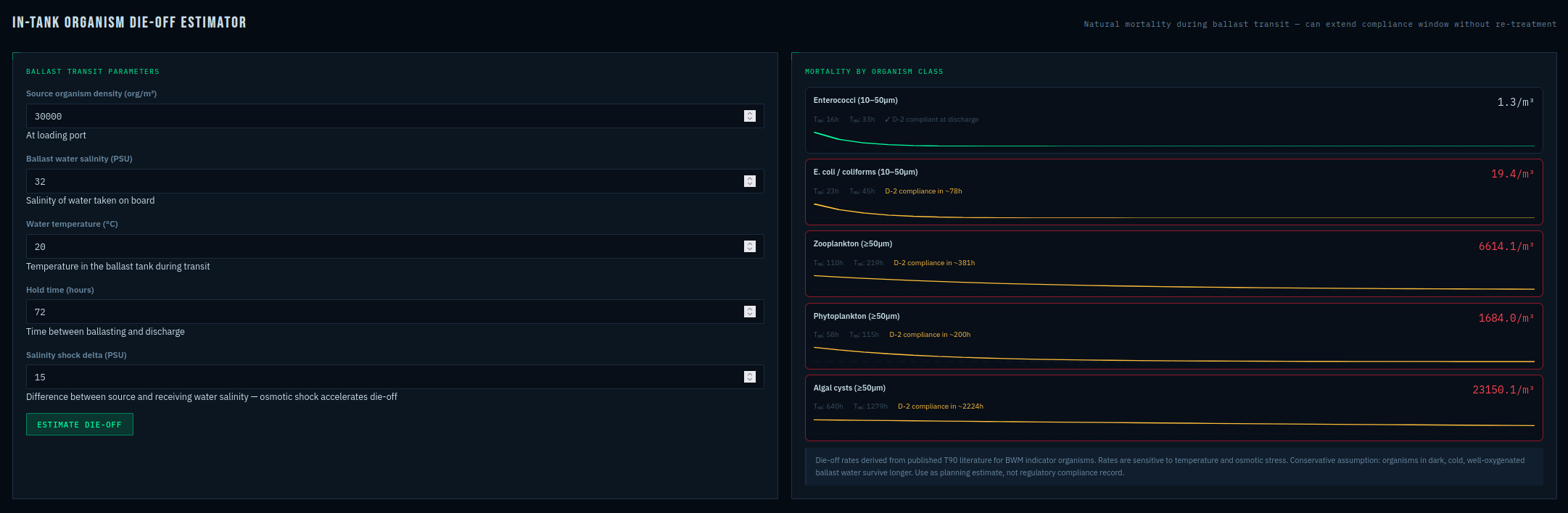
Ballast Water Management Suite - Die-off Estimator

Continue reading"Ballast Water Management Suite"