
Finite Element Analysis is the engineering simulation service that predicts how your designs will perform under real-world conditions — stress, vibration, heat, pressure — before a single physical prototype is built. We don’t sell software licenses. We don’t push subscription platforms. We provide expert FEA services that identify design weaknesses, optimize performance, and validate structural integrity, saving you time, money, and costly physical testing.
The marine and oil & gas industries run on complex engineered systems. Every vessel contains critical load-bearing structures — hull sections, deck fittings, crane foundations, piping systems, support structures. Every component must withstand harsh marine environments, cyclic loading, corrosion, and extreme operational conditions. But traditional design approaches rely on conservative safety factors, physical prototyping, and post-design testing. That’s expensive, time-consuming, and often reveals problems too late in the process.
According to industry assessments, over 60% of engineering redesigns can be traced back to inadequate early-stage structural analysis. Physical prototypes are built, tested, found to be insufficient, and rebuilt. Each iteration costs time and money. Each redesign delays project timelines. The cost of getting structural analysis wrong isn’t just financial — it’s a matter of safety, reliability, and operational readiness.
When an engineering team invests in new designs, they expect confidence in those designs before construction begins. But without proper FEA, that confidence is based on simplified calculations and engineering judgment alone. No one knows if a critical support structure will fail under extreme load. No one can visualize stress concentrations before they become failures. No one can optimize weight and material usage with precision. The design exists, but the validation is incomplete.
And yet, despite this being the single biggest opportunity for design excellence and cost reduction in engineering, virtually no one offers accessible, expert FEA services focused on practical maritime and industrial applications. Every software vendor assumes you have in-house simulation expertise. Every consulting firm charges premium rates for limited analysis. And every engineering team is left with designs they can’t fully validate.
What We Do
Structural Analysis & Validation
We begin every engagement with a comprehensive structural analysis of your design. This isn’t just running a simulation — it’s understanding the physical reality your design must withstand. We perform static analysis to evaluate stress, strain, and deformation under operational loads. We conduct dynamic analysis to understand behavior under time-varying loads — vibration, impact, cyclic loading. We perform buckling analysis to assess stability in slender structures under compressive forces.
This isn’t a surface-level check. We model the actual loading conditions your equipment will face — operational loads, extreme conditions, transient events. We identify stress concentrations, potential failure modes, and safety margins. The result is a validated design that you can build with confidence.
Thermal Analysis & Heat Transfer
Temperature variations are a constant challenge in marine and industrial environments. Engines generate heat. Environmental conditions fluctuate. Process equipment operates at extreme temperatures. We perform steady-state thermal analysis to evaluate temperature distribution under constant thermal loads, and transient thermal analysis to track temperature variation over time as conditions change.
We model heat transfer mechanisms — conduction, convection, radiation — and their interaction with structural components. This ensures that thermal stresses don’t compromise structural integrity and that materials perform within their operational limits throughout the equipment lifecycle.
Nonlinear & Complex Behavior Modeling
Real-world engineering problems are rarely linear. Materials deform plastically. Components experience large deformations. Surfaces come into contact with complex interactions. We address these nonlinear challenges through advanced FEA techniques that capture the true behavior of materials and structures.
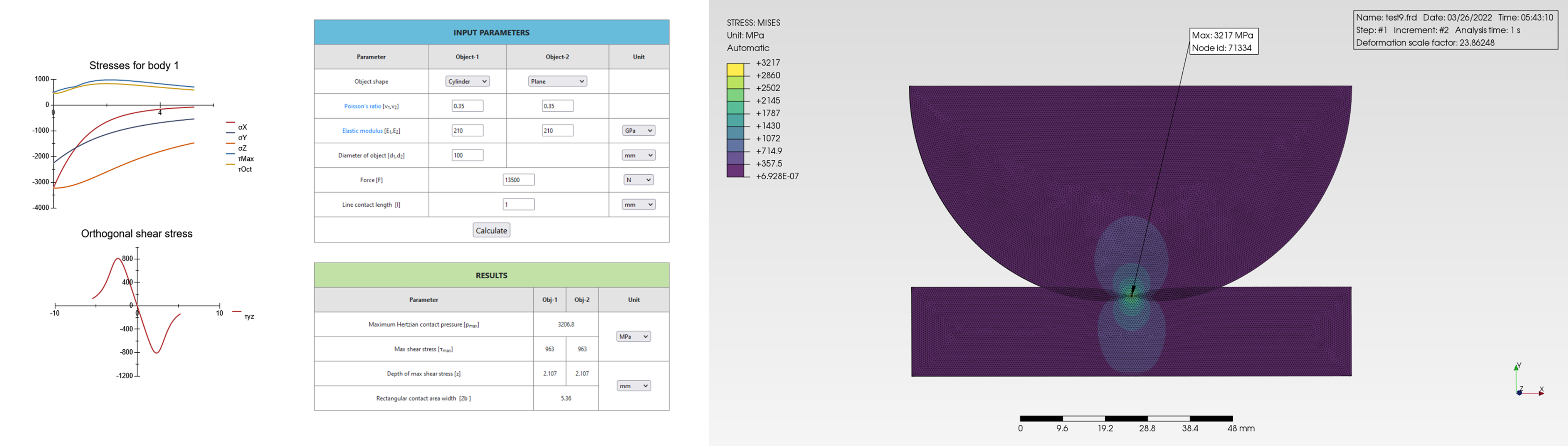
Plasticity models predict permanent deformation. Hyperelasticity models handle rubber-like materials and seals. Contact mechanics simulate interactions between components under load. These analyses reveal behaviors that linear models simply cannot capture, ensuring your design accounts for real-world complexity.
Fatigue Analysis & Life Prediction
Marine equipment and offshore structures face cyclic loading every single day — waves, engine vibrations, operational cycles. Over time, these cycles lead to fatigue failure, even at stress levels well below the material’s yield strength. We perform fatigue analysis to determine the lifespan of components under cyclic loading and identify potential failure points before they occur.
We analyze stress cycles, material S-N curves, and environmental factors to predict component life. This enables proactive design improvements, maintenance planning, and lifecycle management. You don’t just know if your design will work — you know how long it will last.
Why This Matters Right Now
The marine and oil & gas industries demand higher performance, lighter structures, and longer component lifespans. Regulatory requirements are becoming more stringent. Material costs continue to rise. Every kilogram of unnecessary weight adds to operational costs. Every structural failure risks safety, downtime, and reputation. FEA analysis is no longer a luxury — it’s a necessity for competitive, reliable engineering.
Physical Prototyping Is Too Expensive
Every engineering team we talk to wants to validate their designs. They’ve built prototypes. They’ve conducted physical tests. They’ve discovered problems late in the process and had to redesign. Each physical prototype costs tens of thousands. Each redesign delays project timelines by weeks or months. FEA eliminates that cost and risk by validating designs virtually before any physical work begins.
Competitive Advantage Through Validation
Engineering teams who leverage FEA first achieve something their competitors can’t match: complete design confidence. They optimize weight and material usage. They predict component lifespans. They identify failure modes before they become costly field failures. They reduce physical prototyping and accelerate time-to-market. In an industry where margins are thin and reliability is paramount, teams with FEA capabilities have a decisive advantage.
Technology Is Mature and Proven
FEA technology for structural, thermal, and fatigue analysis is mature and proven. The simulation techniques — linear and nonlinear analysis, modal analysis, contact mechanics, fatigue prediction — are established and reliable. The barrier isn’t technology availability. It’s the expertise to properly set up, run, and interpret FEA simulations for specific engineering challenges. That’s where we come in.
Key Capabilities
- Structural Analysis — Static, dynamic, and buckling analysis for comprehensive structural validation
- Thermal Analysis — Steady-state and transient thermal analysis for heat transfer assessment
- Nonlinear Analysis — Large deformations, material plasticity, and contact mechanics modeling
- Fatigue & Life Prediction — Component lifespan determination under cyclic loading conditions
- Design Optimization — Weight reduction, cost efficiency, and performance improvement through iterative FEA
By leveraging FEA analysis, design risks can be minimized, costs reduced, and the design process can be accelerated, leading to better and more reliable products.
Find out how we can help, contact us for further information or download our FEA benchmarking brochure.