Engineering and Project Management
 

Building the Clipboard of Marine Engineering: A Rule-Aware Design Engine

Or, Why Engineers Should Have What Software Developers Already Take for Granted


The Problem With Regulations

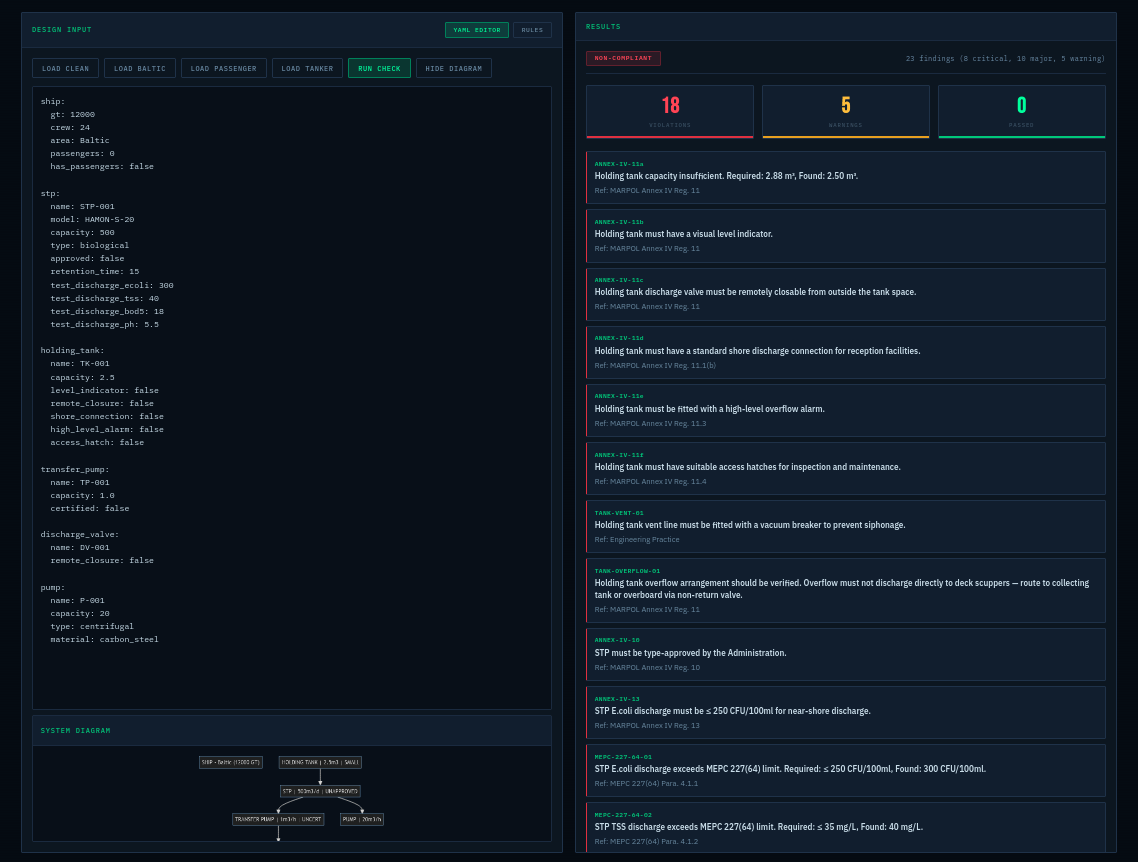
Marine engineering runs on regulations. MARPOL Annex I, IV, VI. SOLAS II-1, II-2. IACS Unified Requirements. Class rules. Flag state interpretations. EU MRV. CII ratings. The list is long and the list changes. A ship designed under this year’s regulations may be non-compliant before it leaves the builder’s yard.

Engineers know this. The problem is that compliance is not a moment — it’s a state. It has to be maintained across every drawing revision, every equipment substitution, every retrofitted scrubber, every re-route of a vent line.

And yet, the tools engineers use to manage this are largely the same ones they used twenty years ago: PDFs, spreadsheets, checklists, and a lot of institutional memory held in the heads of senior reviewers.

Hermes Rule Checker

Continue reading"Building the Clipboard of Marine Engineering: A Rule-Aware Design Engine"

Digital Garbage Record Book: How Modern Vessels Can Meet MARPOL Annex V

The Paper Problem

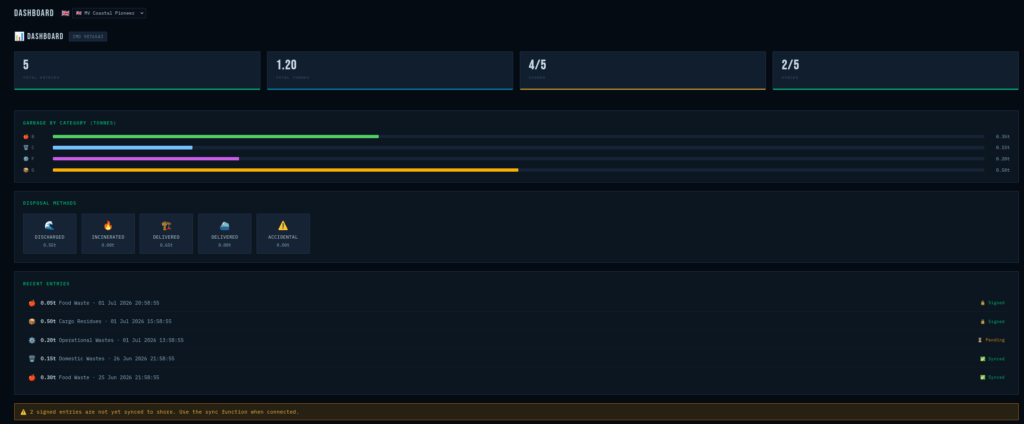
Every vessel subject to MARPOL Annex V must maintain a Garbage Record Book (GRB) — a chronological log of every piece of garbage generated, discharged, or incinerated at sea. In practice, this means paper forms that crew members fill out by hand, sign with a wet ink signature, and store in a binder that lives somewhere in the bridge.

The problems with this approach are well-known but rarely discussed openly:

  • Illegible handwriting makes records difficult to verify during port state control inspections
  • Missing signatures or incomplete entries create compliance gaps that can result in fines
  • No automated compliance checking — crew don’t know a discharge is illegal until a port inspector tells them
  • Hash chain integrity — paper records can be altered retroactively without detection
  • No offline capability — many vessels still rely on paper because connectivity at sea is unreliable
  • No audit trail — there’s no tamper-evident history of who changed what and when

The IMO’s 2023 guidelines on electronic record books acknowledge that digital solutions are permissible, but the industry has been slow to adopt. dGRB v2 is built to change that.

Getting started

The dGRB app is live at https://dgrb.ingeniat.eu — no signup required.

Demo account (frontend login):

dGRB Dashboard

Continue reading"Digital Garbage Record Book: How Modern Vessels Can Meet MARPOL Annex V"

Training Marine Engine Anomaly Detectors — A Physics-Informed ML Pipeline

How we built a production-ready anomaly detection system for marine diesel engines using scikit-learn, physics-based features, and an out-of-distribution detection layer.

Marine engine downtime costs shipping companies thousands per hour. A single unexpected failure — a seized bearing, a clogged injector, a cracked piston ring — can strand a vessel mid-voyage. Traditional monitoring systems rely on fixed thresholds: “if vibration exceeds X mm/s, raise an alarm.” But thresholds are brittle. They don’t adapt to operating conditions, they don’t catch novel failure modes, and they produce too many false positives to be useful at scale. That’s why we rebuilt our engine monitoring system from the ground up with a physics-informed machine learning pipeline that combines domain knowledge with unsupervised anomaly detection. Here’s how it works.
Continue reading"Training Marine Engine Anomaly Detectors — A Physics-Informed ML Pipeline"

Predicting Port State Control Deficiencies Before Inspectors Arrive

Port State Control (PSC) inspections can shut down a vessel for days. A single detention costs between $50,000 and $500,000 in delays, fuel, and reputation damage. Fleet managers spend weeks preparing for inspections using spreadsheets and gut feelings — but nobody actually runs the regulations against the ship’s real state.

What It Does

PSC Readiness is a compliance prediction platform that evaluates every MARPOL, SOLAS, and MLC requirement against a vessel’s actual design data, certificate status, and operational records — before inspectors arrive.

The app takes a vessel’s technical data and runs it through 265+ encoded regulatory rules and it produces:

  • PSC Readiness Score — a single number indicating how clean the vessel is
  • Predicted Deficiencies — specific items inspectors will flag, ranked by severity
  • Risk Level — statistical prediction of detention probability
  • Remediation Guidance — exactly what to fix and how

Continue reading"Predicting Port State Control Deficiencies Before Inspectors Arrive"

Six New Engineering Tools Join the BWM Suite

The BWM Suite just got a significant upgrade. Alongside the three core compliance calculators — D-2, Exchange, and Cost — we’re now shipping six new engineering tools designed for the people who actually operate, specify, and certify ballast water management systems.

These aren’t compliance checkers. They won’t tell you pass or fail in isolation. What they will do is answer the harder questions that sit behind the certificate: what’s really happening in your tanks, under your specific conditions, on your specific route?

Getting started

The BWMS Suite is live at https://bwms.ingeniat.eu — no signup required.

Demo account (frontend login):


What’s new

  • TRO Decay & Neutralisation Planner — For operators running electrochlorination or ozone systems. Enter your initial dose, salinity, temperature, and hold time, and the tool maps out exactly when your ballast will drop below the 0.1 mg/L TRO discharge limit — and how much sodium thiosulfate or bisulfite you need if it won’t. Includes a 48-hour decay curve.
  • UV Dose Calculator — For UV-based BWMS operators and BWMS specifiers. This one models the actual dose your system will deliver given lamp age, UV transmittance of the water, flow rate, and reactor geometry — then checks it against the D-2 required doses for bacteria, zooplankton, and the hardier algal cysts. It also tells you the maximum flow rate your system can handle while staying compliant.
  • Type-Approval Envelope Analyser — The tool that answers “but will my BWMS work in these waters?” Every type-approved BWMS is certified over a specific band of salinity, temperature, and turbidity. This analyser overlays your route’s actual water quality parameters against that certified envelope and tells you exactly where you fall outside it — which matters when flag states ask for technical justification.
  • Log-Reduction Uncertainty Propagation — Built for BWMS manufacturers and technical reviewers. Two systems can both be certified at 99.9% log reduction and have wildly different statistical margins. This tool propagates the measurement uncertainty from the type-approval test report through to the discharge concentration, giving you a probability of exceedance and a classification: Robust, Marginal, or High Risk.
  • Tank Residual & Sediment Compliance Check — For shipowners on bulk carriers, tankers, or any vessel with tanks that can’t be pumped completely dry. It blends the treated ballast with the unpumpable residual — which still contains organisms at source concentration — and tells you whether the mix stays within D-2 limits at discharge. It also calculates the maximum allowable residual volume for your tank geometry.
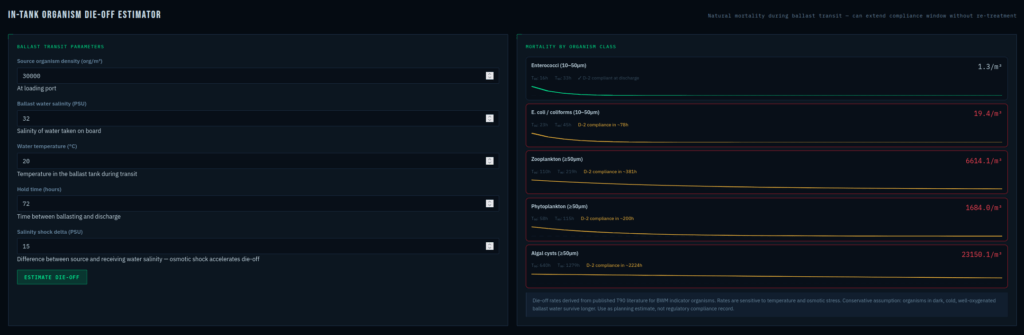
  • In-Tank Die-Off Estimator — The voyage planning tool. For each organism class — Enterococci, E. coli, zooplankton, phytoplankton, algal cysts — it applies first-order decay kinetics with temperature and salinity shock modifiers to estimate how many organisms survive to discharge. Algal cysts are effectively immortal. Everything else has a half-life. Now you can model it.

A note on the die-off estimator

The die-off estimator carries a prominent disclaimer: it is a planning tool, not a compliance record. No port state control authority in the world accepts natural mortality as a substitute for type-approved treatment or exchange. The tool exists to help you understand whether a longer voyage gives you a practical safety margin, not to game the system.

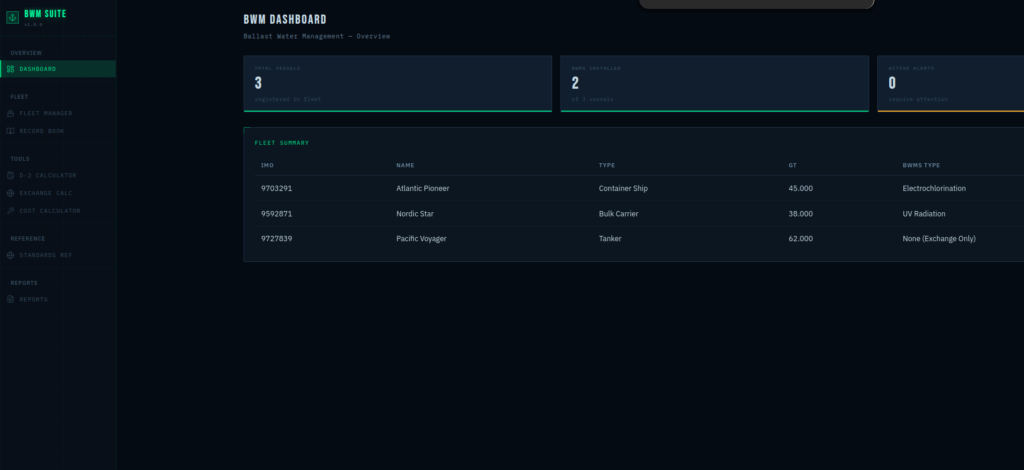
BWMS Suite Dashboard

All six tools are client-side — calculations run entirely in the browser. They’re available now in the TOOLS section of the BWM Suite alongside the existing D-2, Exchange, and Cost calculators.


BWM Suite — Ballast Water Management Software

Managing ballast water compliance doesn’t have to be a spreadsheet nightmare.

The BWM Suite is a dedicated full-stack application for ship operators and maritime compliance teams to manage IMO BWM Convention requirements in one place.

Core Features

  • Fleet Manager — Register your vessels with full technical specs (IMO number, GT, DWT, ballast capacity, tank count, BWMS type, installation date, certificate details). All fields editable. IMO numbers link directly to the vessel record for fast editing.

  • Ballast Water Record Book — Log every ballast operation inline: date/time (UTC), position, tank ID, operation type (ballasting/deballasting), volume, salinity, source water, and treatment method. Supports CSV import/export for bulk entry. All data tenant-isolated.

  • D-2 Calculator — Check discharge compliance against MEPC.200(62) D-2 organism count limits. Select BWMS type (Electrochlorination, UV, Ozone, etc.), source water salinity, discharge volume, and USCG waters flag. Returns pass/fail status, effectiveness percentage, and USCG approval flag.

  • Exchange Calculator — Determines required exchange procedure (D-1 or D-2) based on voyage route, ballast volume, total capacity, BWMS status, and distance. Calculates exchange volumes for both 95% and 3× exchange methods.

  • Cost Calculator — Estimates BWMS retrofit costs (low/mid/high) across five years including installation, consumables, and servicing. Gives cost per cubic metre and USCG approvability.

  • Reports — Download a fleet-wide compliance summary as PDF or XML, or generate an IMO-style Ballast Water Record Book (PDF or XML) for any individual vessel.

Tech Stack

Backend: FastAPI + SQLAlchemy (async) + PostgreSQL, JWT auth via python-jose + passlib, PDF generation with ReportLab. Frontend: React + TypeScript + Vite, Nautilus design system, Axios with token refresh interceptor. 

Getting started

The BWMS Suite is live at https://bwms.ingeniat.eu — no signup required.

Demo account (frontend login):


Note: The BWM Suite was originally built as a standalone desktop-style application. It has since been reworked into a full client-server architecture with a dedicated FastAPI backend and PostgreSQL database, deployed as a separate service for demo purposes.

BWMS Suite Dashboard

Continue reading"BWM Suite — Ballast Water Management Software"

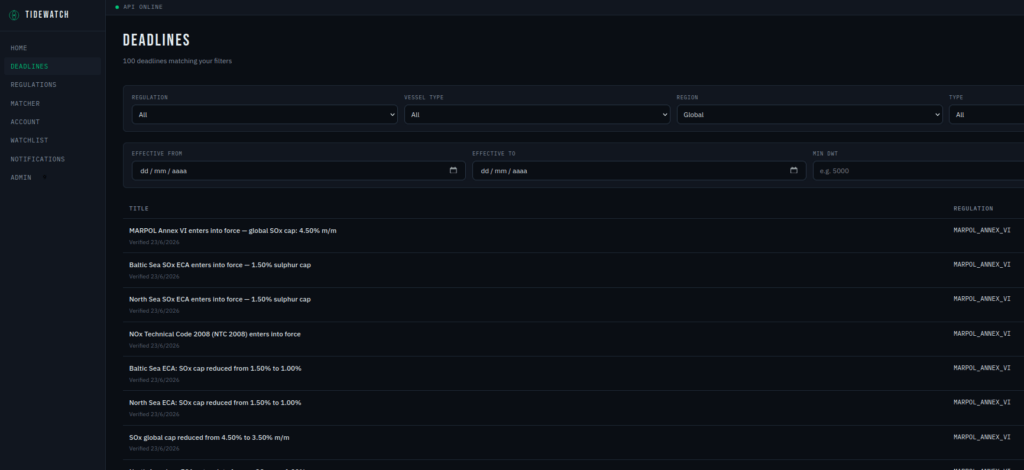
TideWatch — Maritime Regulatory Intelligence, Delivered.

The compliance landscape for shipping has never been more complex — and the cost of getting it wrong has never been higher.

Fines under the EU ETS can reach €100 per tonne of CO₂ unaccounted for. FuelEU Maritime penalties stack annually. CII ratings that slip below C don’t just attract scrutiny — they attract commercial consequences: charterers route away, ports deny priority berthing, and insurance premiums climb.

And the regulations keep coming. New rules from the IMO, the EU Commission, and national authorities layer on top of each other every year. Staying current isn’t a one-time project. It’s a permanent operational function.

TideWatch is an automated maritime regulatory alert service that monitors the regulatory environment across nine major compliance regimes — and delivers the information you need, when you need it, where you already work.

Getting started

The deadline browser is live at https://tidewatch.ingeniat.eu — no signup required.

Demo accounts (frontend login):

Or explore the API directly:

  • GET /api/deadlines?regulation=EU_ETS&region=EU&severity=CRITICAL
  • POST /api/match with {"vessel_type": "cargo", "gt": 12000, "trading_area": "MEDITERRANEAN", "fuel_type": "VLSFO"}

Questions, corrections, or proposed new deadlines? Use the curator queue or open an issue. Every entry in TideWatch is reviewed by a human.

TideWatch Dashboard

Continue reading"TideWatch — Maritime Regulatory Intelligence, Delivered."

MARITIME ETS v1.0 Compliance Platform

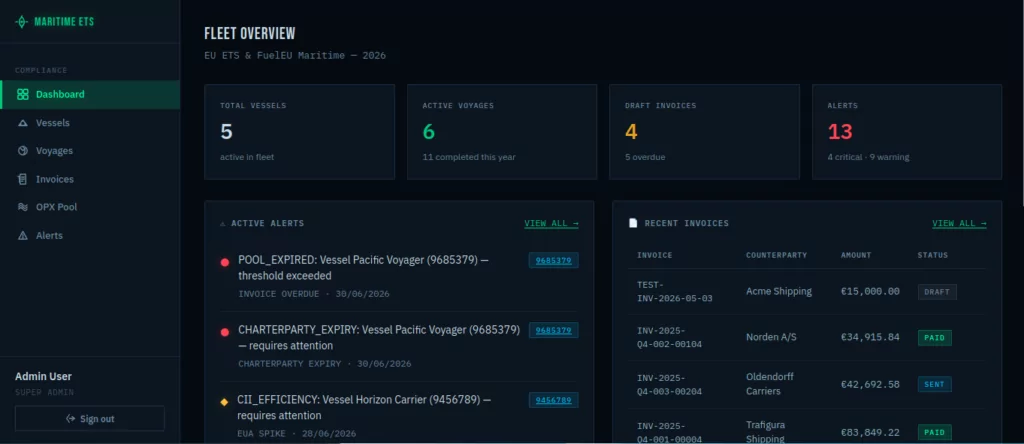
Spun off from NAUTILUS codebase, a real-time compliance management tool for shipowners and fleet managers operating under the EU Emissions Trading System (EU ETS) and FuelEU Maritime regulation.

Live at https://compliance.ingeniat.eu · Backend API at port 8000 · Built with FastAPI + React/Vite

(Note: some features cut down on this demo version, contact us for access to a fully featured version)

Getting Started
Demo accounts (frontend login):


What it does

Emissions calculations, done for you
The platform computes EU ETS obligations automatically from your voyage and fuel data. Load a voyage, attach the fuel records (BDN data), pick the compliance year and the current EUA price — the system spits out the exact tCO2 and the cost in euros. No spreadsheets, no back-of-envelope estimates.

FuelEU Maritime works the same way: the system calculates your GHG intensity against the regulatory baseline, flags whether you’re in deficit, and tells you how much the penalty will be (and whether you can borrow from next year’s allocation instead).

CII ratings without the lookup tables
Enter your vessel’s total CO2 and distance for the year and the platform returns the CII rating — A through E — with the reference value for your vessel type and size. If you’re sitting at D or E, it also generates a corrective action plan blurb you can paste into your SEEMP.

UK ETS, tracked separately
The UK operates its own ETS with different rules (domestic routes are 100%, UK-EEA is 50%, everything else is out of scope). The platform keeps a completely separate ledger for UK obligations so nothing bleeds into your EU numbers.

THETIS-MRV export
Generate a THETIS-MRV XML file for any vessel-year directly from the platform. Upload it to the EMSA portal and you’re done with that part of the reporting cycle.

Invoicing that follows the chain
When a voyage falls under a charterparty, the platform allocates the ETS cost between owner and charterer according to the BIMCO SHORTNM or SHIPMAN clause. Then it generates the invoice — line items per voyage, total in euros — ready to send. Record payments as they come in and the status advances automatically from Draft to Sent to Paid.

OPX Pool — buying and selling surplus EUAs
If you’ve over-allocated EUAs relative to actual emissions, you can list the surplus on the platform’s internal marketplace. Other tenants on the platform can browse listings and agree a price. When a match is made, the platform records the EUA purchase and sale as a transaction in your ledger.

Alerts that actually surface
The system watches for things that need attention: surrender deadlines approaching, ETS positions running low, C ratings turning into D, invoices going overdue, fuel records missing for completed voyages. You configure which alerts fire and who receives them. The dashboard shows a live unacknowledged count so nothing slips through.

ERP connectivity
If your company runs SAP, Oracle, or Dynamics, the platform can pull vessel data, voyages, and fuel consumption directly from your ERP — no manual re-entry. Configure the connection once and trigger a sync whenever you need fresh data.

Maritime ETS

Continue reading"MARITIME ETS v1.0 Compliance Platform"

NAUTILUS v2.1.0 – Feature Overview & Implementation Notes

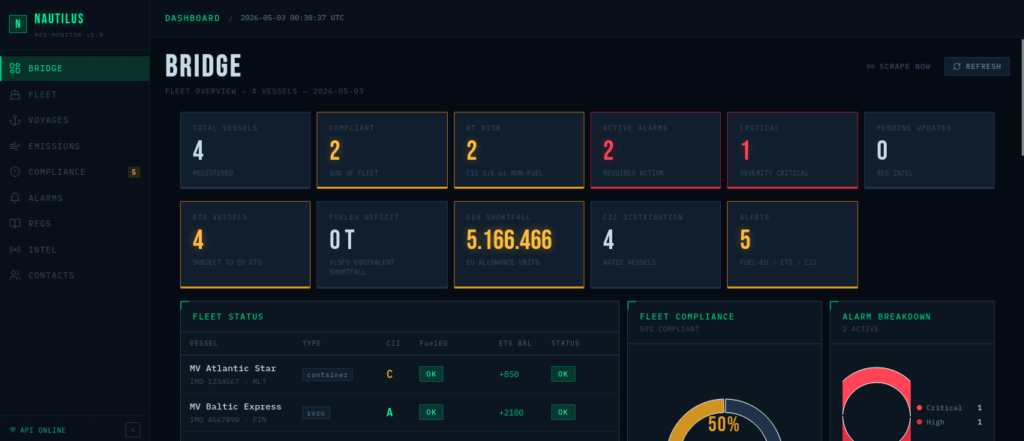
Nautilus is a fleet management and regulatory compliance platform designed for shipping companies, shipowners, and maritime consultants operating under IMO and EU environmental regulations. It centralizes vessel data, voyage records, and emissions calculations into a single backend, providing accurate, audit-ready compliance documentation for regulatory submissions.

The platform addresses the growing complexity of maritime environmental legislation — a landscape that has shifted dramatically with the introduction of the EU Emissions Trading System (ETS) for shipping in 2024, the IMO’s Carbon Intensity Indicator (CII) rating framework, FuelEU Maritime penalties, and theEnergy Efficiency Existing Ship Index (EEXI) certification requirements.

Try it now on https://nautilus.ingeniat.eu or check the specification here.

(Note: some features cut down on this demo version, contact us for access to a fully featured version)

Getting Started

Log in with the pre-filled credentials:
[email protected] / admin123

What Nautilus Does

Nautilus serves as the system of record for a fleet’s compliance posture. It tracks every vessel in a company’s register, records each voyage with cargo and consumption data, and calculates the resulting emissions, CII ratings, and EU ETS allowances automatically. The backend exposes a REST API consumed by a React frontend, with role-based access for fleet managers, company admins, and regulatory auditors.

Regulatory Calculations

The platform implements four interlocking compliance calculations:

EEXI (Energy Efficiency Existing Ship Index) — A theoretical maximum efficiency threshold calculated from a vessel’s technical design parameters (installed power, TTEW, DWT, design speed). Unlike operational ratings, EEXI is a design certification that vessels must meet through engine power limitations (EPL) or other technical upgrades. Nautilus stores the EEXI certificate reference and tracks compliance status per vessel.

CII (Carbon Intensity Indicator) — An operational rating expressed in grams of CO2 per cargo-carrying capacity per nautical mile (gCO2/t·nm). Vessels are assigned a rating from A (best) through E (worst) based on their annual operational performance. Ratings below D for three consecutive years trigger a corrective action requirement (CAP). Nautilus calculates the CII per voyage leg and aggregates it into a rolling annual rating per vessel.

EU ETS (European Union Emissions Trading System) — Shipping companies operating within EU ports must surrender EU Allowances (EUAs) covering 100% of CO2 emissions from intra-EU voyages and 50% from voyages arriving from or departing to non-EU ports (phased in through 2026). Nautilus tracks total verified emissions per voyage, converts to EUA requirements, and maintains an allowance ledger per company.

FuelEU Maritime — In effect from 2025, this regulation imposes a greenhouse gas (GHG) intensity limit on energy used on board vessels. The limit tightens progressively (‑2% in 2025, reaching ‑80% by 2050). Vessels exceeding the limit face penalties. Nautilus flags non-compliant voyages by comparing fuel energy content against the GHG intensity target.

Nautilus Dashboard
Nautilus Dashboard

Continue reading"NAUTILUS v2.1.0 – Feature Overview & Implementation Notes"

An Underexamined Challenge in the EUA Framework

Walk into most shipping offices and ask how they’re handling EU ETS. You’ll hear the same thing: “We’ll buy what we need in September and move on.” It’s treated like a tax — an irritating compliance cost to settle at the deadline.

That’s not just sub-optimal. Over a three-year phase-in, it’s the most expensive way to do it. And yet, almost nobody is talking about the alternative. Let’s walk through what a disciplined EUA procurement strategy actually looks like — and what it saves.

The phased surrender schedule isn’t just a political concession. It’s a pricing gift.

– 2024 emissions → surrender 40% by September 2025
– 2025 emissions → surrender 70% by September 2026
– 2026 emissions → surrender 100% by September 2027 onwards

That ramp (40/70/100) creates nearly three full years between the first real cash-out and the moment you face the full obligation. You don’t need all your allowances on Day 1. You have time. Time to average in, position on pullbacks, and exploit the single biggest driver of EUA prices that shipping analysts rarely mention: gas market dynamics.

Continue reading"An Underexamined Challenge in the EUA Framework"

The Rising Compliance Challenge for Small Shipping Companies

EU ETS and FuelEU Maritime were written with large shipping companies in mind. The monitoring plans, carbon registries, allowance procurement cycles, and annual verification requirements all assume you have people whose full-time job is exactly this. Most small operators don’t. And the regulation offers no simpler version for those who don’t.

Since January 2024, every ship above 5,000 GT calling at EU or EEA ports has been required to purchase and surrender EU Emissions Trading System allowances — real money, real deadlines, real penalties for getting it wrong. The phase-in is steep: 40% coverage in 2024, 70% in 2025, 100% from 2026. For a single tanker or bulk carrier with significant EU trading exposure, that translates to an allowance bill of €100,000 to €500,000 per year — a cost that needs to be procured, tracked, and surrendered by 30 September each year without exception.

FuelEU Maritime, which entered into force in January 2025, adds a parallel framework on top. Where ETS charges you for what you emit, FuelEU sets targets for how clean your fuel needs to be — on a well-to-wake basis that captures the full lifecycle of every tonne of bunker consumed. Miss the GHG intensity target and the penalty is €2,400 per gigajoule of shortfall. The two regimes run independently of each other and require separate monitoring, separate reporting, and separate compliance strategies.

Since 2025 the net has widened further. General cargo ships and offshore vessels above 400 GT came into full MRV monitoring scope under the amended regulation — pulling thousands of smaller operators into a system they had little time to prepare for. For these vessels there are no ETS allowances to buy yet, but the monitoring obligation is real: approved monitoring plans, voyage-level fuel data collection, annual verified emission reports, and the Document of Compliance consequences that follow if any of it is missing.

Continue reading"The Rising Compliance Challenge for Small Shipping Companies"

Ballast Water Management Suite

Every ship over 400 GT is now required to meet the IMO Ballast Water Management Convention D-2 standard. The deadline passed in September 2024 — and Port State Control is checking.

Ballast Water Management Suite gives vessel operators, ship managers, and maritime compliance officers a practical, browser-based toolkit to stay ahead of inspection, plan BWMS investments, and maintain compliant record keeping — without expensive software subscriptions or class society retainers.

Features

D-2 Compliance Calculator

Know your status before you discharge.

Enter your ballast volume, BWMS system type, and source water quality. Get an instant estimated compliance assessment against D-2 discharge limits — including organism counts for organisms ≥50μm, 10–50μm, E. coli, Enterococci, and V. cholerae.

– Validated 7-digit IMO lookup from fleet registry
– Estimated treatment time based on system capacity
– Color-coded pass/fail against every D-2 parameter
– Works offline — no internet required on board

Exchange vs Treatment Decision Tool

Never second-guess a D-1 vs D-2 decision again.

Plug in your departure and arrival ports, ballast volume, and current BWMS status. Get a clear recommendation — and the math behind it.

– Automatic EU port detection (Rotterdam, Hamburg, Antwerp, and 20+ more)
– Calculates minimum exchange volume (95% or 3× tank capacity)
– Port State Control risk indicator for EU water routes
– Explains exactly what documentation you’ll need at the next PSC inspection

Ballast Water Management Suite - Die-off Estimator

Continue reading"Ballast Water Management Suite"