
The cost argument for standard offshore containers is real. They are cheaper upfront and available faster. For a project with genuinely standard requirements — a storage container, a workshop unit, a laydown area with no unusual payload or interface constraints — a modified standard unit can be the right answer.
But most offshore projects are not standard. The payload is asymmetric. The centre of gravity is off-centre. The deck pad eyes on the vessel are not where the container manufacturer put them on a generic 20-foot frame. The hazardous area classification requires something the standard unit was never designed for.
In these cases, the appeal of standard offshore containers collapses under the weight of the modifications required to make them work. And modifications to a certified offshore container are not a minor add-on — they can void the certification, require recertification, and end up costing more than starting with a bespoke DNV 2.7-1 container design.
The Appeal of Standard Containers — and Where It Breaks Down
Standard offshore containers are built to a commercial envelope. The structural frame, corner castings, and pad eyes are positioned to suit a generic set of assumptions: symmetric loading, a defined payload range, standard lifting configurations, and an operating environment that does not depart significantly from sheltered water conditions.
These assumptions are explicit in the standard container’s design basis. When your project departs from that basis — and most offshore projects do — you are modifying a structure that was not designed for the modification you are making.
The most common failure mode is payload and centre of gravity. A standard offshore container is designed for a payload distributed within a symmetric envelope. If your payload sits 400mm outside that envelope, the structural analysis that underpins the container’s certification no longer applies. The container may be rated for 15 tonnes, but not for 15 tonnes in your configuration.
The second failure mode is deck interface. Standard containers have pad eyes at standard positions. If your vessel or platform has deck fittings in different locations, the container arrives offshore and cannot be lifted or lashed as designed. The cost of an offshore modification — mobilisation, schedule impact — is an order of magnitude higher than resolving the same issue at the engineering stage.
Where Standard Offshore Containers Consistently Fall Short
Payload-to-tare ratio. A standard container carries structural weight that your application does not need. Bespoke offshore container engineering removes the excess structure and replaces it with structure sized precisely for your load case. The tare weight saving translates directly into more payload capacity.
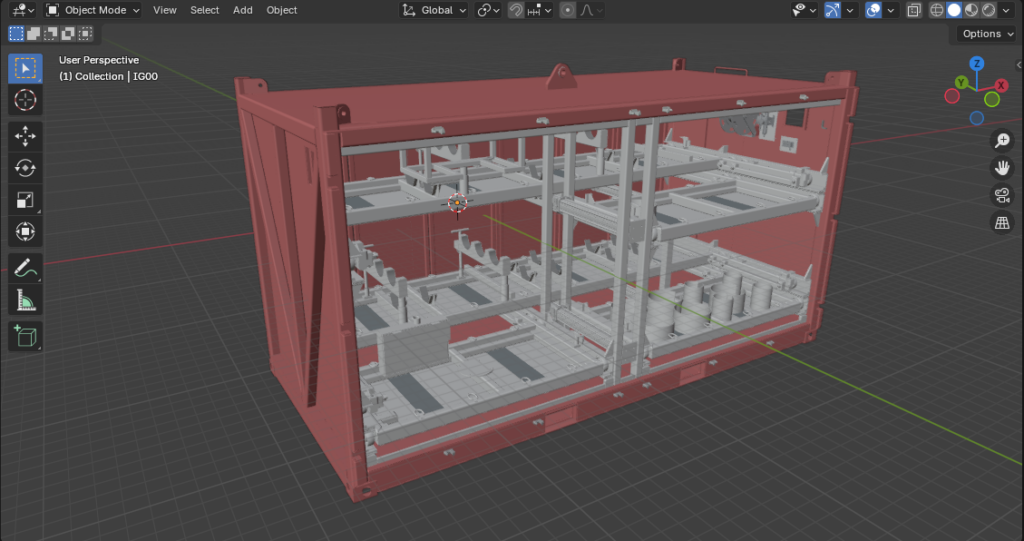
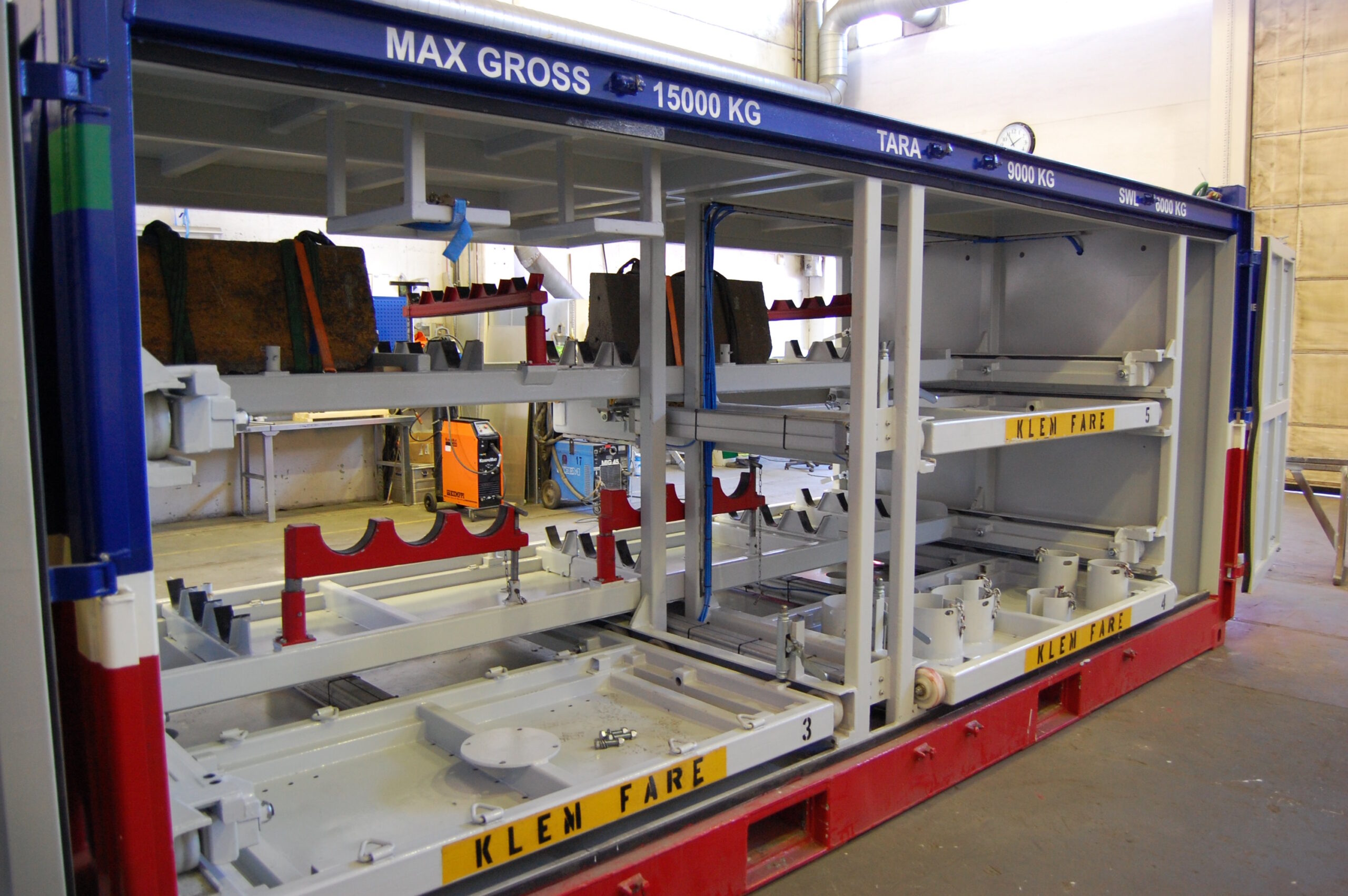
Centre of gravity constraints. Standard containers assume near-symmetric load distribution. Offshore process containers, chemical stores, and equipment enclosures routinely have eccentric CoGs. A bespoke DNV 2.7-1 container design accounts for this from the outset — the primary frame is asymmetric where your load case is asymmetric.
Deck interface. Pad eye positions, lashing point locations, and any interface with platform or vessel structural members are defined by your installation, not by a notional standard arrangement. Bespoke offshore container engineering starts from the interface geometry and designs the structure to match it.
Access and internal layout. Standard container door positions and internal arrangements are fixed. If you need a specific door location for egress, equipment installation, or hose connections, you are cutting into a certified structure and managing the recertification implications.
Hazardous area compatibility. Standard offshore containers are not designed for Zone 1 or Zone 2 deployment. If your container is going into a classified area, a standard unit requires significant modification to accommodate pressurisation systems, electrical equipment, and ventilation — modifications that may void the original certification and require a new DNV 2.7-1 certification package anyway.
What Bespoke Offshore Container Engineering Actually Costs
The cost comparison most buyers make — bespoke vs. modified standard — is incomplete. It omits the recertification cost.
When you modify a certified offshore container, the modification scope determines whether the original certification remains valid. Minor modifications may be assessed by the certification body as falling outside the certified scope. Significant modifications require re-certification of the affected structure. The cost of re-certification — additional engineering, surveyor fees, potentially re-testing — is borne by the buyer, not the container supplier.
A proper cost comparison for a modified standard unit includes: the base container cost, the modification engineering, the recertification assessment or re-certification, and any schedule impact if the recertification process extends beyond the modification work.
Against that total, bespoke offshore container engineering — which produces a container designed to your exact requirements, certified correctly the first time, with no recertification exposure — typically shows a smaller premium than the initial price comparison suggests.
Lead time comparison is similarly skewed. A standard offshore container procurement might take 8 weeks. A bespoke procurement might take 16 weeks. But if the standard unit requires significant modification and recertification, the effective lead time for a certified, fit-for-purpose container can exceed the bespoke lead time.
The lifecycle argument reinforces the upfront comparison. A fit-for-purpose container, correctly certified for its actual load case and interface, requires fewer modifications, sustains its certification through its operational life, and can be recertified more straightforwardly if modifications are needed later.
When Standard Offshore Containers Are the Right Answer
There are legitimate cases for standard units. Short-duration projects with genuinely standard requirements — a temporary stores container, a welfare unit for a short-term campaign, a rental unit where certification continuity is not a project concern — can be served by standard containers without the premium of bespoke engineering.
Rental or temporary deployment where the unit moves between projects and the certification is managed as a fleet matter rather than a project matter. In this case, the standard unit’s generic certification is actually an advantage.
Before committing to a standard unit, the question to ask is: does the standard container’s design envelope actually contain my load case, my interface geometry, and my operational environment? If the answer is yes, the standard unit is worth serious consideration. If the answer requires significant modification to make it fit, the honest answer is that the standard offshore container is not the right solution for that project.
Ask us for a bespoke offshore container feasibility assessment before committing to a standard unit. In most cases the cost gap is smaller than buyers expect — and it includes a side-by-side comparison against a modified standard unit if relevant.
Share your project requirements below. We’ll review your specifications and respond with a detailed engineering proposal.
Please follow this link to download our brochure showcasing typical scopes of supply, or read this article for further information on the certification process.