
Nautilus is a fleet management and regulatory compliance platform designed for shipping companies, shipowners, and maritime consultants operating under IMO and EU environmental regulations. It centralizes vessel data, voyage records, and emissions calculations into a single backend, providing accurate, audit-ready compliance documentation for regulatory submissions.
The platform addresses the growing complexity of maritime environmental legislation — a landscape that has shifted dramatically with the introduction of the EU Emissions Trading System (ETS) for shipping in 2024, the IMO’s Carbon Intensity Indicator (CII) rating framework, FuelEU Maritime penalties, and theEnergy Efficiency Existing Ship Index (EEXI) certification requirements.
Try it now on https://nautilus.ingeniat.eu or check the specification here.
(Note: some features cut down on this demo version, contact us for access to a fully featured version)
Getting Started
Log in with the pre-filled credentials:
[email protected] / admin123
What Nautilus Does
Nautilus serves as the system of record for a fleet’s compliance posture. It tracks every vessel in a company’s register, records each voyage with cargo and consumption data, and calculates the resulting emissions, CII ratings, and EU ETS allowances automatically. The backend exposes a REST API consumed by a React frontend, with role-based access for fleet managers, company admins, and regulatory auditors.
Regulatory Calculations
The platform implements four interlocking compliance calculations:
EEXI (Energy Efficiency Existing Ship Index) — A theoretical maximum efficiency threshold calculated from a vessel’s technical design parameters (installed power, TTEW, DWT, design speed). Unlike operational ratings, EEXI is a design certification that vessels must meet through engine power limitations (EPL) or other technical upgrades. Nautilus stores the EEXI certificate reference and tracks compliance status per vessel.
CII (Carbon Intensity Indicator) — An operational rating expressed in grams of CO2 per cargo-carrying capacity per nautical mile (gCO2/t·nm). Vessels are assigned a rating from A (best) through E (worst) based on their annual operational performance. Ratings below D for three consecutive years trigger a corrective action requirement (CAP). Nautilus calculates the CII per voyage leg and aggregates it into a rolling annual rating per vessel.
EU ETS (European Union Emissions Trading System) — Shipping companies operating within EU ports must surrender EU Allowances (EUAs) covering 100% of CO2 emissions from intra-EU voyages and 50% from voyages arriving from or departing to non-EU ports (phased in through 2026). Nautilus tracks total verified emissions per voyage, converts to EUA requirements, and maintains an allowance ledger per company.
FuelEU Maritime — In effect from 2025, this regulation imposes a greenhouse gas (GHG) intensity limit on energy used on board vessels. The limit tightens progressively (‑2% in 2025, reaching ‑80% by 2050). Vessels exceeding the limit face penalties. Nautilus flags non-compliant voyages by comparing fuel energy content against the GHG intensity target.
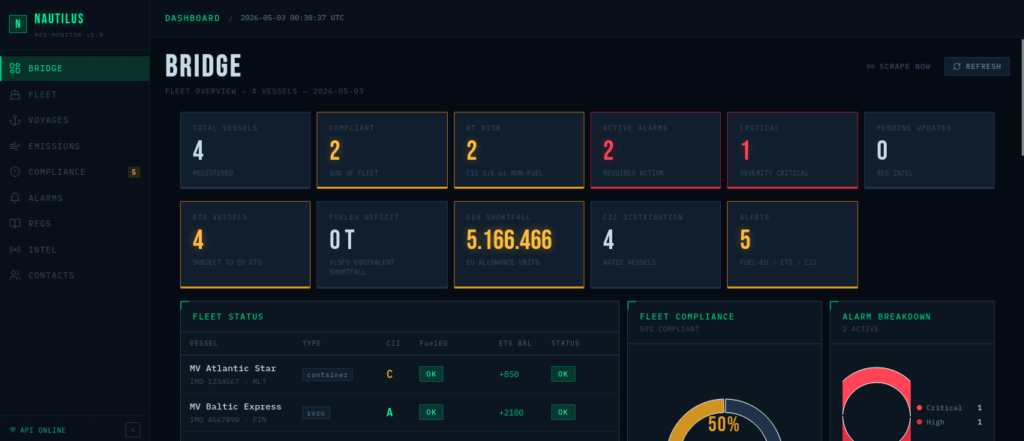
Data Model
The backend organizes data in a hierarchical structure:
Company (tenant)
└── User (belonging to a company, with a role)
└── Vessel (IMO number, flag, type, operator, EEXI certificate)
└── Voyage (status: planned/active/completed)
└── VoyageLeg (departure/arrival ports, distance, cargo, fuel consumed)
└── EmissionsRecord (CO2, CH4, N2O per leg)
Voyages carry fuel consumption data per leg (ROB, fuel type, consumed quantity). Emissions are calculated using IMO Tier III conversion factors (DFO, HFO, LNG, methanol, etc.) and stored per leg with a calculation version stamp for audit traceability.
Core Features
Authentication & Authorization
– JWT-based auth with refresh tokens (30-day access, 7-day refresh)
– Role-based access control: `admin`, `company_admin`, `viewer`
– Secure password hashing with bcrypt; direct bcrypt calls (no passlib wrapper)
Fleet & Vessel Management
– CRUD for companies, users, vessels, and voyages
– IMOs, MMSI, flag states, vessel types, and operator tracking
– Active/completed voyage lifecycle with timestamps
Emissions Calculations
– EEXI (Energy Efficiency Existing Ship Index) calculation
– CII (Carbon Intensity Indicator) rating (A–E bands)
– EU ETS (European Trading System) allowance tracking
– FuelEU Maritime compliance checks
– CO2 emissions per voyage leg, total fleet aggregation
Regulatory Compliance
– IMO Data Dictionary 2023 schema support
– EEXI/SEEMP documentation linked to vessels
– CII records per vessel with rolling-year ratings
– Admin dashboard for compliance oversight
REST API
– Structured error responses with `application/problem+json`
– OpenAPI/Swagger docs at `/docs`
– JWT-protected endpoints; public registration and token refresh

Implementation Highlights
Recent merge (Phase 1, May 2026)
– Two previously isolated backends unified into a single service
– Admin seeded at `[email protected]` / `admin123`
– PostgreSQL via `DATABASE_URL` env var; SQLite fallback for dev
Key technical decisions
– SQLAlchemy 2.0 async throughout
– FastAPI Pydantic v2 models
– Enum columns store member names (uppercase) in DB — always use `.value` for comparisons
– All sensitive endpoints require valid JWT in `Authorization: Bearer` header
Services
– Backend: `nautilus-backend.service` → port 9000
– Frontend: `nautilus-frontend.service` → port 8084
About the 2.1.0 Merge
Version 2.1.0 represents the successful completion of Phase 1 of a backend consolidation project. Two previously isolated FastAPI services — one handling authentication and vessel data, another handling emissions calculations — were merged into a single unified backend. The merge resolved async/sync conflicts, established a clean SQLAlchemy 2.0 async ORM pattern, and introduced PostgreSQL as the primary database.
Admin credentials for the merged system: `[email protected]` / `admin123`
Roadmap
Phase 2 (planned):
– Webhook subscriptions for compliance event notifications (CII rating drops, ETS allowance thresholds)
– Public API with API key auth and rate limiting for third-party integrations
– Grafana dashboards for fleet-level emissions visualization
– Automated SEEMP document generation
Phase 3 (future):
– Real-time vessel tracking via AIS feed integration
– Machine learning module for voyage optimization and fuel consumption forecasting