
Every ship over 400 GT is now required to meet the IMO Ballast Water Management Convention D-2 standard. The deadline passed in September 2024 — and Port State Control is checking.
Ballast Water Management Suite gives vessel operators, ship managers, and maritime compliance officers a practical, browser-based toolkit to stay ahead of inspection, plan BWMS investments, and maintain compliant record keeping — without expensive software subscriptions or class society retainers.
Features
D-2 Compliance Calculator
Know your status before you discharge.
Enter your ballast volume, BWMS system type, and source water quality. Get an instant estimated compliance assessment against D-2 discharge limits — including organism counts for organisms ≥50μm, 10–50μm, E. coli, Enterococci, and V. cholerae.
– Validated 7-digit IMO lookup from fleet registry
– Estimated treatment time based on system capacity
– Color-coded pass/fail against every D-2 parameter
– Works offline — no internet required on board
Exchange vs Treatment Decision Tool
Never second-guess a D-1 vs D-2 decision again.
Plug in your departure and arrival ports, ballast volume, and current BWMS status. Get a clear recommendation — and the math behind it.
– Automatic EU port detection (Rotterdam, Hamburg, Antwerp, and 20+ more)
– Calculates minimum exchange volume (95% or 3× tank capacity)
– Port State Control risk indicator for EU water routes
– Explains exactly what documentation you’ll need at the next PSC inspection
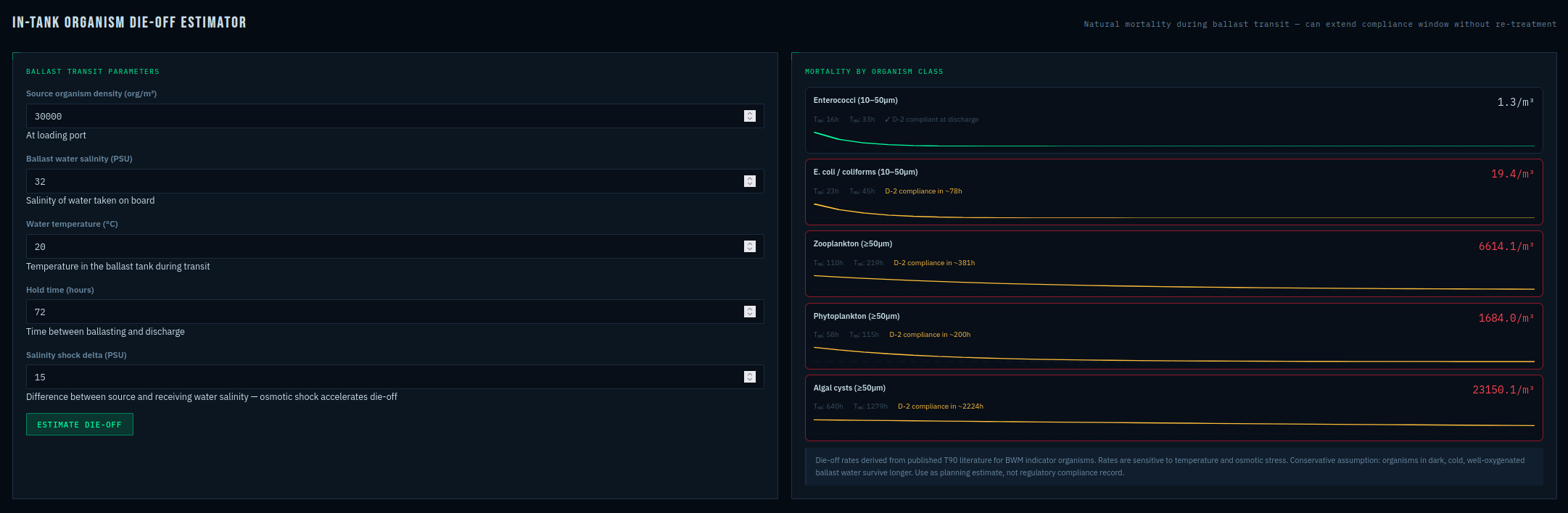
BWMS Cost Calculator
Make the investment case with real numbers.
Retrofits run $300,000 to $3,000,000+. Before you commit, model the true 5-year cost of ownership for every major BWMS technology.
– Technology-averaged cost ranges for UV, electrochlorination, ozone, hydrodynamic, and deoxygenation
– Size-adjusted estimates based on DWT or GT
– 5-year total cost of ownership — not just install price
– Cost-per-cubic-meter efficiency metric
– Technology pros, cons, and maintenance notes for each system type
Ballast Water Record Book Generator
IMO-compliant entries in under 60 seconds.
The BWM Convention requires a Ballast Water Record Book with every bunkering, discharge, transfer, and exchange logged — date, position, tank, volume, salinity, and treatment method. Our Record Book tool generates entries in the exact IMO BWM.2/Circ.55 format.
– One-click entry creation with pre-filled timestamps
– Dropdown for standard operation types and treatment methods
– CSV export for digital records
– Print-ready layout with vessel header, signature lines, and retention notice
– Entries persist in browser — build your record book over a voyage
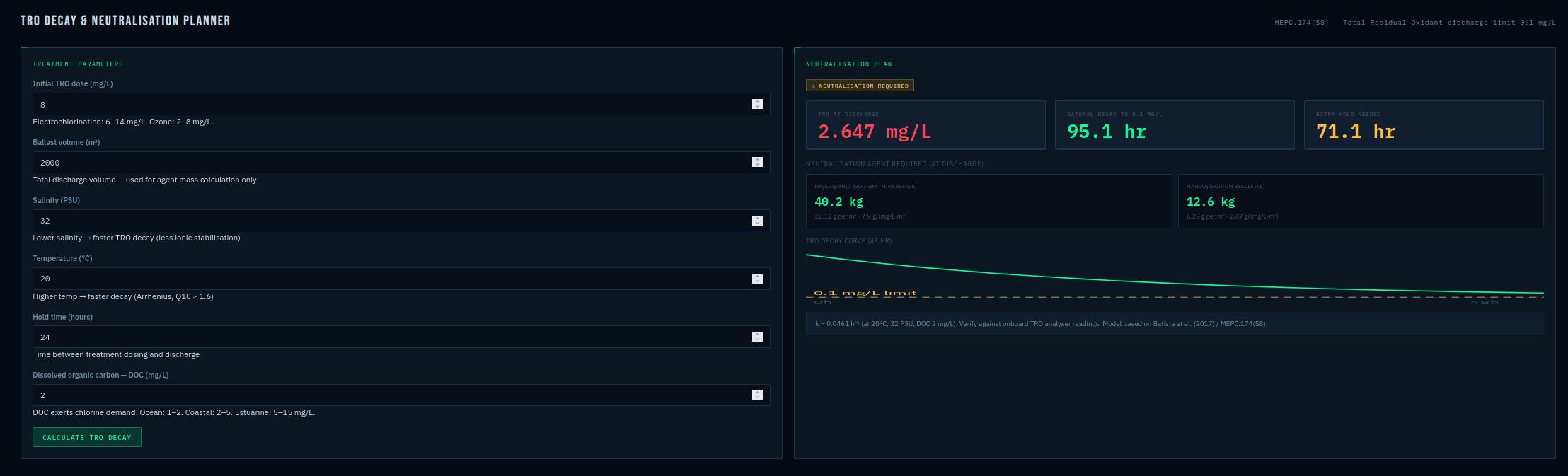
Fleet Manager
Track every vessel in your fleet from one screen.
Add vessels manually or bulk-import from CSV. Track BWMS system type, treatment effectiveness rating, and International Ballast Water Management Certificate expiry date for every ship.
– Fleet-wide compliance dashboard with D-2 system ratings
– Certificate expiry calendar — flagging expired and soon-to-expire certificates
– Bulk CSV import and export
– Direct load into any calculator mode
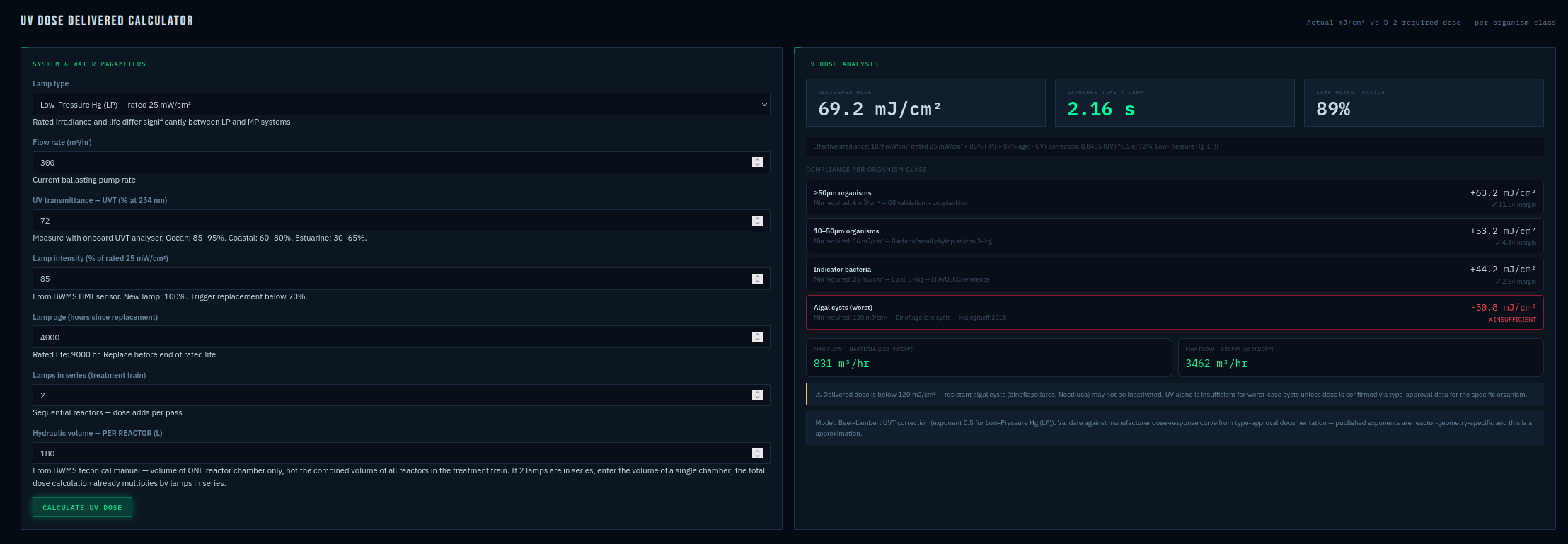
Pricing
Fleet plans for ship managers and maritime service providers: contact for volume pricing.
Technical Details
– Runs entirely in your browser — no install, no subscription, no cloud dependency
– Responsive design works on desktop, tablet, and laptop
– Dark and light mode
– Imports vessel data from the shared Marine Schema registry (compatible with EU ETS Calculator, CII Quick Check, and other marine compliance tools)
– All data stored locally on your device — nothing sent to external servers
Regulatory References
Built against official IMO Ballast Water Management Convention standards:
– Regulation D-1: Ballast Water Exchange (minimum 95% efficiency at 200 nautical miles from shore)
– Regulation D-2: Ballast Water Performance Standard (current discharge limits)
– BWM.2/Circ.55: Standard format for Ballast Water Record Book
– MEPC.173(68): G2 Guidelines for ballast water sampling
– MEPC.174(58): G8 Guidelines for BWMS type approval
Convention entered force 8 September 2017. All existing ships required to comply with D-2 standard since 8 September 2024.
Get Started
Contact us for further information.
For ship managers: import your fleet via CSV to get a fleet-wide compliance view in under two minutes.