
Engineering and Project Management
 

Legacy System Data Extraction

Your vessels are generating more data than ever before. Engine control units are logging performance metrics. Navigation systems are streaming position and speed information. Maintenance management platforms are tracking every work order, every spare part, every inspection. But that data is trapped. Trapped behind NMEA 0183 serial protocols that haven’t …
TBE Engine: Automated Technical Bid Evaluation for Modern Procurement

Stop evaluating vendor bids in spreadsheets. Get accurate compliance matrices, deviation registers, and vendor comparisons in seconds—not days. The Problem Every significant procurement decision requires technical bid evaluation. Your engineers receive specifications from vendors. They spend days manually comparing offerings against requirements. They build endless spreadsheets. They chase clarification emails. …

In-Tank Die-Off: Planning Tool or Compliance Shortcut?

The idea is seductive: organisms die naturally during a voyage. If you have enough time at sea, do you really need full treatment? The In-Tank Die-Off Estimator exists to answer that question quantitatively—but it comes with critical caveats. How Die-Off Works Organisms in ballast water don’t live forever. They die …

Tank Residuals and Sediment: The Compliance Gap Most Shipowners Miss

For bulk carriers, tankers, and vessels with tanks that can’t be pumped completely dry, ballast water compliance isn’t just about treatment efficacy. It’s about what happens when treated ballast mixes with residual water and sediment that was never treated. The Problem with Unpumpable Residuals No cargo tank can be pumped …

Beyond Log Reduction: Understanding Uncertainty in BWMS Performance

A 99.9% log reduction sounds impressive. But what does it really mean for discharge compliance? Two systems with identical certified log reductions can have vastly different practical performance—and the difference lies in measurement uncertainty. The Problem with Log Reduction Numbers Log reduction is a statistical measure. When laboratories test BWMS …

Type-Approval Envelope Analysis: Will Your BWMS Work in These Waters?

Every type-approved Ballast Water Management System is certified over a specific envelope of operating conditions—salinity, temperature, and turbidity. But what happens when your operational waters fall outside that envelope? Understanding Type-Approval Envelopes When a BWMS receives type approval, it’s tested under controlled laboratory conditions. The approval documents specify the range …

UV Dose Calculator: Modelling Real-World Performance for UV-Based BWMS

UV-based Ballast Water Management Systems promise effective treatment without chemicals—but only when they deliver sufficient UV dose. The challenge? UV dose isn’t constant. It varies with lamp age, water quality, flow rate, and reactor design. What Affects UV Dose? 1. Lamp Age UV lamps lose intensity over time. A lamp …

TRO Decay & Neutralisation: A Practical Guide for Electrochlorination Operators

When you’re running an electrochlorination or ozone-based Ballast Water Management System (BWMS), managing Total Residual Oxidant (TRO) levels isn’t just about compliance—it’s about understanding the chemistry happening in your tanks throughout the voyage. What is TRO Decay? TRO decays naturally over time through reactions with organic matter, metals, and through …

Building the Clipboard of Marine Engineering: A Rule-Aware Design Engine

Or, Why Engineers Should Have What Software Developers Already Take for Granted


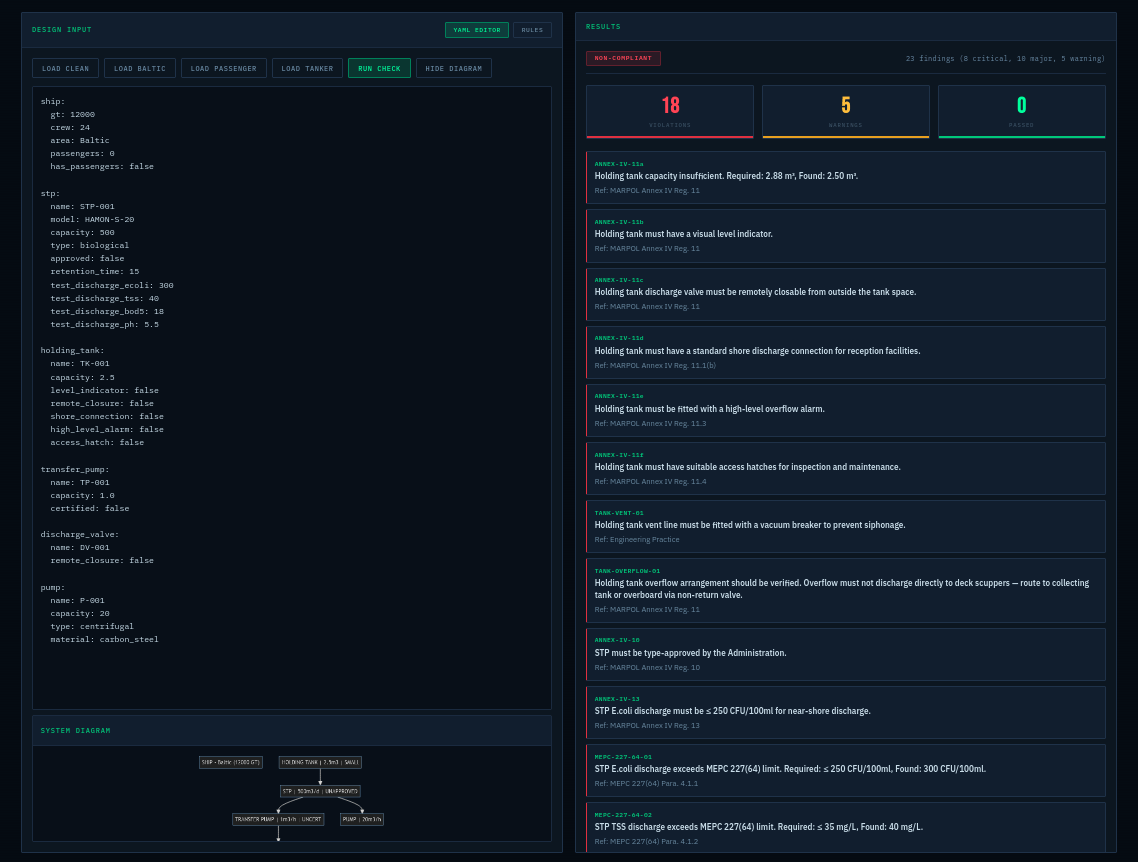
The Problem With Regulations

Marine engineering runs on regulations. MARPOL Annex I, IV, VI. SOLAS II-1, II-2. IACS Unified Requirements. Class rules. Flag state interpretations. EU MRV. CII ratings. The list is long and the list changes. A ship designed under this year’s regulations may be non-compliant before it leaves the builder’s yard.

Engineers know this. The problem is that compliance is not a moment — it’s a state. It has to be maintained across every drawing revision, every equipment substitution, every retrofitted scrubber, every re-route of a vent line.

And yet, the tools engineers use to manage this are largely the same ones they used twenty years ago: PDFs, spreadsheets, checklists, and a lot of institutional memory held in the heads of senior reviewers.

Hermes Rule Checker

Continue reading"Building the Clipboard of Marine Engineering: A Rule-Aware Design Engine"

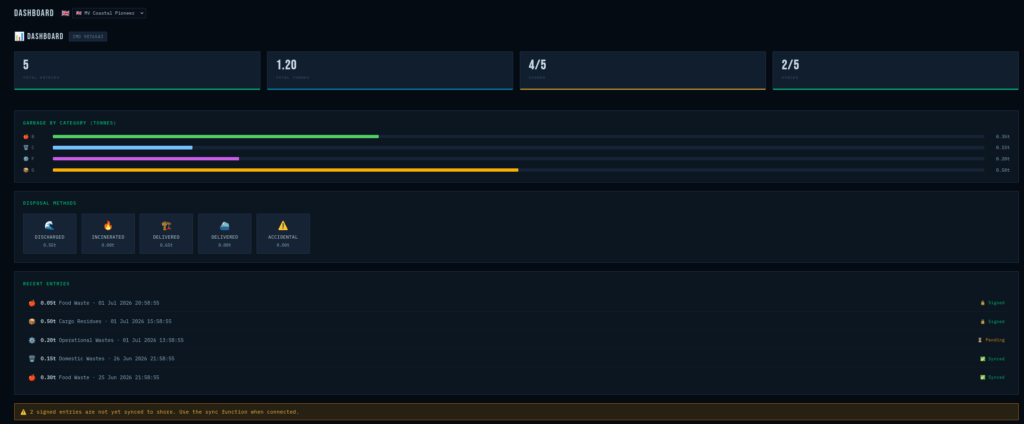
Digital Garbage Record Book: How Modern Vessels Can Meet MARPOL Annex V

The Paper Problem

Every vessel subject to MARPOL Annex V must maintain a Garbage Record Book (GRB) — a chronological log of every piece of garbage generated, discharged, or incinerated at sea. In practice, this means paper forms that crew members fill out by hand, sign with a wet ink signature, and store in a binder that lives somewhere in the bridge.

The problems with this approach are well-known but rarely discussed openly:

  • Illegible handwriting makes records difficult to verify during port state control inspections
  • Missing signatures or incomplete entries create compliance gaps that can result in fines
  • No automated compliance checking — crew don’t know a discharge is illegal until a port inspector tells them
  • Hash chain integrity — paper records can be altered retroactively without detection
  • No offline capability — many vessels still rely on paper because connectivity at sea is unreliable
  • No audit trail — there’s no tamper-evident history of who changed what and when

The IMO’s 2023 guidelines on electronic record books acknowledge that digital solutions are permissible, but the industry has been slow to adopt. dGRB v2 is built to change that.

Getting started

The dGRB app is live at https://dgrb.ingeniat.eu — no signup required.

Demo account (frontend login):

dGRB Dashboard

Continue reading"Digital Garbage Record Book: How Modern Vessels Can Meet MARPOL Annex V"

Training Marine Engine Anomaly Detectors — A Physics-Informed ML Pipeline

How we built a production-ready anomaly detection system for marine diesel engines using scikit-learn, physics-based features, and an out-of-distribution detection layer.

Marine engine downtime costs shipping companies thousands per hour. A single unexpected failure — a seized bearing, a clogged injector, a cracked piston ring — can strand a vessel mid-voyage. Traditional monitoring systems rely on fixed thresholds: “if vibration exceeds X mm/s, raise an alarm.” But thresholds are brittle. They don’t adapt to operating conditions, they don’t catch novel failure modes, and they produce too many false positives to be useful at scale. That’s why we rebuilt our engine monitoring system from the ground up with a physics-informed machine learning pipeline that combines domain knowledge with unsupervised anomaly detection. Here’s how it works.
Continue reading"Training Marine Engine Anomaly Detectors — A Physics-Informed ML Pipeline"