
When you’re running an electrochlorination or ozone-based Ballast Water Management System (BWMS), managing Total Residual Oxidant (TRO) levels isn’t just about compliance—it’s about understanding the chemistry happening in your tanks throughout the voyage.
What is TRO Decay?
TRO decays naturally over time through reactions with organic matter, metals, and through natural degradation. The rate depends on:
- Initial dose – How much chlorine/ozone was generated
- Salinity – Higher salinity waters tend to maintain TRO longer
- Temperature – Warmer waters accelerate decay
- Hold time – Longer voyages give more decay time
The discharge limit is 0.1 mg/L TRO, and knowing when your ballast will drop below this threshold is critical for planning neutralisation requirements.
Why You Might Need Neutralisation
If your voyage is shorter than the time required for natural decay to bring TRO below 0.1 mg/L, you’ll need to add a neutralising agent:
- Sodium thiosulfate – Most common for chlorine systems
- Bisulfite – Often used for ozone systems
The tricky part? You need to calculate the exact dose based on your specific conditions—not a generic table value.
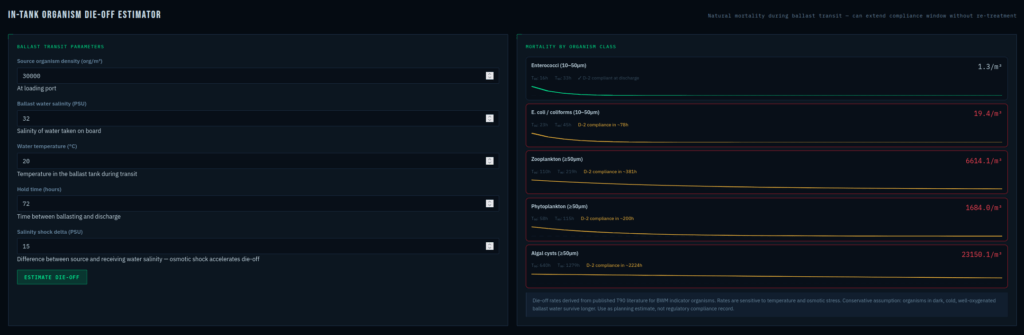
Enter the TRO Decay & Neutralisation Planner
The new tool in the BWM Suite answers these questions:
- When will your ballast drop below the 0.1 mg/L limit?
- How much neutralising agent do you need if it won’t?
- What does the 48-hour decay curve look like?
Simply input your initial dose, salinity, temperature, and hold time—and get a complete decay curve with neutralisation requirements.
Key Considerations
- Always verify calculations with onboard measurements
- Document everything for PSC inspections
- Plan ahead—short voyages require more neutralisation
The TRO Decay & Neutralisation Planner is available now in the BWM Suite alongside the existing compliance calculators.
Access the BWM Suite at https://bwms.ingeniat.eu
Demo account (frontend login):
[email protected]/admin123— admin role