Engineering and Project Management
 

Predicting Port State Control Deficiencies Before Inspectors Arrive

Port State Control (PSC) inspections can shut down a vessel for days. A single detention costs between $50,000 and $500,000 in delays, fuel, and reputation damage. Fleet managers spend weeks preparing for inspections using spreadsheets and gut feelings — but nobody actually runs the regulations against the ship’s real state.

What It Does

PSC Readiness is a compliance prediction platform that evaluates every MARPOL, SOLAS, and MLC requirement against a vessel’s actual design data, certificate status, and operational records — before inspectors arrive.

The app takes a vessel’s technical data and runs it through 265+ encoded regulatory rules and it produces:

  • PSC Readiness Score — a single number indicating how clean the vessel is
  • Predicted Deficiencies — specific items inspectors will flag, ranked by severity
  • Risk Level — statistical prediction of detention probability
  • Remediation Guidance — exactly what to fix and how
Continue reading"Predicting Port State Control Deficiencies Before Inspectors Arrive"

Six New Engineering Tools Join the BWM Suite

The BWM Suite just got a significant upgrade. Alongside the three core compliance calculators — D-2, Exchange, and Cost — we’re now shipping six new engineering tools designed for the people who actually operate, specify, and certify ballast water management systems.

These aren’t compliance checkers. They won’t tell you pass or fail in isolation. What they will do is answer the harder questions that sit behind the certificate: what’s really happening in your tanks, under your specific conditions, on your specific route?

Getting started

The BWMS Suite is live at https://bwms.ingeniat.eu — no signup required.

Demo account (frontend login):


What’s new

  • TRO Decay & Neutralisation Planner — For operators running electrochlorination or ozone systems. Enter your initial dose, salinity, temperature, and hold time, and the tool maps out exactly when your ballast will drop below the 0.1 mg/L TRO discharge limit — and how much sodium thiosulfate or bisulfite you need if it won’t. Includes a 48-hour decay curve.
  • UV Dose Calculator — For UV-based BWMS operators and BWMS specifiers. This one models the actual dose your system will deliver given lamp age, UV transmittance of the water, flow rate, and reactor geometry — then checks it against the D-2 required doses for bacteria, zooplankton, and the hardier algal cysts. It also tells you the maximum flow rate your system can handle while staying compliant.
  • Type-Approval Envelope Analyser — The tool that answers “but will my BWMS work in these waters?” Every type-approved BWMS is certified over a specific band of salinity, temperature, and turbidity. This analyser overlays your route’s actual water quality parameters against that certified envelope and tells you exactly where you fall outside it — which matters when flag states ask for technical justification.
  • Log-Reduction Uncertainty Propagation — Built for BWMS manufacturers and technical reviewers. Two systems can both be certified at 99.9% log reduction and have wildly different statistical margins. This tool propagates the measurement uncertainty from the type-approval test report through to the discharge concentration, giving you a probability of exceedance and a classification: Robust, Marginal, or High Risk.
  • Tank Residual & Sediment Compliance Check — For shipowners on bulk carriers, tankers, or any vessel with tanks that can’t be pumped completely dry. It blends the treated ballast with the unpumpable residual — which still contains organisms at source concentration — and tells you whether the mix stays within D-2 limits at discharge. It also calculates the maximum allowable residual volume for your tank geometry.
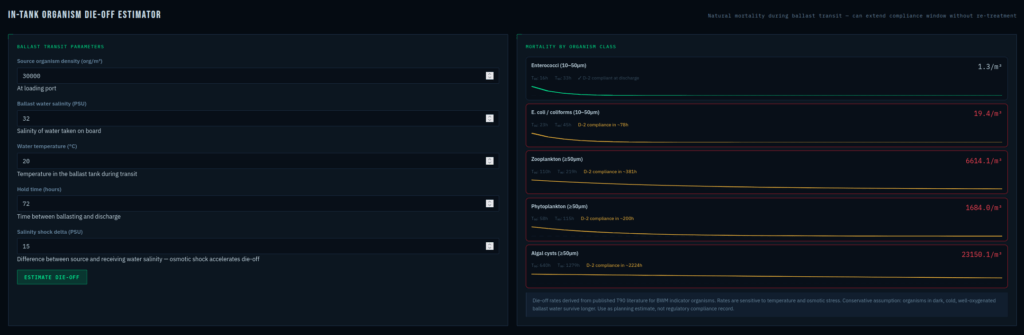
  • In-Tank Die-Off Estimator — The voyage planning tool. For each organism class — Enterococci, E. coli, zooplankton, phytoplankton, algal cysts — it applies first-order decay kinetics with temperature and salinity shock modifiers to estimate how many organisms survive to discharge. Algal cysts are effectively immortal. Everything else has a half-life. Now you can model it.

A note on the die-off estimator

The die-off estimator carries a prominent disclaimer: it is a planning tool, not a compliance record. No port state control authority in the world accepts natural mortality as a substitute for type-approved treatment or exchange. The tool exists to help you understand whether a longer voyage gives you a practical safety margin, not to game the system.

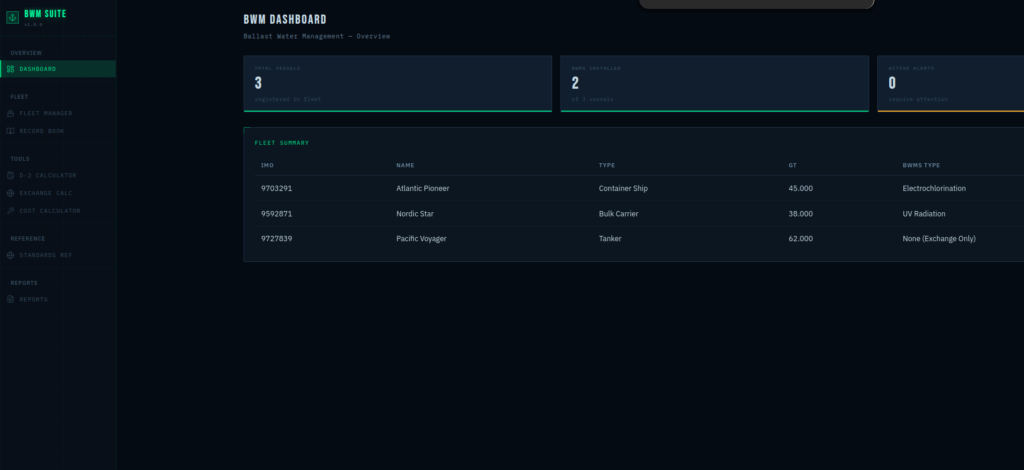
BWMS Suite Dashboard

All six tools are client-side — calculations run entirely in the browser. They’re available now in the TOOLS section of the BWM Suite alongside the existing D-2, Exchange, and Cost calculators.


BWM Suite — Ballast Water Management Software

Managing ballast water compliance doesn’t have to be a spreadsheet nightmare.

The BWM Suite is a dedicated full-stack application for ship operators and maritime compliance teams to manage IMO BWM Convention requirements in one place.

Core Features

  • Fleet Manager — Register your vessels with full technical specs (IMO number, GT, DWT, ballast capacity, tank count, BWMS type, installation date, certificate details). All fields editable. IMO numbers link directly to the vessel record for fast editing.

  • Ballast Water Record Book — Log every ballast operation inline: date/time (UTC), position, tank ID, operation type (ballasting/deballasting), volume, salinity, source water, and treatment method. Supports CSV import/export for bulk entry. All data tenant-isolated.

  • D-2 Calculator — Check discharge compliance against MEPC.200(62) D-2 organism count limits. Select BWMS type (Electrochlorination, UV, Ozone, etc.), source water salinity, discharge volume, and USCG waters flag. Returns pass/fail status, effectiveness percentage, and USCG approval flag.

  • Exchange Calculator — Determines required exchange procedure (D-1 or D-2) based on voyage route, ballast volume, total capacity, BWMS status, and distance. Calculates exchange volumes for both 95% and 3× exchange methods.

  • Cost Calculator — Estimates BWMS retrofit costs (low/mid/high) across five years including installation, consumables, and servicing. Gives cost per cubic metre and USCG approvability.

  • Reports — Download a fleet-wide compliance summary as PDF or XML, or generate an IMO-style Ballast Water Record Book (PDF or XML) for any individual vessel.

Tech Stack

Backend: FastAPI + SQLAlchemy (async) + PostgreSQL, JWT auth via python-jose + passlib, PDF generation with ReportLab. Frontend: React + TypeScript + Vite, Nautilus design system, Axios with token refresh interceptor. 

Getting started

The BWMS Suite is live at https://bwms.ingeniat.eu — no signup required.

Demo account (frontend login):


Note: The BWM Suite was originally built as a standalone desktop-style application. It has since been reworked into a full client-server architecture with a dedicated FastAPI backend and PostgreSQL database, deployed as a separate service for demo purposes.

BWMS Suite Dashboard

Continue reading"BWM Suite — Ballast Water Management Software"

FuelEU Banking — How Surplus Pooling Works and Why Most Operators Are Calculating It Wrong

FuelEU Maritime’s banking mechanism is the single most powerful compliance tool available to fleet operators — and it is the single most misunderstood. The regulation allows vessels that perform better than the GHG intensity limit to generate a surplus. That surplus can be banked and used to offset deficits on …

SEEMP Part III in Plain English — What a D-Rated Vessel’s Technical Manager Needs to Do Now

If your vessel has been rated D under the IMO CII framework, you have a regulatory obligation that is not optional. You must develop and submit a SEEMP Part III — a Corrective Action Plan — to your flag state administration. Most technical managers I speak with have three questions: …

EU ETS Monitoring Plan — What It Must Include and What Most Plans Get Wrong

The EU ETS monitoring plan is not a form to fill out. It is a living document that describes how a shipping company measures, records, and reports its CO₂ emissions — and it is the single most important compliance document a vessel operator can have. A poorly written monitoring plan …

What a CII D-Rating Costs in 2026 — The Full Calculation for a Handymax Bulker

If you manage a Handymax bulk carrier and it’s rated D under the IMO CII framework, you are not facing a theoretical problem. You are facing a real, quantifiable cost that compounds across multiple revenue streams. This post walks through the exact math for a 42,000 DWT Handymax bulker trading …

Emergency Maritime Compliance Packages: When the Deadline Is Tomorrow and the Fine Is Real

How Shipowners and Fleet Managers Can Respond When a CII Rating Drops, a FuelEU Deadline Approaches, or an EU ETS Audit Looms It is 09:00 on a Tuesday. Your fleet manager opens the latest CII verification report. D rating. Not a close D. Not a borderline C that slipped. A …

TideWatch — Maritime Regulatory Intelligence, Delivered.

The compliance landscape for shipping has never been more complex — and the cost of getting it wrong has never been higher.

Fines under the EU ETS can reach €100 per tonne of CO₂ unaccounted for. FuelEU Maritime penalties stack annually. CII ratings that slip below C don’t just attract scrutiny — they attract commercial consequences: charterers route away, ports deny priority berthing, and insurance premiums climb.

And the regulations keep coming. New rules from the IMO, the EU Commission, and national authorities layer on top of each other every year. Staying current isn’t a one-time project. It’s a permanent operational function.

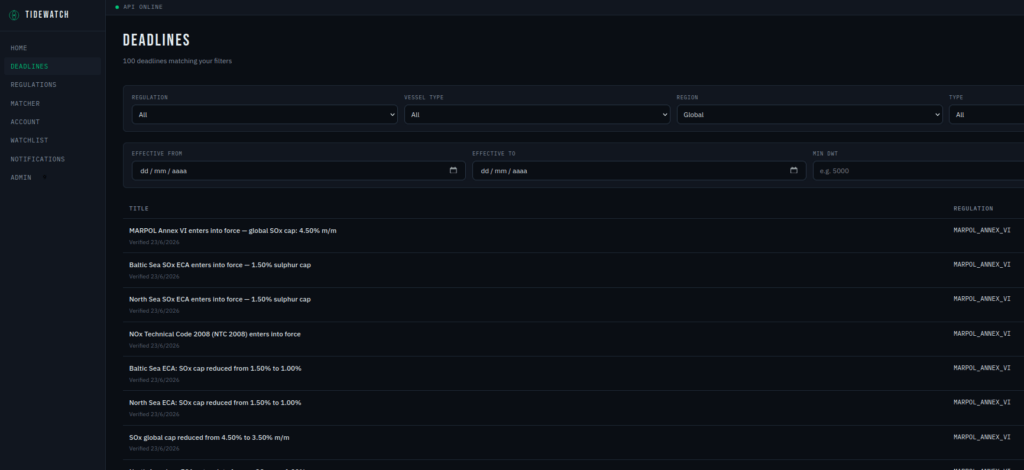
TideWatch is an automated maritime regulatory alert service that monitors the regulatory environment across nine major compliance regimes — and delivers the information you need, when you need it, where you already work.

Getting started

The deadline browser is live at https://tidewatch.ingeniat.eu — no signup required.

Demo accounts (frontend login):

Or explore the API directly:

  • GET /api/deadlines?regulation=EU_ETS&region=EU&severity=CRITICAL
  • POST /api/match with {"vessel_type": "cargo", "gt": 12000, "trading_area": "MEDITERRANEAN", "fuel_type": "VLSFO"}

Questions, corrections, or proposed new deadlines? Use the curator queue or open an issue. Every entry in TideWatch is reviewed by a human.

TideWatch Dashboard

Continue reading"TideWatch — Maritime Regulatory Intelligence, Delivered."

Beyond the Annual Gap Analysis: Running CII Improvement Pathway Reviews as a Living Programme

For technical directors, compliance leads, ESG/sustainability leads, and owners with fleet-level CII exposure who need the forward view to actually hold across the planning horizon. The five posts before this one in the CII improvement pathway series have covered what a pathway review is, why ratings deteriorate, the operational and …

CII Gap Analysis Explained: What It Is, Who Needs One, When

A primer for shipowners, technical directors, and compliance officers approaching the Carbon Intensity Indicator regime for the first time — and for those who have been living with it but never had the framework explained as a whole. A CII gap analysis is, in Ingeniat’s words, “a structured, forward-looking assessment …

Why Your CII Rating Can Deteriorate Even When Nothing Changes

A diagnostic for shipowners, technical managers, and anyone who has been told “we’re a C-rated ship” without being told how long that rating will hold. The most counter-intuitive feature of the CII regime is that a vessel can hold its emissions profile steady and still slide down the rating bands. …