
The compliance landscape for shipping has never been more complex — and the cost of getting it wrong has never been higher.
Fines under the EU ETS can reach €100 per tonne of CO₂ unaccounted for. FuelEU Maritime penalties stack annually. CII ratings that slip below C don’t just attract scrutiny — they attract commercial consequences: charterers route away, ports deny priority berthing, and insurance premiums climb.
And the regulations keep coming. New rules from the IMO, the EU Commission, and national authorities layer on top of each other every year. Staying current isn’t a one-time project. It’s a permanent operational function.
TideWatch is an automated maritime regulatory alert service that monitors the regulatory environment across nine major compliance regimes — and delivers the information you need, when you need it, where you already work.
Getting started
The deadline browser is live at https://tidewatch.ingeniat.eu — no signup required.
Demo accounts (frontend login):
[email protected]/curator123— curator role[email protected]/admin123— admin role[email protected]/fleet123— fleet operator role
Or explore the API directly:
GET /api/deadlines?regulation=EU_ETS®ion=EU&severity=CRITICALPOST /api/matchwith{"vessel_type": "cargo", "gt": 12000, "trading_area": "MEDITERRANEAN", "fuel_type": "VLSFO"}
Questions, corrections, or proposed new deadlines? Use the curator queue or open an issue. Every entry in TideWatch is reviewed by a human.
What TideWatch tracks:
| Regime | Issuing Body | Key Deadlines |
|---|---|---|
| EU ETS | EU | Surrender deadlines, phase-in percentages |
| FuelEU Maritime | EU | GHG intensity limits, monitoring plans, compliance cycles |
| UK ETS | UK | Monitoring & surrender obligations |
| CII | IMO | SEEMP submissions, rating thresholds |
| EEXI | IMO | Verification deadlines, certification |
| MARPOL Annex VI | IMO | SOx/NOxECA zones, 2020 sulfur cap |
| EU MRV | EU | Verified emissions reports |
| BWM Convention | IMO | D-1/D-2 ballast water standards |
| AFIR | EU | Shore power mandates, LNG infrastructure |
How the service works:
Every morning at 08:00 Berlin time, subscribers receive a daily briefing via Telegram or WhatsApp covering all deadlines due in the next seven days — sorted by regulation, flagged by severity, with enough context to brief a superintendent or a board.
Every Monday morning, a weekly intelligence digest goes out with:
- Upcoming deadlines for the month ahead
- Recent regulatory developments pulled from primary sources
- Market pulse — EUA price movements, fuel spread shifts, port state control trends
When something material changes — a regulation amended, a deadline moved, a new compliance obligation introduced — TideWatch issues a real-time alert so you’re not reading about it three weeks too late.
Built for how compliance actually works:
Most shipping companies find out about regulatory deadlines the way they find out about traffic jams — when they’re already stuck in one. The information exists. The primary sources are all public. But scrubbing EU Commission press releases, IMO circulars, and national maritime authority websites is a full-time job that most teams don’t have.
TideWatch does that job continuously, 24/7.
What you get:
- ✅ Daily morning deadline alerts (Telegram + WhatsApp)
- ✅ Weekly regulatory intelligence digest (every Monday)
- ✅ Real-time amendment and change notifications
- ✅ Coverage of 9 major regulatory regimes
- ✅ Scope-level applicability filters — we tell you which deadlines actually apply to your vessels
- ✅ All deadlines cross-referenced to primary source citations
Who it’s for:
🏭 Shipowners & fleet managers — track obligations across your entire fleet without assigning a full-time regulator to the problem.
👔 Compliance officers — turn raw regulatory text into actionable briefings for management and masters.
📈 Brokers & intermediaries — differentiate by offering regulatory compliance intelligence as part of your service stack.
🏛️ P&I clubs & service providers — give clients something useful before the renewal conversation starts.
No software to install. No login required. Just a Telegram bot or a WhatsApp message — and you’re connected.
→ Telegram: Use our invite link and start a chat
→ WhatsApp: Message us to subscribe
Or try our online service, TideWatch is a public maritime regulatory deadline tracker covering five major regimes — EU ETS, FuelEU Maritime, IMO CII, the BWM Convention, and MARPOL Annex VI — with 67 verified deadlines at launch, each citing its legal source.
What’s in the database
EU Emissions Trading System (EU ETS) — Maritime
Maritime transport entered the EU ETS in 2024 under Directive 2023/959/EU. TideWatch covers the full phase-in schedule:
- 2018: MRV monitoring begins (CO₂ reporting under Regulation (EU) 2015/757)
- 2024 (Apr): Monitoring plans due to administering authorities
- 2024 (Jan): CH₄ and N₂O monitoring begins (counted as CO₂e from 2026 surrender)
- 2025 (Jan): 70% of verified emissions in scope
- 2025 (Mar): Verified emissions report for 2024 data due
- 2025 (Sep): 2024 vintage allowances surrendered (40% scope)
- 2026 (Jan): 100% scope; CH₄/N₂O included as CO₂e
- 2026 (Sep): 2025 vintage surrendered (70%)
- 2027 (Sep): First 100%-scope surrender (2026 CO₂e)
Annual MRV reports (31 Mar) and surrender deadlines (30 Sep) continue through 2028–2029 and beyond.
FuelEU Maritime
Regulation (EU) 2023/1805 sets the GHG intensity trajectory for shipping:
- 2024 (Aug): Monitoring plans submitted for verification
- 2025 (Jan): First compliance year — GHG intensity limit reduced to 91.16 × 0.98 gCO₂e/MJ (WtW)
- 2026 (Jan): First monitoring data report to verification body
- 2026 (Apr): First compliance balance report via THETIS-MRV
- 2030 (Jan): GHG limit drops to 91.16 × 0.94 gCO₂e/MJ (−6%)
- 2030 (Jan): Shore power (OPS) obligation for container ships and passenger ships at major EU ports
Annual compliance cycles (Jan reporting + Apr balance submission) continue indefinitely.
IMO Carbon Intensity Indicator (CII)
The CII rating system under MARPOL Annex VI Chapter 4 requires ships to maintain a carbon intensity rating of C or above:
- 2023 (Jan): CII enters force; SEEMP Part III required on board
- 2024–2026 (31 Mar annually): Operational data reported via SEEMP Part II
- Event-triggered: If a vessel receives an E rating in any year, or a D rating for three consecutive years, a Corrective Action Plan (SEEMP Part III) must be submitted without undue delay
The reference line tightens approximately 2.3% per year, making compliance progressively harder without fleet efficiency improvements.
Ballast Water Management Convention (BWM)
The BWM Convention (IMO 2004) reached full implementation on 8 September 2024. All ships must now comply with the D-2 performance standard — treating ballast water to eliminate viable organisms — at their next IOPP renewal survey. The old D-1 exchange standard is no longer sufficient.
MARPOL Annex VI — Air Pollution
SOₓ, NOₓ, and fuel quality requirements under MARPOL Annex VI span two decades of step-downs:
| Date | Requirement |
|---|---|
| 2005 | Annex VI enters force; global SOₓ cap: 4.50% |
| 2006 | Baltic Sea SOₓ ECA: 1.50% |
| 2007 | North Sea SOₓ ECA: 1.50% |
| 2012 | Global SOₓ cap: 3.50% |
| 2012 | North American ECA: 1.00% |
| 2014 | US Caribbean ECA: 1.00% |
| 2015 | Baltic, North Sea, North American ECAs: 0.10% |
| 2016 | NOₓ Tier III in North American/Caribbean NECAs (new builds) |
| 2020 | Global SOₓ cap: 0.50% (IMO 2020) |
| 2020 | Carriage ban: no fuel >0.50% without EGCS (scrubber) |
| 2021 | NOₓ Tier III in Baltic and North Sea NECAs (new builds) |
| 2025 (May) | Mediterranean Sea SOₓ ECA: 0.10% |
| 2026 (Jan) | NOₓ Tier III in Mediterranean NECA (new builds) |
| 2027 (Mar) | Canadian Arctic Waters and Norwegian Sea SOₓ ECAs: 0.10% |
How TideWatch works
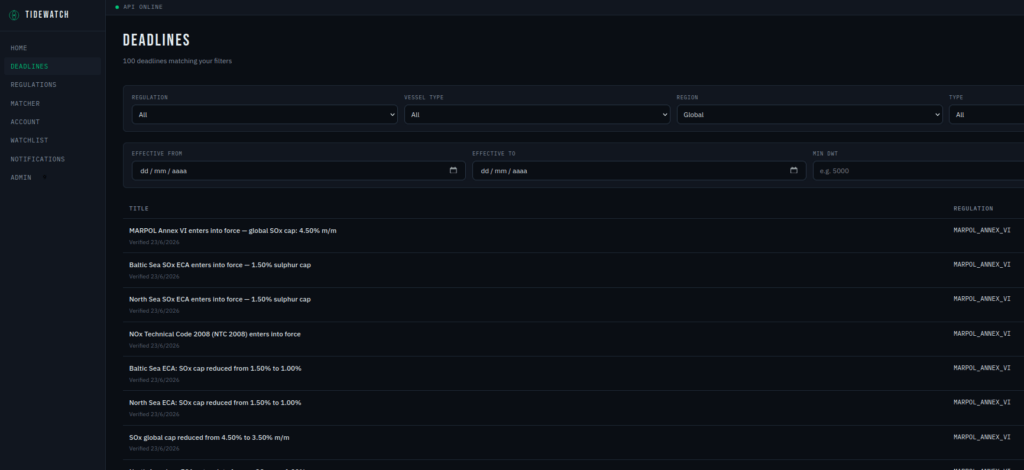
Public deadline browser
No account required. Browse by regulation, filter by region, vessel type, gross tonnage, and effective date range. Every deadline is returned with its legal citation and a link to the primary regulatory text.
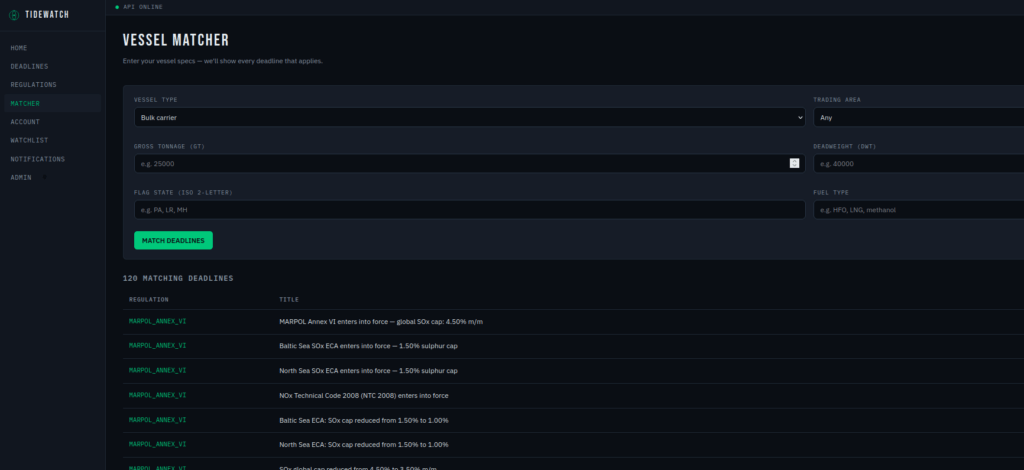
Vessel matcher
Describe any vessel — type, GT, DWT, flag, trading area, fuel type — and TideWatch returns every deadline whose scope matches. This is the core of the product: a shipping company can enter a vessel’s specs and immediately see every applicable obligation, current and future, across all five regimes.
Scope engine
Deadlines in TideWatch are not simple calendar entries. Each has a structured scope covering:
- Vessel type (cargo, passenger, tanker, etc.)
- Gross tonnage (GT) range
- Trading area (Baltic, North Sea, Mediterranean, EU/EEA, global, etc.)
- Fuel type (HFO, VLSFO, LNG, methanol, etc.)
- Flag state (where applicable)
A vessel trading only in the Baltic Sea and North Sea will not be matched against a Mediterranean-specific obligation. A vessel under 5,000 GT will not be matched against EU ETS thresholds. The scope engine handles this correctly.
Verified, cited, traceable
Every deadline has:
- A citation (regulation article or IMO resolution number)
- A citation URL linking to the primary regulatory text
- A
last_verified_attimestamp showing when a curator last confirmed the entry
This is not scraped data with no provenance. A curator reviewed it.
Upcoming deadlines
/api/deadlines/upcoming?days=90 returns deadlines effective in the next quarter. Drop this into a dashboard widget, a fleet management tool, or a morning briefing.
Change feed
/api/deadlines/changes?since=2026-06-01 returns amendments and new entries since any given date. Track what changed, when, and why.
For fleet operators: watchlist and notifications
The public product is free and requires no account. Fleet operators who want proactive alerts can create a free account and add vessels to a watchlist.
When a deadline matches a watched vessel, TideWatch sends an email notification at three intervals before the effective date: 30 days, 7 days, and 1 day out.
Notifications are logged. The notification preferences page shows delivery status, history, and allows resending.
For curators and administrators
TideWatch includes a full curator workflow:
- Draft → Published: new deadline entries are created in DRAFT status, reviewed, then published
- Amendment: when a regulation changes, curators create an amendment that preserves the full change history
- Curator queue: external proposed changes (from users or automated source monitoring) enter a queue for curator review
- Audit trail: every change to every deadline is logged with who made it, when, and what changed
A ChangeDetector background task re-fetches primary regulatory sources daily, computes a content hash, and flags the curator queue when something has changed. This means TideWatch doesn’t go stale between manual reviews.
What TideWatch is not
TideWatch is an informational deadline tracker, not a legal advisory service. Every deadline cites primary regulatory text. The last_verified_at field shows currency. Users are responsible for verifying obligations with their flag administration, class society, or legal counsel before acting.
What’s next
Phase 2 adds:
- More regulations: EU MRV, EEXI, UK ETS, AFIR (shore power), regional SECAs
- Multi-tenancy: shipping company accounts with isolated watchlists
- Compliance Platform integration: import vessels directly from the existing Compliance Platform
- In-app notifications: real-time notifications without email
The goal is 200+ deadlines across 10+ regulations within 12 months.