
FuelEU Maritime’s banking mechanism is the single most powerful compliance tool available to fleet operators — and it is the single most misunderstood.
The regulation allows vessels that perform better than the GHG intensity limit to generate a surplus. That surplus can be banked and used to offset deficits on other vessels in the same fleet. This is surplus pooling — and it is the mechanism that turns FuelEU compliance from a vessel-by-vessel compliance exercise into a fleet-wide optimization problem.
Most fleet operators are calculating their surplus and deficit positions incorrectly. They are leaving money on the table — or worse, exposing themselves to unnecessary penalty payments.
This post explains how FuelEU banking actually works, how surplus pooling is calculated, and the common mistakes that operators make.
How FuelEU Banking Works
FuelEU Maritime sets a maximum GHG intensity limit for energy used on board covered vessels. The limit becomes progressively stricter each year:
| Period | GHG Intensity Limit Reduction vs. Baseline |
|---|---|
| 2025–2026 | -0.2% to -0.5% |
| 2027–2028 | -5% to -10% |
| 2029–2030 | -10% to -15% |
| 2030+ | -15% to -62% (by 2035) |
Each vessel calculates its actual GHG intensity and compares it to the applicable limit. The result is either a surplus (better than the limit) or a deficit (worse than the limit).
Surplus Calculation
Surplus = (Limit - Actual GHG Intensity) × Energy Consumed
Where:
- Limit = the maximum allowed GHG intensity for that year
- Actual GHG Intensity = the vessel’s actual GHG intensity (well-to-tank + tank-to-propeller)
- Energy Consumed = total energy consumed by the vessel during the reporting period
A positive result is a surplus. A negative result is a deficit.
Deficit Calculation
Deficit = (Actual GHG Intensity - Limit) × Energy Consumed
A positive result is a deficit. A negative result is a surplus.

How Surplus Pooling Works
Surplus pooling aggregates surpluses and deficits across all covered vessels in a fleet. The net position determines whether the fleet has a surplus or deficit:
Net Fleet Position = Σ(Surpluses) - Σ(Deficits)
If the net position is positive, the fleet has a surplus and no penalty is due. If the net position is negative, the fleet has a deficit and must pay a penalty.
The Penalty
The penalty for an unoffset deficit is €1,500 per tonne of CO₂eq (for the 2025–2026 period, increasing annually). This is a powerful incentive to manage surpluses and deficits proactively.
How Most Operators Calculate It Wrong
Mistake 1: Managing Each Vessel in Isolation
The most common mistake is calculating surpluses and deficits vessel-by-vessel rather than fleet-wide. Each vessel is assessed independently, and deficits are paid even when other vessels in the fleet have surplus that could offset them.
The correct approach: Aggregate all surpluses and deficits across the fleet. A surplus on Vessel A offsets a deficit on Vessel B. Only the net position determines whether a penalty is due.
Mistake 2: Ignoring Banked Surpluses from Previous Years
Surpluses can be banked for use in future periods. Operators who fail to track banked surpluses from previous years may pay penalties unnecessarily.
The correct approach: Maintain a cumulative banked surplus ledger for each vessel. Track:
- Annual surplus/deficit for each vessel
- Banked surplus carried forward from previous years
- Net fleet position after banked surplus is applied
- Remaining banked surplus for future years
Mistake 3: Using the Wrong GHG Intensity Value
FuelEU calculates GHG intensity using a well-to-tank (WTT) + tank-to-propeller (TTP) approach. The WTT component accounts for emissions from fuel production and delivery. The TTP component accounts for emissions from fuel combustion on board.
Operators who use only the TTP component (ignoring WTT) or who use incorrect WTT values are calculating their GHG intensity incorrectly.
The correct approach: Use the WTT values specified in the FuelEU regulation for each fuel type. The regulation provides default WTT values for conventional fuels and fuel blends. Measured WTT values from fuel suppliers can be used if available.
Mistake 4: Not Accounting for Fuel Blends
When a vessel uses a fuel blend (e.g., 50% VLSFO + 50% biofuel), the GHG intensity must be calculated using the weighted average of the individual fuel components. Operators who use the WTT value for the base fuel (VLSFO) without adjusting for the biofuel component are calculating incorrectly.
The correct approach: For fuel blends, calculate the GHG intensity as:
GHG Intensity = Σ(Fuel_i × GHG_i) / Σ(Fuel_i)
Where Fuel_i is the energy content of fuel component i and GHG_i is the GHG intensity of fuel component i.
Mistake 5: Overbanking in Early Years
Generating large surpluses in 2025–2026 to bank for 2030+ may not be optimal. The regulation becomes progressively stricter, meaning that a tonne of surplus banked in 2025 has less value than a tonne of surplus generated in 2029 (when the limit is tighter and the penalty exposure is higher).
The correct approach: Balance near-term and long-term surplus generation. Invest in decarbonization measures that generate surplus in the years when the limit is tightest.
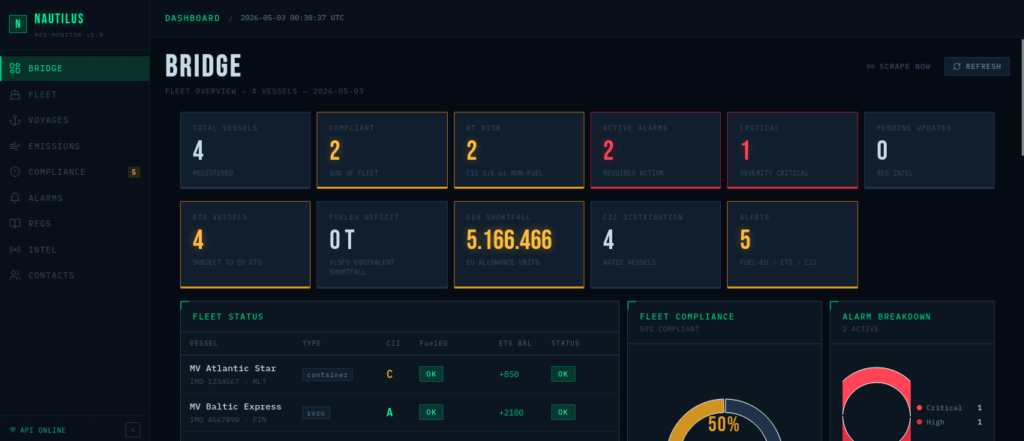
Fleet-Wide Optimization Strategy
The optimal FuelEU compliance strategy requires a fleet-wide optimization model that tracks:
1. Baseline GHG Intensity for Each Vessel
Calculate the baseline GHG intensity for each vessel based on current fuel consumption and fuel type. This is the starting point for all optimization scenarios.
2. Projected Intensity Under Different Scenarios
Model the projected GHG intensity for each vessel under different scenarios:
- Scenario A: Business as usual (current fuel and operations)
- Scenario B: Speed reduction only
- Scenario C: Biofuel blend only
- Scenario D: Combined speed reduction + biofuel blend
- Scenario E: Wind assistance + speed reduction
3. Annual Limit for Each Vessel
The annual limit is specified in the FuelEU regulation and varies by year. Calculate the limit for each vessel for each year of the planning horizon.
4. Surplus/Deficit for Each Vessel, Each Year
Calculate the surplus or deficit for each vessel for each year under each scenario.
5. Net Fleet Position
Aggregate the surplus/deficit across all vessels for each year. The net position determines the penalty exposure.
6. Banked Surplus
Track the cumulative banked surplus across all vessels. A surplus in year N can be carried forward to offset a deficit in year N+1 or later.
7. Penalty Exposure
If the banked surplus is insufficient to offset the deficit, calculate the penalty exposure:
Penalty = Deficit × €1,500/tonne
Example: Fleet of 5 Vessels
| Vessel | 2027 GHG Intensity | Limit | Surplus/Deficit |
|---|---|---|---|
| VLCC (tanker) | 82 gCO₂eq/MJ | 90 gCO₂eq/MJ | +40 tCO₂eq |
| Capesize (bulk) | 92 gCO₂eq/MJ | 90 gCO₂eq/MJ | -30 tCO₂eq |
| Container ship | 88 gCO₂eq/MJ | 90 gCO₂eq/MJ | +10 tCO₂eq |
| Product tanker | 95 gCO₂eq/MJ | 90 gCO₂eq/MJ | -50 tCO₂eq |
| Chemical tanker | 85 gCO₂eq/MJ | 90 gCO₂eq/MJ | +25 tCO₂eq |
| Net fleet position | +5 tCO₂eq |
In this example, the fleet has a net surplus of +5 tCO₂eq. No penalty is due. The VLCC and chemical tanker surpluses offset the Capesize and Product tanker deficits, with a small surplus remaining.
If the fleet had not pooled surpluses and deficits, the Capesize and Product tanker would each have incurred penalties:
- Capesize: 30 tCO₂eq × €1,500 = €45,000
- Product tanker: 50 tCO₂eq × €1,500 = €75,000
- Total penalty without pooling: €120,000
With pooling, the penalty is €0.
The Bottom Line
FuelEU banking and surplus pooling is the single most important compliance mechanism available to fleet operators. It turns a vessel-by-vessel compliance exercise into a fleet-wide optimization problem — and the difference between paying €120,000 in penalties and €0 is the ability to pool surpluses across the fleet.
Most operators are calculating their surplus and deficit positions incorrectly — managing each vessel in isolation, ignoring banked surpluses, using incorrect GHG intensity values, or failing to account for fuel blends. The cost of these mistakes is real and quantifiable.
*Need a FuelEU surplus pooling assessment for your fleet? Request a FuelEU Compliance Assessment from Ingeniat — fixed scope, fixed deliverable, fixed price. Fleet-wide optimization model included. Or check our marine compliance platform for other tools of interest.