
Most offshore container manufacturers are still producing their DNV 2.7-1 certification calculations in Excel. The spreadsheet might be well-built — with formulas locked, units clearly labeled, and a senior engineer reviewing the printout before submission. But it still arrives at the surveyor's desk as a spreadsheet PDF, often with cross-sheet references that are hard to follow, cell references that might have been accidentally modified, and without any clause-level traceability visible in the document itself.
The industry is shifting. This post examines why digital, standards-aligned calculation tools are replacing spreadsheet workflows for DNVGL-ST-E271 and EN 12079 certification, and what the practical benefits are for manufacturers and consultants.
The Spreadsheet Problem Is Not the Math
To be clear: the problem with spreadsheets is rarely the math itself. An experienced engineer who built a DNV 2.7-1 spreadsheet with care will produce correct numbers. The problems are traceability, reviewability, and longevity.
Traceability
A spreadsheet calculation connects inputs to outputs through cell references. The intermediate steps — which might show the derivation of sling tension, the pad eye tear-out check, the combined stress calculation — are embedded in formula chains. To follow a surveyor's question "can you show me how you got the pad eye tear-out value?" you need to open the spreadsheet, find the right sheet, trace the formula chain, and print or screenshot the relevant cells.
A PDF calculation report generated from a purpose-built tool presents the same calculation as a readable document: formula, substituted values, result. It is self-contained and readable without any software other than a PDF viewer.
Reviewability
Classification society surveyors and in-house reviewers are not checking your math in the way a university professor marks an exam. They are asking: "Is this correct? Can I follow the reasoning? Does the clause reference match the requirement?" A document laid out with clause references and named calculation steps is faster to review and harder to challenge than a spreadsheet with cell references.
Longevity
Excel files from 10 years ago may not open correctly in current versions. Spreadsheet templates get modified incrementally until the original logic is lost. A PDF is readable in 20 years on any device. For certification records that may be audited years after the container was built, this matters.
What a Purpose-Built DNV 2.7-1 Tool Actually Changes
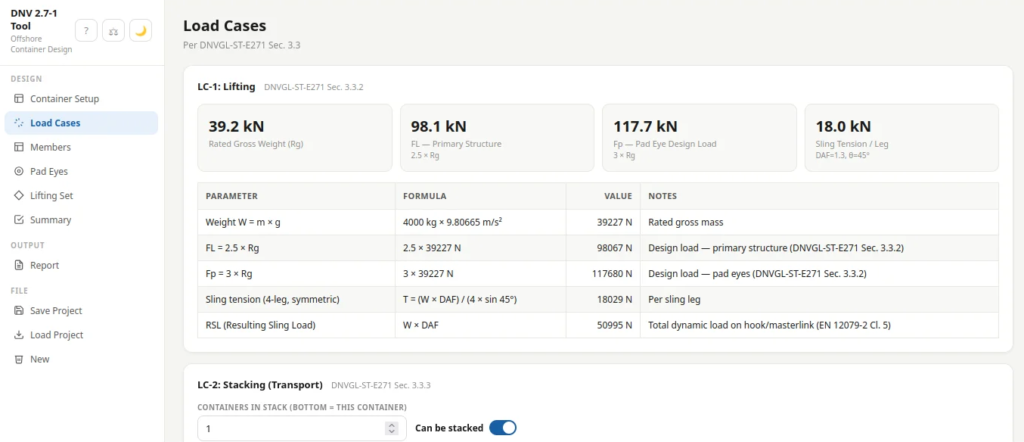
A dedicated DNV 2.7-1 calculator — whether a web tool or a desktop application — encodes the standard's requirements structurally:
- Load cases are pre-defined with the correct load factors
- Material properties are stored in a database with the right units
- Allowable stresses are computed automatically from the material grade
- The clause references are embedded in the output
This means three things happen in practice:
1. Errors of principle become impossible
If the standard says pad eyes are designed at 3.0 × Rg, a purpose-built tool applies 3.0 × Rg for pad eyes. You cannot accidentally type 2.5 × Rg for a pad eye in a well-designed tool because the tool knows which load factor applies to which calculation. In a spreadsheet, you can type anything.
2. The report writes itself
Instead of copying values from a spreadsheet into a Word document, the tool generates a PDF report directly from the calculation. The report contains the formula, the substituted values, the result, and the clause reference. This is the output the surveyor reviews.
3. Revision control is built in
When the customer changes the payload from 8,000 kg to 10,000 kg, a purpose-built tool recalculates the entire structure in real time and regenerates the PDF. In a spreadsheet workflow, changing an input value and re-printing the report requires manually re-running every formula, checking every cell, and then rebuilding the Word document.
The Clause Traceability Requirement
Classification society reviewers and auditors are increasingly focused on clause-level traceability — the ability to show that each calculation step maps to a specific clause in the governing standard.
DNVGL-ST-E271 and EN 12079 are large documents. A well-structured calculation report should be able to answer the question "what clause requires you to use 3.0 × Rg for pad eyes?" by pointing to the relevant line in the calculation report, not by the engineer citing from memory during a video call.
A purpose-built tool with clause-traceable output makes this a natural byproduct of the calculation process. It is not an add-on; it is built into the report generation.
What Remote Survey Needs
The shift toward remote survey — accelerated since 2020 and now standard practice for many classification societies — has made digital documentation even more critical. When a surveyor reviews a certification package remotely, they are working from whatever you send them digitally. There is no physical folder of paper to flip through. If the documentation package is incomplete, ambiguous, or requires the surveyor to request clarifications, the remote review process breaks down and the certification timeline extends.
A structured PDF report from a purpose-built tool is: - Self-contained — no cell references to chase, no hidden formulas - Searchable — find a clause reference or a value without scrolling - Comparable — the same container type can be compared across batches by opening two PDFs - Archivable — PDF/A format survives software transitions
The Market Reality: Most Manufacturers Are Still Using Spreadsheets
Despite the availability of purpose-built tools, the majority of offshore container manufacturers — particularly smaller operations in Southern Europe, Southeast Asia, and the Middle East — still use spreadsheet-based calculation workflows. This is not because the spreadsheets don't work. It is because:
- The engineering team has used the same spreadsheet for years and trusts it
- The customer base has accepted spreadsheet PDFs as certification packages
- There is no perceived benefit strong enough to justify retraining
The calculus is starting to shift. Two forces are changing this:
First, classification societies are becoming more specific about documentation format expectations. The expectation that a certification package is a structured PDF with clear clause traceability — not a spreadsheet printout — is becoming more common in Northern European and North American projects.
Second, the engineering talent pool is changing. New graduate engineers are more comfortable with purpose-built software tools than with complex Excel workbooks. The spreadsheet-as-calculation-tool workflow that was second nature to a senior engineer in 2010 is increasingly seen by the next generation as technical debt.
What to Look for in a DNV 2.7-1 Calculation Tool
If you are evaluating moving away from spreadsheets, the non-negotiable features are:
- Correct load factors: LC-1 at 2.5 × Rg for primary structure, 3.0 × Rg for pad eyes; LC-2 at 2.0 × Rg; LC-3 per specification
- Material database: E36, Grade A, 316L, 5083-H116 with correct allowable stress formulas
- Pad eye checks: tear-out, bearing, shear, and von Mises combined — all four
- Sling calculation: sling tension, RSL, WLL selection from standard table
- PDF report generation: with clause references for every calculation step
- Save and load: local storage or file export so projects can be revised without rebuilding from scratch
Features that are important but not showstoppers:
- Unit conversion: handled automatically (user enters mm, MPa, kg; engine runs in SI internally)
- Multiple container profiles: 20ft, 10ft, 8ft, 6ft, 5ft with pre-loaded frame geometry
- Clause reference lookup: searchable explanation of each clause in the standard
- Pass/fail summary dashboard: color-coded utilization ratios per member and per pad eye
The Bottom Line
The spreadsheet versus purpose-built tool question is not about which produces better numbers — an experienced engineer with a well-built spreadsheet will produce correct numbers. It is about certification risk, review efficiency, and long-term documentation quality.
A purpose-built tool reduces the risk of wrong load factors, missing clause references, and ambiguous documentation. It makes the reviewer's job faster and the certification package more defensible. And it produces documentation that will be readable and auditable for the full life of the container.
The spreadsheet that works today is still a spreadsheet that will need to be rebuilt when the senior engineer who built it leaves. A PDF report from a purpose-built tool is a document that can be reproduced in 15 years without institutional knowledge of the original tool.
The DNV 2.7-1 Offshore Container Design Tool generates certification-ready PDF reports with full clause traceability for DNVGL-ST-E271 and EN 12079. It runs entirely in the browser with no install, no server, and no external data transmission. Try it for your next container certification.
Find out more, fill in your contact details below and we will come back to you as soon as possible.