
If you've typed "DNV 2.7-1 vs 2.7-2 vs 2.7-3" into a search bar, you're not alone. These three standards are routinely confused — even by experienced procurement teams. This guide explains each one plainly, shows how they differ, and gives you a concrete decision tree to identify which standard governs your equipment.
Why these standards exist
DNV (Det Norske Veritas) developed the 2.7 series to establish unified international requirements for lifting and handling units in offshore environments. Before these standards existed, offshore operators faced a patchwork of conflicting requirements across regions and projects. The 2.7 series brought consistency — but the trade-off was that different unit types required different documents.
Today, the 2.7 family has three active standards. Each targets a distinct category of offshore unit. They are not interchangeable, and a certificate issued under one does not satisfy the requirements of another.
The three standards at a glance
Offshore Containers
The original and most widely applied standard. Covers general-purpose containers used to transport goods and equipment to and from offshore installations by crane lift.
Cargo containers · CCUs · DNV BoxesOffshore Service Containers
Applies to containers that are inhabited or occupied during use offshore — workshops, control rooms, laboratories, and accommodation modules lifted onto platforms.
Workshops · Labs · Habitable unitsPortable Offshore Units
Addresses units that are more complex than containers but not permanently installed — pressurised systems, equipment skids, and purpose-built portable modules.
Skids · Pressurised units · Portable modulesDNV 2.7-1: Offshore Containers
DNV 2.7-1 is the standard most people encounter first, and for good reason — it covers the workhorse of offshore logistics: the offshore container. These are closed containers, open half-height containers, basket containers, and similar units that carry materials, equipment, and supplies from supply vessels to offshore installations via crane.
The standard sets requirements for structural design, fabrication, testing, inspection, and certification. It defines the structural loading cases — vertical lift, stacking, forklift handling — and specifies minimum safety factors. Every unit certified under 2.7-1 must carry a permanently affixed identification plate and a DNV certificate confirming it has passed design appraisal and prototype testing.
What makes a unit subject to 2.7-1?
- The unit is a closed, open, or half-height container used to transport cargo offshore
- It is designed for crane lifting from supply boats to installation decks
- It is not inhabited while suspended or in transit
- Maximum gross mass is typically 25,000 kg (some exemptions apply)
- It is not a pressurised system and does not house live process equipment
Common examples: DNV boxes, tool baskets, refrigerated food containers, chemical tote containers, open cargo baskets, mud skips, and offshore cargo tank frames.
DNV 2.7-2: Offshore Service Containers
DNV 2.7-2 was introduced to address a growing category of unit that 2.7-1 was never designed to cover: containers that people occupy during offshore operations. A workshop module, a laboratory, a control room, an electrochlorination room — these are all fundamentally different from a cargo container, because human safety inside the unit becomes a design requirement.
The standard adds requirements well beyond structural integrity. It prescribes ventilation, emergency exits, fire detection and suppression, electrical installations to ATEX/IECEx standards where required, and ergonomic access for escape. Structural requirements are comparable to 2.7-1, but the total scope of compliance is considerably wider.
Many operators procure a 2.7-1 certified container and then modify it into a habitable workshop or control room. The moment it becomes an occupied unit, a 2.7-1 certificate is no longer sufficient. The unit requires a separate 2.7-2 assessment — and in practice, the structural design often needs to be revisited as well.
What makes a unit subject to 2.7-2?
- The unit is inhabited or occupied during normal offshore operations
- Personnel enter and work inside it while it is installed offshore
- It contains electrical, HVAC, or fire suppression systems serving occupants
- It is routinely crane-lifted between vessel and installation, not permanently fixed
- Examples: workshop containers, lab containers, control rooms, generator houses, accommodation units
DNV 2.7-3: Portable Offshore Units
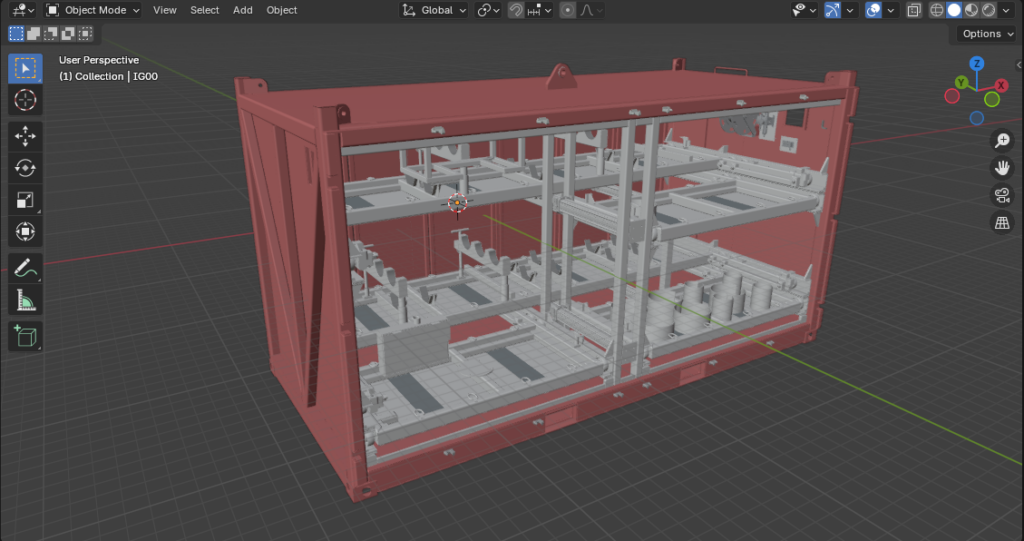
DNV 2.7-3 is the most technically complex of the three standards, and also the most frequently misapplied. It covers what the industry calls "portable offshore units" (POUs) — equipment packages and skids that are designed to be lifted onto offshore installations and hooked up to the platform's infrastructure, but which are not containers in the conventional sense.
A typical 2.7-3 unit might contain pressure vessels, chemical injection systems, a gas compression skid, or a water treatment package. Because these units house pressurised or hazardous systems, the standard incorporates requirements from multiple engineering disciplines: structural, process, electrical, and instrumented safety systems (SIS). It also requires a thorough hazard identification (HAZID) process and a documented risk assessment as part of certification.
DNV 2.7-3 does not replace the individual equipment standards that govern the components inside a unit (e.g. PED for pressure vessels, ATEX for zone equipment). Instead, it sits on top of them — verifying that the assembled portable unit is safe as a system when lifted and installed offshore.
What makes a unit subject to 2.7-3?
- The unit contains process equipment, pressure vessels, or chemical systems
- It is a purpose-built skid or module, not a converted freight container
- It requires hookup to platform utilities (power, piping, instrumentation) after lift
- It has its own instrumented safety systems or emergency shutdown devices
- The hazard profile requires a formal risk assessment under the standard
Side-by-side comparison
| Feature / Requirement | DNV 2.7-1 | DNV 2.7-2 | DNV 2.7-3 |
|---|---|---|---|
| Primary use | Cargo transport | Occupied service unit | Process equipment skid |
| Inhabited during operations | ✗ No | ✓ Yes | ◑ Operational visit only |
| Structural design verification | ✓ Required | ✓ Required | ✓ Required |
| Crane lift requirements | ✓ Core focus | ✓ Core focus | ✓ Required |
| Fire & life safety systems | ✗ Not required | ✓ Mandatory | ◑ Risk-dependent |
| HVAC / ventilation requirements | ✗ Not required | ✓ Mandatory | ◑ Where process demands |
| Pressurised systems / process equipment | ✗ Excluded | ✗ Excluded | ✓ Core scope |
| HAZID / formal risk assessment | ✗ Not required | ◑ Limited scope | ✓ Mandatory |
| ATEX / hazardous area classification | ✗ Not applicable | ◑ Where installed | ✓ Often required |
| Prototype test required | ✓ Yes (2× SWL) | ✓ Yes | ◑ Structural test required |
| Periodic inspection interval | 2.5 years | Annual + 2.5 year | Per project / operator |
| Governing body | DNV (Class) | DNV (Class) | DNV (Class) |
| Certification document issued | DNV Container Certificate | DNV Service Container Certificate | DNV POU Certificate |
Decision tree: which standard do you need?
Work through the questions below in order. The first "Yes" answer that leads to a verdict is your answer — do not continue further down the tree once you have a result.
| # | Question to ask about your unit | If YES → | If NO → | Typical examples |
|---|---|---|---|---|
| 1 | Does the unit contain pressure vessels, process piping, or chemical injection systems that require hookup to platform utilities? | DNV 2.7-3 | Go to Q2 | Chemical injection skids, gas compression packages, produced water treatment units |
| 2 | Will personnel occupy or work inside the unit while it is installed offshore (not just access it briefly for checks)? | DNV 2.7-2 | Go to Q3 | Workshop containers, laboratory modules, control rooms, electrical equipment rooms with regular occupation |
| 3 | Is the unit a conventional closed, half-height, or open container used to carry cargo, tools, or materials by crane to offshore installations? | DNV 2.7-1 | Go to Q4 | DNV boxes, tool baskets, refrigerated containers, mud skips, chemical tote frames |
| 4 | Is the unit a purpose-built module — not a container, not purely a cargo carrier — designed to be crane-lifted offshore and connected to platform systems? | DNV 2.7-3 | Go to Q5 | Portable power packs, portable compressor modules, instrument calibration units with process connections |
| 5 | Does the unit contain habitable space AND process or pressurised equipment in the same enclosure? | 2.7-2 + 2.7-3 (dual cert) | Consult your certifying authority | Combined control room / chemical storage modules; hybrid units with live process and manned spaces |
This decision tree is a guide, not a substitute for formal engineering assessment. DNV 2.7-3 in particular contains scope boundaries that require project-specific interpretation. When a unit sits at the boundary between two standards, always involve your DNV-accredited certifying authority at the concept stage — before fabrication begins.
The most common mistakes — and their consequences
1. Certifying a habitable workshop under 2.7-1
This is by far the most frequent error. A 2.7-1 certificate confirms structural integrity for crane lift — it says nothing about ventilation, egress, fire suppression, or electrical safety for occupants. Operators who accept a 2.7-1 certificate for an occupied unit expose themselves to serious liability and almost certain rejection during offshore operator audits.
2. Using 2.7-3 for a simple cargo container
Less common but expensive: specifying 2.7-3 for a unit that only needs 2.7-1 significantly increases certification cost and lead time without adding any real safety value. The HAZID requirement alone can add weeks to a project programme.
3. Forgetting periodic inspection requirements
All three standards mandate periodic inspection. DNV 2.7-1 requires inspection every 2.5 years. DNV 2.7-2 typically adds annual inspection of safety-critical systems. Units operating offshore without a valid current certificate can be impounded and will fail operator pre-job checks.
"The certificate isn't the last step — it's the beginning of a compliance lifecycle. Offshore operators don't just check the plate; they check the date."
4. Modifying a certified unit without reassessment
Any significant modification — cutting an additional opening, changing the floor loading, adding equipment — can void an existing certificate. The unit must be reassessed and a revised certificate issued. This applies under all three standards.
Which standard do major offshore regions recognise?
DNV 2.7-1 is accepted virtually everywhere: the North Sea, Gulf of Mexico, West Africa, Southeast Asia, and Australia all accept 2.7-1 as the baseline standard for offshore containers. DNV 2.7-2 and 2.7-3 are similarly recognised across these regions, though some NOCs (national oil companies) have supplementary requirements layered on top.
In the US Gulf of Mexico, BSEE (Bureau of Safety and Environmental Enforcement) references DNV standards but has its own additional requirements for certain unit types. In Brazil, Petrobras has supplementary technical specifications that run parallel to DNV standards. Always verify regional acceptance before committing to a certification route for high-value or complex units.
How certification actually works
Regardless of which standard applies, the certification process follows a broadly similar structure. First, the designer submits drawings and calculations for DNV design appraisal. Once approved, fabrication begins under DNV survey. On completion, the unit undergoes prototype testing — for 2.7-1 and 2.7-2, this includes a proof load test to twice the safe working load. DNV issues the certificate and identification plate, and the unit enters the periodic inspection regime.
For DNV 2.7-3, the process is more involved: the HAZID is conducted early in design, a preliminary hazard list is developed, and the risk assessment must be reviewed and closed before the certificate can be issued. Budget for this additional stage in your project schedule — typically 3–6 weeks for a moderately complex unit.
Not sure which standard applies to your unit?
Our certification specialists review your equipment specification and confirm the correct standard, scope, and timeline — before you commit to fabrication.
Quick-reference summary
If you take only one thing from this article, let it be this: the three DNV 2.7 standards are not tiers of a hierarchy — they are parallel standards covering fundamentally different equipment categories. A unit that needs 2.7-2 does not "upgrade" from 2.7-1; it is a different type of unit entirely, and the two standards address different risks.
Use the decision tree above to identify your standard. Engage a DNV-accredited body at the concept stage. And build periodic inspection into your asset management programme from day one — a lapsed certificate offshore is a grounded unit.
Share your project requirements below. We’ll review your specifications and respond with a detailed engineering proposal.