
The August 2017 edition of DNVGL-ST-E271 replaced the previous DNV 2.7-1 standard, consolidating the offshore container requirements into a single DNV GL standard document and introducing a number of changes that designers and manufacturers need to be aware of. This post explains what changed, what stayed the same, and what the 2025–2026 regulatory environment means for new build and recertification projects.
The Numbering Change: DNV 2.7-1 Becomes DNVGL-ST-E271
The most visible change was the restructuring of the DNV GL standards library. DNV 2.7-1 was renamed to DNVGL-ST-E271 as part of DNV GL's standardization of its portfolio after the merger of Det Norske Veritas and Germanischer Lloyd. The technical content remained broadly similar to the 2009 edition of DNV 2.7-1, but the clause structure was reorganized.
If you are working from an older calculation template that references "DNV 2.7-1 Section 4.2" you should verify the equivalent clause in DNVGL-ST-E271, as section numbering changed.
What Actually Changed in the 2017 Edition
1. Dynamic Amplification Factor (DAF) — Clarified but Not Prescribed
The 2017 edition clarified the treatment of DAF but still does not prescribe a single value. It references DNV-RP-E301 for guidance on selecting an appropriate DAF, which remains the correct approach for certification submissions.
The clarification emphasized that the DAF must be justified by the lifting operation geometry and environmental conditions — not just selected from a table. In practice, DNV surveyors now expect to see a brief DAF justification memo in the calculation package for anything other than standard offshore crane lifts.
What this means for you: For a standard offshore crane lift in the North Sea, a DAF of 1.3 is almost always accepted. For any lift that deviates from vertical or involves vessel motion (tender-assisted lifts, cargo transfers from smaller vessels), a higher DAF or a dynamic analysis is expected.
2. Corrosion Allowance — Made More Explicit
The 2017 edition made the corrosion allowance discussion more explicit in the structural design section. While the 1.5 mm default allowance for carbon steel in a normal offshore atmosphere was carried forward, the new edition requires that the design corrosion allowance be documented in the calculation report, even when the default is used.
This is a documentation change, not a technical change. But surveyors now check for it explicitly.
3. Stiffened Plate Design — Methodology Alignment
The 2017 edition aligns the stiffened plate calculation methodology more closely with DNV GL rules for hull structures, introducing reference to DNV's plate buckling guidance. For most standard offshore containers — which use flat plate panels with regularly spaced stiffeners — this does not introduce new requirements, but it changes the reference methodology for complex panel configurations.
The practical impact is small for standard ISO-sized containers. For custom large-format containers (e.g., 20ft+ long containers with non-standard stiffener configurations), a review of the buckling methodology against DNV GL rules is recommended.
4. Lifting Set — Stronger EN 12079-2 Integration
The 2017 edition explicitly references EN 12079-2 for lifting set design, making the cross-standard alignment more explicit. If you are designing pad eyes, slings, or shackle connections, the WLL tables in EN 12079-2 are now the primary reference for DNV certification as well.
This convergence means that dual certification to DNVGL-ST-E271 and EN 12079 is now effectively the same exercise — the structural calcs are identical, and the lifting set design follows EN 12079-2 in both cases.
5. Documentation Requirements — More Prescriptive
The 2017 edition added requirements for traceability documentation in the calculation report. The following must now be clearly identified in the calculation package:
- Design basis and customer requirements
- Material certificates and traceability to the relevant material standard
- Weld procedure specifications (WPS) and their qualification records
- Non-destructive testing (NDT) records and acceptance criteria
- As-built deviations from design and their justification
This is a significant change for manufacturers who previously treated documentation as a post-design exercise. The documentation must be concurrent with the design, not an afterthought.
Remote Survey and Digital Certification — The 2024–2026 Development
The most significant recent development is not a change to DNVGL-ST-E271 itself, but a change in how certification is delivered: remote survey and digital documentation.
DNV GL and other classification societies have progressively adopted remote survey capabilities following IMO MSC.1/Circ.1588 guidelines. The COVID-19 period accelerated this significantly. As of 2025–2026:
- Initial certification for standard offshore containers can be conducted partially or fully remote, depending on the complexity of the design and the manufacturer's quality management system
- Periodic surveys (annual and five-year) can be conducted remotely where the container is in a location that makes physical attendance difficult (e.g., offshore platforms, remote shipyards)
- Digital documentation packages in standardized formats (PDF/A, structured data exchange) are increasingly accepted for remote review
What This Means for Manufacturers
Manufacturers with a well-documented digital quality management system — ISO 9001:2015 certification, digital WPS registry, electronic material certificates — are now at a significant advantage. The ability to provide a complete documentation package to a remote surveyor in short order directly affects certification timeline and cost.
The containers most likely to benefit from remote certification are: - Standard designs (cargo baskets, waste skips, tool containers) that have been previously certified - Repeat orders of established container types with no design changes - Containers in remote locations where physical survey is logistically complex
The 25,000 kg Cap and Why It Matters for New Designs
DNVGL-ST-E271 maintains the 25,000 kg maximum gross mass limit for offshore containers. This is a hard cap derived from the lifting equipment standard (ISO 10855 references the same limit).
For manufacturers designing large-format containers, this cap means that structural design for maximum payload containers (25,000 kg gross) is the most demanding certification scenario. Designs intended for lower payloads may pass with lighter structures, but every certification is valid only for the specific gross mass and payload declared.
If a container is certified to 10,000 kg gross mass and the customer wants to load it to 15,000 kg, a new certification is required — not an amended one.
What Hasn't Changed
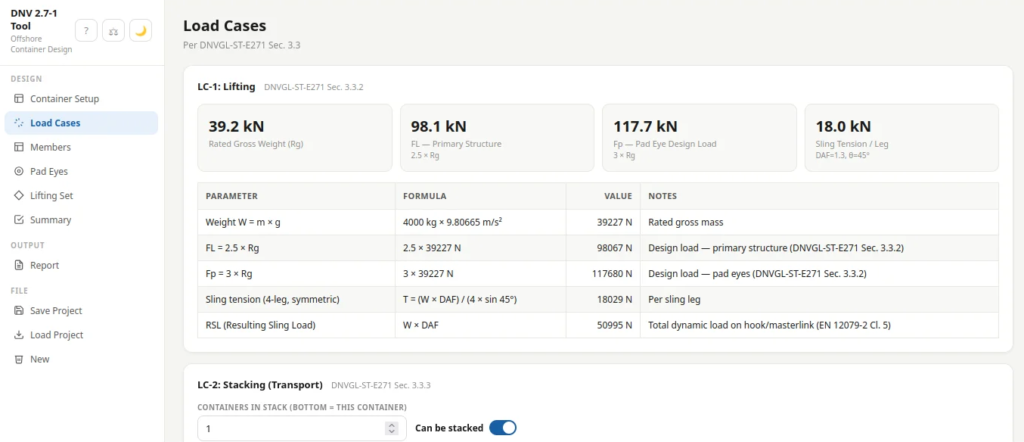
The core engineering has not changed: - The three load cases (LC-1, LC-2, LC-3) remain the same - The load factors (2.5, 3.0, 2.0) remain the same - The allowable stress basis (0.85 × Re) remains the same - The pad eye tear-out, bearing, and shear checks are unchanged - The sling tension and WLL selection methodology is unchanged
For engineers trained on the pre-2017 DNV 2.7-1, the transition was straightforward. The changes were largely in documentation expectations and cross-referencing, not in the underlying structural engineering.
Preparing a Certification Package
A certification package that meets current DNVGL-ST-E271 requirements and is suitable for remote survey review should contain:
- Cover letter with project reference, container ID, customer reference, and applicable standard
- Design basis document summarizing geometry, materials, load cases, and design standards
- Calculation report with clause-by-clause traceability (DNVGL-ST-E271 or EN 12079 as applicable)
- Drawing package — general arrangement, structural detail drawings, pad eye details, weld drawings
- Material certificates (3.1 mill certificates per EN 10204 for all structural materials)
- WPS and WPQR for all weld procedures used
- NDT acceptance criteria and (for initial certification) first article inspection records
- Corrosion protection specification (paint system, galvanizing, or other)
- Lifting set design calculations per EN 12079-2
- Summary compliance statement from the manufacturer
The key change in recent years is that surveyors expect all of this in a single digital package, not a physical folder of paper documents.
The DNV 2.7-1 Offshore Container Design Tool generates PDF calculation reports with full DNVGL-ST-E271 clause traceability — the foundational document for any certification package. Export, add your material certificates and weld records, and you have a complete submission-ready package.
Find out more, fill in your contact details below and we will come back to you as soon as possible.