
When a manufacturer sets out to certify an offshore container, the question surfaces almost immediately: do I certify against DNV 2.7-1 or EN 12079? The short answer is that for most practical purposes, you are certifying against the same technical requirements. But the longer answer involves different standards bodies, slightly different clause structures, and some real differences in how each is applied in practice.
This post cuts through the confusion and gives you a clear basis for decision.
The Short Version
DNV 2.7-1 and EN 12079 are technically aligned — EN 12079 was largely derived from DNV 2.7-1, and both draw from the same root standard. The structural requirements, load factors, allowable stresses, and design philosophies are essentially identical. A container that passes one will pass the other.
The practical difference lies in how and where each standard is applied.
The Standards in Context
DNV 2.7-1 is a DNV GL (formerly Det Norske Veritas, now part of DNV) standard originally developed for offshore containers used in the oil and gas industry. It is currently published as DNVGL-ST-E271 (August 2017 edition). It is the dominant standard in the North Sea, Gulf of Mexico, West Africa, and Southeast Asia offshore markets.
EN 12079 is a European Norm developed by CEN (European Committee for Standardization), published in 2006 in three parts: - EN 12079-1: Design, manufacture and marking - EN 12079-2: Lifting sets — Design, manufacture and marking - EN 12079-3: Periodic examination, inspection and maintenance
EN 12079 is the standard more commonly referenced in European Union regulatory contexts and in tenders issued by European EPCs and operators.
The Load Factor Table — Nearly Identical
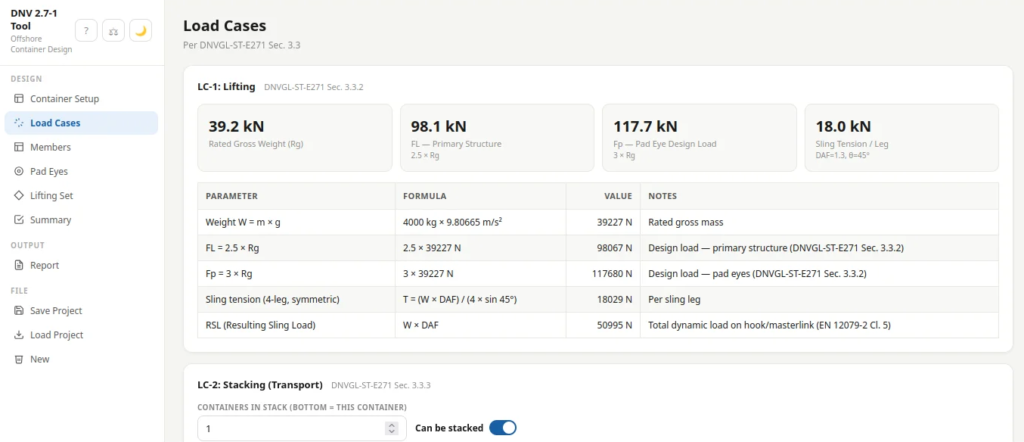
Both standards use the same load factors for the three canonical load cases:
| Load Case | DNV 2.7-1 | EN 12079 | Description |
|---|---|---|---|
| LC-1 Lifting — Primary Structure | 2.5 × Rg | 2.5 × Rg | Mass-based, dynamic amplification factor applied separately |
| LC-1 Lifting — Pad Eyes | 3.0 × Rg | 3.0 × Rg | Higher factor for local attachment points |
| LC-2 Stacking | 2.0 × Rg per container | 2.0 × Rg per container | Applies to bottom container in a stack |
| LC-3 Floor / Base | Per applicable table | Per applicable table | Uniformly distributed load on floor |
The identity of these values is not coincidental — EN 12079 was deliberately written to be technically equivalent to DNV 2.7-1.
Where the Differences Actually Appear
1. Clause Structure and Numbering
DNVGL-ST-E271 organizes requirements by section (Section 3 for loads, Section 4 for structural design, Section 5 for manufacture, etc.). EN 12079 uses clause numbers that run sequentially across its three parts. When you are producing a calculation report, the clause references differ, even though the underlying requirement is the same.
For example: - DNVGL-ST-E271, Section 4.2.1 specifies allowable stress as 0.85 × Re for steel - EN 12079-1, Clause 6.2 specifies the same thing with different wording
A surveyor familiar with one standard may need a mapping table to navigate the other.
2. Lifting Set Requirements — EN 12079-2 is More Prescriptive
EN 12079-2 provides a dedicated standard for lifting sets (slings, shackles, pad eyes) and includes specific WLL (Working Load Limit) tables that are more granular than what DNV 2.7-1 references in its appendices. If you are designing the complete lifting arrangement — not just the container structure — EN 12079-2 gives you a more complete picture.
DNVGL-ST-E271 references EN 12079-2 for lifting set design, which means in practice, DNV certification flows through EN 12079-2 for the lifting components.
3. Certification Body Requirements
In Norway (NCS), the Norwegian Oil and Gas organization has traditionally referenced DNV 2.7-1 in its recommended guidelines. In the UK, the Health and Safety Executive (HSE) and North Sea operators often accept EN 12079 certification. DNV GL will issue certification against DNVGL-ST-E271; a Notified Body (like Lloyd's Register, Bureau Veritas, or DNV) can issue certification against EN 12079.
If your customer specifies a particular classification society or notified body, check which standard they are set up to certify against.
4. Corrosion Allowance
DNVGL-ST-E271 Section 4.3 specifies a default corrosion allowance of 1.5 mm for carbon steel structures in a non-corrosive environment. EN 12079-1 Clause 6.3 specifies the same. In practice, the corrosion allowance becomes a negotiation with the certifying body based on intended service environment (saline atmosphere, chemical exposure, etc.).
5. Maximum Gross Mass
Both standards cap maximum gross mass at 25,000 kg. This is one of the few hard limits that is unambiguous across both frameworks.
Which Standard Should You Certify Against?
| Situation | Recommended Standard |
|---|---|
| North Sea oil & gas — operator or EPC specifies DNV | DNVGL-ST-E271 |
| European project with CE marking requirements | EN 12079 |
| Tendering to a classification society directly | Ask the society — they may offer both |
| Both markets simultaneously | Certify to both — the tests are the same |
The most pragmatic approach for most manufacturers is to design to the stricter interpretation of both standards and obtain dual certification if the market demands it. The incremental engineering cost is minimal; the market access is significantly broader.
Practical Takeaway
The DNV 2.7-1 vs EN 12079 question is largely a format and market access question, not a technical one. The structural calculations are the same. The load cases are the same. The allowable stresses are the same.
What changes is the documentation structure, the clause references in your calculation report, and which certification body you engage. If your container passes DNVGL-ST-E271, it will pass EN 12079 — and vice versa.
The real engineering work is in getting the calculations right, documenting them to clause level, and having a certification body that trusts your methodology. Choose the standard your end customer requires, and make sure your calculation tool can produce reports with the right clause references.
Need to run DNV 2.7-1 structural calculations with EN 12079 clause mapping? The DNV 2.7-1 Offshore Container Design Tool generates certification-ready PDF reports with full clause traceability for both standards.
Find out more, fill in your contact details below and we will come back to you as soon as possible.