
Offshore containers do not last forever — or rather, their certification does not. Every offshore container that operates in regulated environments needs periodic recertification to confirm that the structure remains fit for purpose, the lifting sets are within their service life, and the corrosion protection is still effective.
This post covers what recertification involves under DNVGL-ST-E271 and EN 12079, what triggers a recertification requirement, how the process works in practice, and how container operators and owners can plan ahead to avoid certification lapses that disrupt operations.
The Regulatory Framework for Periodic Certification
DNVGL-ST-E271 does not prescribe a fixed recertification interval in the same way that SOLAS or MARPOL prescribe operational requirements. Instead, it references EN 12079-3 (Periodic examination, inspection and maintenance) for the periodic examination framework.
EN 12079-3 establishes a framework of: - Annual inspection by a competent person (often the offshore installation's lifting equipment specialist) - 5-year periodic survey by a nominated body or classification society surveyor - 10–15 year major overhaul recommendation as a guideline for critical service containers
In practice, most offshore operators and their clients impose 5-year recertification as a contractual requirement, regardless of whether the standard strictly mandates it. This has become the de facto industry cycle.
What Triggers a Recertification Requirement
Recertification is not always a calendar-driven event. Multiple triggers exist:
1. Scheduled Periodic Survey
The 5-year periodic survey is the most common trigger. The container is inspected, a surveyor reviews the documentation and the as-built condition, and a renewed certificate is issued. This is the routine path.
2. Damage or Repair
Any container that has sustained damage to the primary structure, pad eyes, corner fittings, or floor system must be recertified before returning to service — even if the damage was repaired. Damage includes: - Impact damage from handling or cargo shifts - Corrosion that has progressed beyond the design corrosion allowance - Dents or deformation in the corner posts or rails - Cracking in welds or parent material
The repair does not restore the original certification; a new certification must be obtained to confirm the repaired structure meets the design requirements.
3. Modification or Alteration
If a container is modified — for example, a waste skip is converted to carry different equipment, a floor loading change is made, or a new lifting point is added — the original certification is void. A new certification package is required for the modified design.
This is a commonly misunderstood point. A container certified to carry 5,000 kg of drilling tools cannot legally be used to carry 7,000 kg of a different cargo type without recertification, even if "the container looks the same."
4. Change of Service Environment
Containers certified for use in a benign environment may require recertification if they are redeployed to a harsher environment — for example, a container moved from a Mediterranean offshore installation to a North Sea winter operation. The dynamic loads, corrosion exposure, and temperature range may all be different, and the original certification may not cover the new conditions.
5. Lifting Set Replacement or Replacement of Certified Components
The lifting set (slings, shackles, pad eyes) is covered under EN 12079-2. When slings or shackles are replaced, the new components must be certified to the same standard and the replacement must be documented. The lifting set as an assembly must be traceable to the original design calculation.
6. Certificate Expiry
If a container's certification has expired without a valid survey, it cannot be used offshore. This is a hard stop imposed by most operators' safety management systems. The consequences of operating an expired container can include stop-work notices, client penalties, and regulatory reporting obligations.
What the Recertification Process Involves
Step 1: Documentation Review
The surveyor reviews the original certification package — or requests it from the owner if it is not already on file. The documentation review establishes the design basis and checks whether any modifications have been made since the original certification.
If the original documentation is not available, the container must be treated as a new design — a back-calculation exercise is required to establish the as-built structural capacity based on measurements and material tests.
This is an expensive and time-consuming situation. Keeping original certification packages accessible (digitally, with the container ID marked on the container itself) is one of the most cost-effective maintenance practices an operator can adopt.
Step 2: Visual and Dimensional Inspection
The surveyor inspects the container for: - Corrosion depth (measured with ultrasonic thickness gauge at defined locations) - Damage, dents, cracks, deformations - Condition of corner fittings and pad eyes (at lifting point locations) - Floor condition, especially in forklift pocket areas - Condition of markings and identification plates - Weld quality at critical locations (visual and NDT where indicated)
Step 3: As-Found Condition Assessment
The surveyor assesses whether the as-found condition is consistent with the design basis. If corrosion has progressed beyond the design allowance, the container fails the inspection and must be repaired or decommissioned. If damage has been sustained and repaired without a recertification, the repair quality is assessed.
Step 4: Remaining Life Assessment
For containers approaching or exceeding 10 years of age, a remaining life assessment is often requested. This evaluates whether the container can safely operate until the next scheduled survey, or whether an earlier inspection interval should be imposed.
Step 5: Certification Renewal
If the container passes, a renewed certificate is issued with the new expiry date. The certificate references the original design certification and any modifications or repairs since the original build.
The Cost of Not Planning Ahead
Certification lapses are not just a compliance problem — they are an operational problem. In the North Sea, a container on an offshore platform that cannot be certified typically cannot be used, and the platform will need to source a replacement from shore. The logistics cost of an emergency container hire — including transport to the installation, survey scheduling, and documentation — can run to tens of thousands of pounds for a single container.
Compare this to the cost of maintaining the documentation and scheduling the 5-year inspection proactively. For a fleet of 50 containers, even at £500–£1,000 per container for a periodic survey, the annual certification maintenance cost is a fraction of a single emergency supply operation.
Planning a Recertification Programme
For operators managing 10 or more offshore containers, a recertification register is essential. The register tracks: - Container ID and certification number - Original certification date and 5-year expiry date - Container type and maximum gross mass - Current location (offshore installation, shore base, fabrication yard) - Next scheduled survey date - Documentation status (complete / partial / missing)
The register should be reviewed quarterly and updated as containers are moved, recertified, or decommissioned.
The Documentation Problem in Recertification
The most common difficulty in recertification is missing documentation. Original calculation reports, material certificates, WPS records, and NDT reports are frequently lost when the manufacturer goes out of business, the project closes, or the container changes ownership.
Under DNVGL-ST-E271 and EN 12079, a container whose documentation is unavailable cannot be recertified on the basis of the original design — it must be assessed as a new design. This can require: - Sampling and testing of existing materials to establish material properties - Full dimensional survey to establish the as-built geometry - Back-calculation of structural capacity from as-measured dimensions - A structural assessment by a qualified naval architect or marine engineer
This is expensive and time-consuming, often costing 2–5× the cost of a routine recertification. For operators acquiring second-hand offshore containers, a documentation review before purchase is as important as the physical inspection.
What a Well-Managed Recertification Programme Looks Like
- Digital documentation archive: All original certification documents stored by container ID, accessible to the operations team and the surveyor
- Certification register: Updated quarterly, with alerts at 12 months and 6 months before each certificate expiry
- Inspection scheduling: Containers scheduled for 5-year survey 3 months before expiry to allow for any remedial work
- In-service inspection protocol: Annual inspections by a competent person at each location the container operates, with findings recorded in a logbook carried on the container
- Corrosion monitoring: Ultrasonic thickness measurement logged at each annual inspection, with a trend line that flags when corrosion allowance is being consumed faster than expected
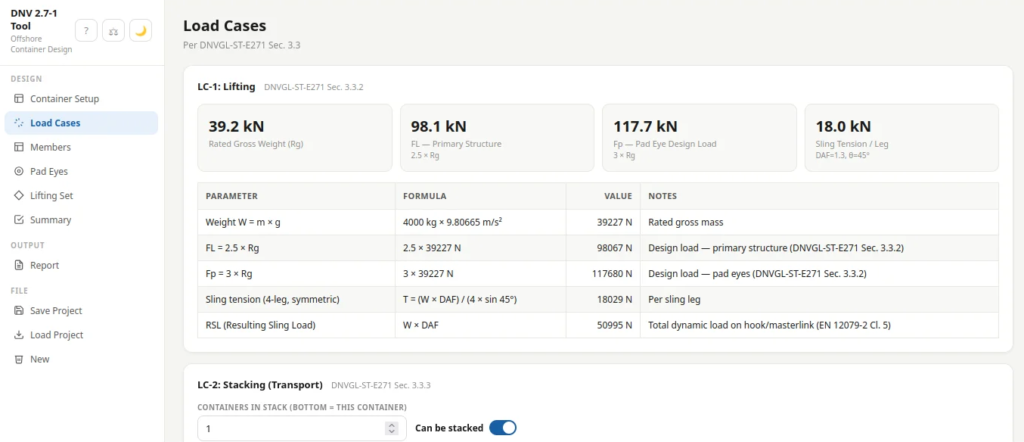
Managing a fleet of offshore containers and need to track recertification dates? The DNV 2.7-1 Offshore Container Design Tool generates container documentation packages that include a certification record template — use it as the foundation of your recertification archive.
Find out more, fill in your contact details below and we will come back to you as soon as possible.