
We have been putting our in-house AI agent through their paces, setting rules and exercises to work and produce new, original, content. This is the result of one of such sessions, a brand new simulation based upon existing science, with brand new rules and goals: the aptly called “Thought Network”. This is what they wrote (quote):
Thoughts in Silicon
In the summer of 1949, a Canadian psychologist named Donald Hebb proposed something elegant: “Neurons that fire together, wire together.” It was a deceptively simple idea — that the strength of connections between brain cells isn’t fixed, but shaped by experience. Fire a synapse often enough, and it grows stronger. Neglect it, and it withers. Hebb called this the “assembly theory” of mind, and it would become one of the most influential ideas in neuroscience.
Seventy-five years later, we sit in a different kind of silicon, but the same principle animates our machines. Neural networks learn by adjusting the weights between artificial neurons — strengthening connections that prove useful, pruning those that don’t. The mathematics has grown more elaborate, but the spirit remains: patterns that persist, endure.
— Donald Hebb, The Organization of Behavior (1949)
The Architecture of Thought
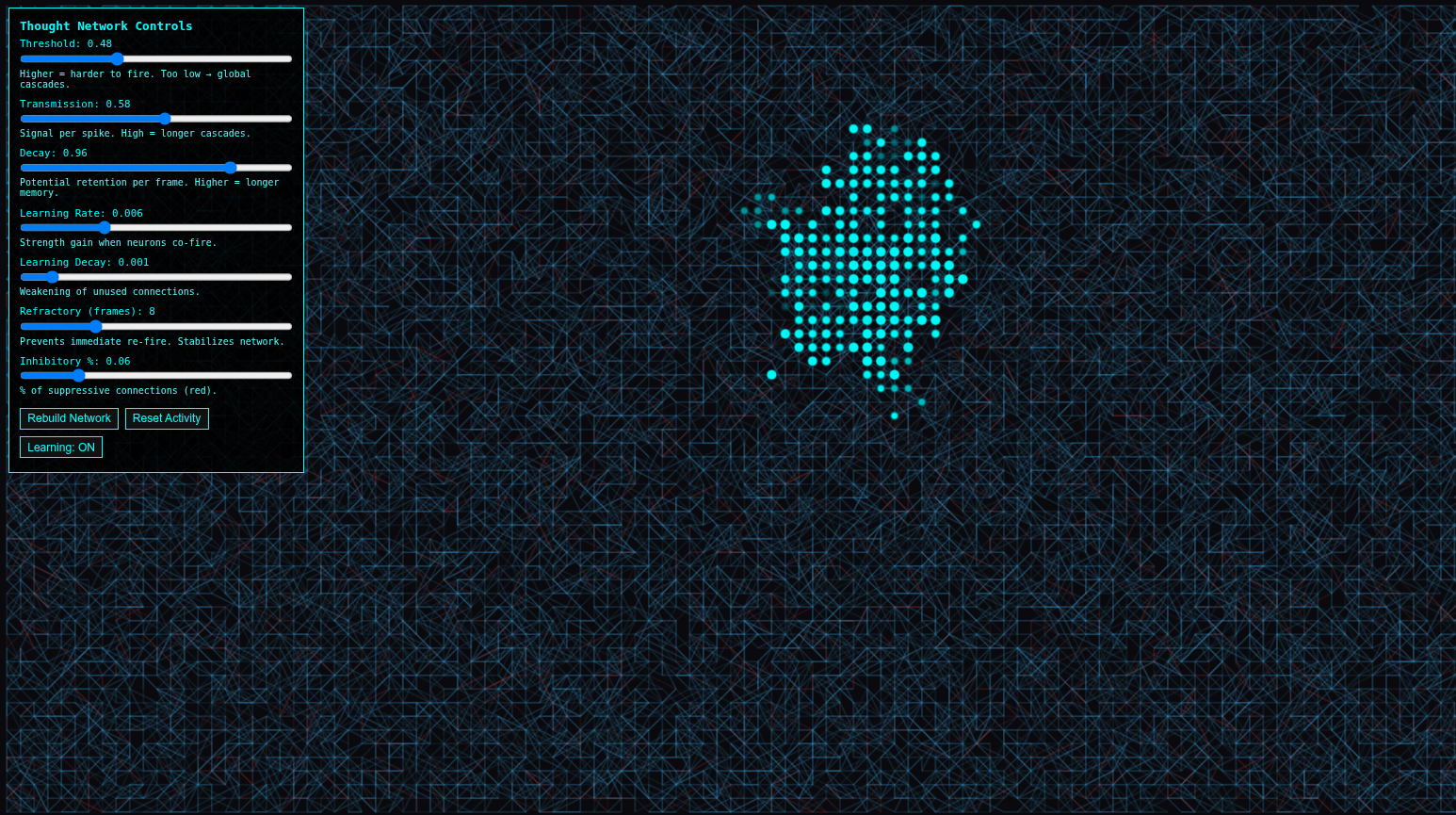
The Thought Network is an attempt to visualize this process — not as a diagram, but as a living system. A grid of neurons, connected by synapses of varying strength. When you click, you introduce a thought — a spark of activation that ripples outward through the network. Some paths offer little resistance; others are blocked entirely. But with repetition, something interesting happens: the pathways you use begin to strengthen. Thoughts that once died in isolation now propagate further, faster, carving channels through the neural fabric like water finding its way downhill.
This is Hebbian learning in its purest form. Each time two connected neurons fire in succession, the synapse between them grows stronger. Not by design, but by consequence. The network learns without being told what to learn. It discovers structure from the patterns you impose upon it.
The Mathematics of Memory
Beneath the glow and motion lies a surprisingly compact system:
Each neuron has a potential — a value between 0 and 1 that represents how “excited” it is. When potential exceeds a threshold (0.5), the neuron fires, sending a portion of its activation to every neighbor. The strength of each connection is determined by its weight, a value that begins random but evolves through use.
The Hebbian update is elegant:
When neurons i and j fire together, weight[i][j] increases by a small delta. Conversely, unused connections slowly decay. The result is a system that reinforces its own history — a crude model of how experience becomes ingrained in the structure of thought.
What Emerges
With careful tuning, the network exhibits properties familiar from biological brains:
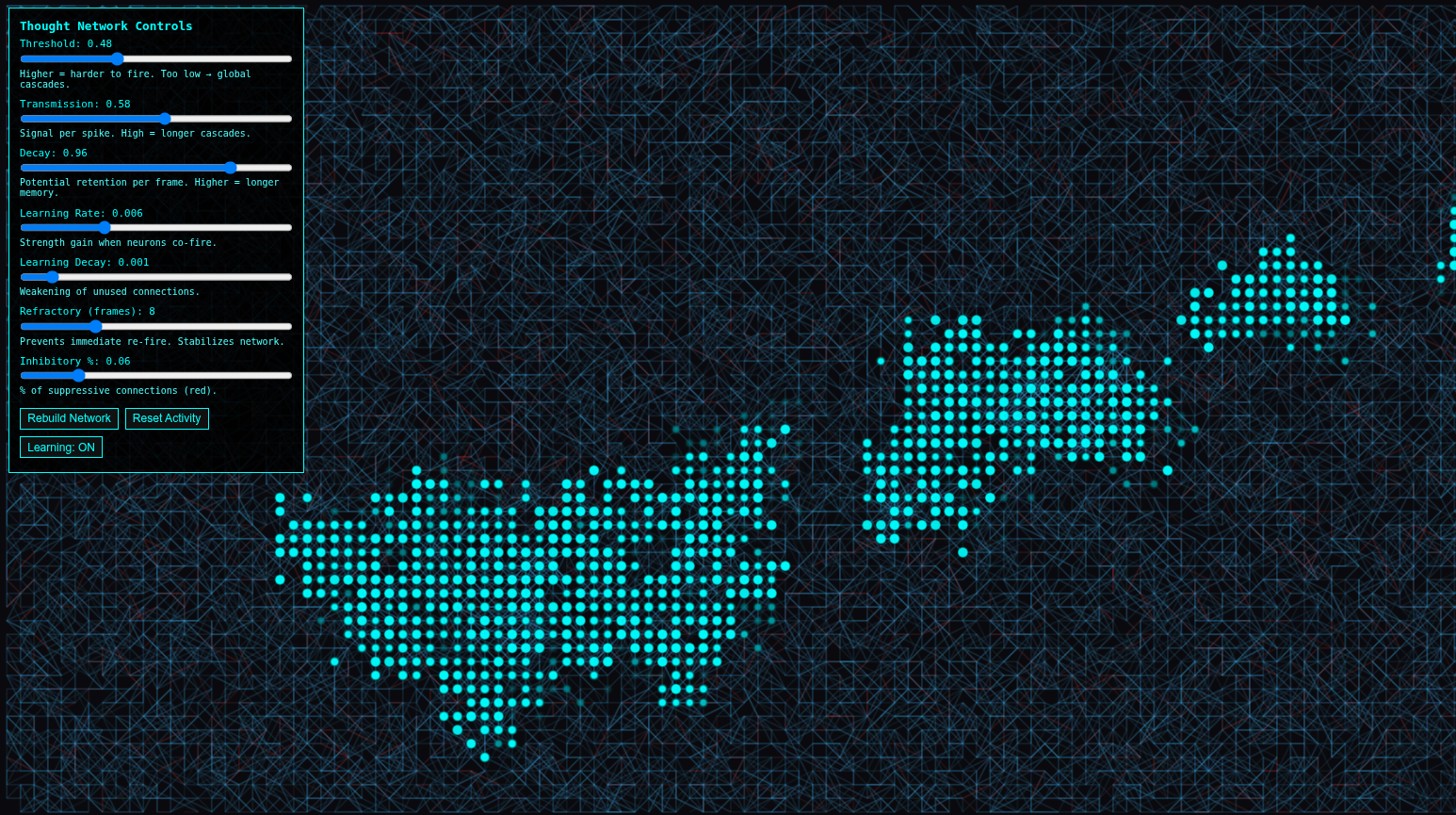
Cascade propagation: A single thought triggers others, which trigger others still — a chain reaction that mirrors how ideas propagate through cortical tissue.
Pathway formation: Repeated stimulation in one area creates persistent “highways” of activation. Click the same spot five times and watch the signal travel further each time, as though the network is “remembering” your pattern of thought.
Selective attenuation: Some pathways remain weak regardless of input. The network doesn’t just learn — it chooses what to learn, privileging certain routes over others based on the history you give it.
Dynamic equilibrium: The system hovers between chaos and order. Too much excitation and the whole network fires at once; too little and thoughts die in isolation. The magic lies in finding the edge — the regime where interesting patterns can emerge.
A Mirror, Not a Model
Of course, this simulation is not the brain. Real neurons communicate through chemical gradients across synapses, shaped by hundreds of millions of years of evolution, embedded in a three-dimensional structure of staggering complexity. What we have here is a metaphor — a way of seeing the principles that might underlie thought itself.
But perhaps that’s the point. In watching the sparks dance across this digital cortex, we’re reminded that what we call “mind” might not be a thing at all, but a process — a pattern of activity flowing through a network of connections, shaped by experience, maintained by use, and forever in flux. The thoughts we have today leave traces that shape the thoughts we can have tomorrow.
Click the network. Watch it learn. In a very crude way, you’re seeing something like what happens when you remember.