The Onboard Sludge-to-Energy System (OSTS) is an integrated machinery space solution engineered to recover thermal energy from the oily residues generated by fuel oil purification and onboard separation processes. By combining mechanical dewatering with controlled thermal incineration and waste heat recovery, the system converts what is otherwise a MARPOL-regulated waste stream into a measurable contribution to the vessel’s steam generation capacity.
The system addresses a practical operational problem that every HFO and VLSFO-burning vessel faces: centrifugal fuel purifiers continuously generate a sludge stream — a concentrated mixture of heavy hydrocarbons, catfine particles, emulsified water, and oxidation products — that must be retained onboard, processed, and either incinerated at sea or transferred to port reception facilities. Without an energy recovery arrangement, this material represents a compliance burden with no operational return.
Unlike simple sludge incineration, which disposes of the waste without recovering its energy content, and unlike shore-side reception alone, which carries port facility dependency and cost, the OSTS closes the loop: the calorific value of the dewatered sludge is captured as steam, which is returned to the fuel heating system that originally created the sludge. The result is a reduction in auxiliary boiler demand, a corresponding reduction in fuel consumption and CO₂ emissions, and full compliance with MARPOL Annex I and Annex VI requirements.
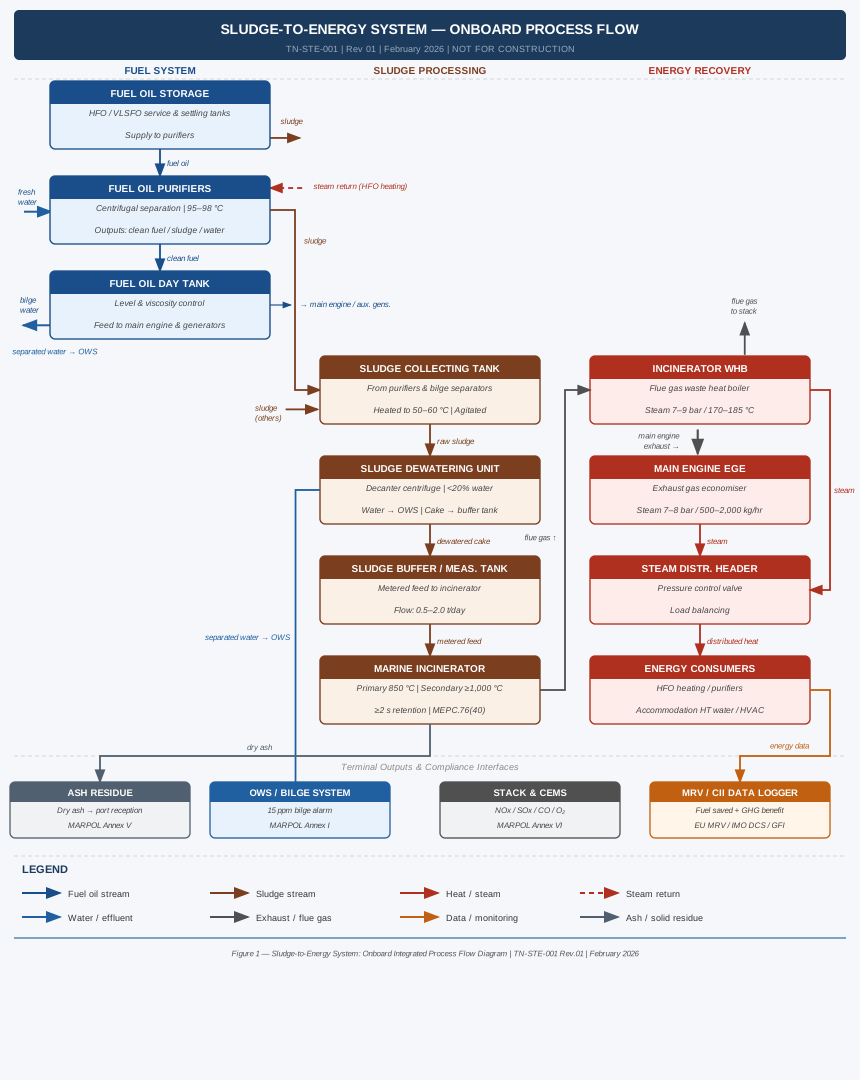
The system operates as a continuous sequential process comprising four primary stages:
a) Fuel Oil Purification and Sludge Generation
Fuel oil stored in settling and service tanks is preheated to 95–98 °C and fed to self-cleaning disc-stack centrifuges. Operating at 6,000–9,000 rpm, the purifiers separate the fuel into three distinct output streams by density: clean fuel oil to the day tank, oily separated water to the bilge holding tank, and sludge to the collecting tank.
This stage performs the following critical functions:
- Reduces catfine content (Al₂O₃ + SiO₂ abrasive particles) from up to 80 ppm in bunkered fuel to below 15 ppm, protecting injection equipment.
- Removes free and emulsified water, reducing fuel water content to below 0.3% by volume.
- Generates a sludge stream representing 0.3–1.5% of throughput volume, with 40–70% water content by mass, a net calorific value of 8–15 MJ/kg as discharged, and temperatures of 70–90 °C.
- Initiates the MARPOL Annex I record-keeping obligation: all sludge volumes must be logged in the Oil Record Book Part 1 under Code C.
b) Sludge Collection, Transfer and Mechanical Dewatering
Sludge from the purifiers, supplemented by fuel tank drains and separator residues from elsewhere in the machinery space, is accumulated in a heated collecting tank maintained at 40–60 °C. A progressive-cavity transfer pump — selected for its ability to handle viscous, abrasive, and heterogeneous fluids without cavitation — delivers the sludge to a horizontal scroll decanter centrifuge for dewatering.
The dewatering stage achieves the following:
- Reduces sludge water content from 40–75% to below 20–25% by mass through continuous centrifugal separation at 2,000–4,000 rpm.
- Raises the net calorific value of the dewatered cake to 18–28 MJ/kg, making it viable for incineration without auxiliary fuel support under steady operating conditions.
- Discharges a centrate stream (the separated water, typically 500–5,000 ppm oil content) to the bilge water holding tank for subsequent OWS treatment.
- Feeds the dewatered cake, at a discharge temperature of 50–65 °C and a paste-like consistency, to the sludge buffer and measuring tank.
c) Controlled Incineration
The sludge buffer and measuring tank provides level-controlled, agitated storage and metered delivery to the incinerator burner at a controlled flow rate of 20–100 kg/hr. The metering pump feed rate and cumulative throughput are logged as required by MARPOL Annex I, Oil Record Book Part 1, Code C.
The marine incinerator operates as a dual-chamber combustion system in compliance with IMO Resolution MEPC.76(40) (type approval standard for shipboard incinerators):
- Primary chamber: sludge is atomised through the burner nozzle and combusted at a minimum of 850 °C. Ash accumulates on the grate. Incomplete combustion products pass to the secondary chamber.
- Secondary chamber: gases are held at a minimum of 1,000 °C for at least two seconds, ensuring destruction of dioxins, furans, and other persistent organic pollutants generated during combustion of contaminated hydrocarbons.
- Combustion air is supplied by a forced-draft fan at 20–30% excess air. A pilot/support fuel burner using MGO maintains chamber temperature during startup, shutdown, and periods of low sludge feed rate.
- Ash residue (2–8% of dry sludge mass, composed of metal oxides, silicates, and inorganic incombustibles) is retained for port reception under MARPOL Annex V and recorded in the Garbage Record Book.
d) Waste Heat Recovery and Steam Distribution
Flue gas exits the incinerator at 850–1,000 °C and passes through a shell-and-tube waste heat boiler (WHB) where its thermal energy is transferred to treated boiler feedwater. The cooled gas — reduced to 250–400 °C after the WHB — is discharged through the exhaust stack and monitored by a continuous emissions monitoring system (CEMS) for compliance with MARPOL Annex VI NOx and SOx limits.
Steam generated by the WHB is delivered at 7–9 bar saturated (170–185 °C) to the vessel’s common steam distribution header, where it is combined with the output of the main engine exhaust gas economiser (EGE). From the header, steam is distributed to energy consumers including:
- Fuel oil heating (storage tanks and purifier preheaters) — closing the energy loop by partially offsetting the steam consumed to create the original sludge.
- Accommodation heating, hot water calorifiers, and HVAC systems.
- High-temperature fresh water systems and other vessel-specific heat consumers.
Operational and Environmental Advantages
The OSTS delivers quantifiable improvements across three operational dimensions:
Waste Compliance and Risk Reduction
- Eliminates dependence on port reception for routine sludge disposal, reducing port call scheduling constraints and associated costs.
- Converts a MARPOL-controlled waste stream from a liability into a recoverable asset with measurable energy value.
- Automatic Oil Record Book data capture and CEMS logging reduces the administrative burden on the Chief Engineer and the risk of record-keeping non-compliance.
- Complete ash containment and documentation satisfies flag state and port state control requirements for incinerator ash under MARPOL Annex V.
Energy Recovery and Fuel Savings
- A vessel burning 0.5 t/day of dewatered sludge at 22 MJ/kg releases approximately 127 kW of gross thermal energy on a continuous basis; practical WHB recovery is 50–70% of this, equating to 64–89 kW of useful steam output.
- Recovered steam displaces auxiliary boiler fuel consumption, directly reducing HFO or MGO burn rate and the associated CO₂ and SOx emissions reported under EU MRV and IMO DCS.
- Steam integration with the main engine EGE header maximises system utilisation and avoids the steam generation capacity loss that occurs when the EGE output alone cannot meet demand at reduced engine loads.
- The energy loop closure — in which steam from sludge combustion heats the fuel that will produce the next batch of sludge — reduces the net auxiliary boiler on-time and extends burner service intervals.
Automated Control and Monitoring
- PLC-based sequencing manages purifier desludging cycles, dewatering unit feed rate, incinerator temperature control, and WHB steam pressure within a unified control architecture.
- Interlocked safety shutdowns halt sludge feed if incinerator primary or secondary chamber temperatures fall below regulatory minimums, preventing non-compliant combustion without crew intervention.
- Temperature, flow, and pressure data are time-stamped and stored for regulatory audit, reducing reliance on manual log entries.
- Condition-based maintenance alerts — based on decanter differential speed, bowl vibration, and incinerator refractory temperature trends — allow planned maintenance to replace reactive repairs.
Compact Marine Footprint
- Skid-mounted modular assembly integrates purifier sludge outlet, collecting tank, dewatering unit, buffer tank, and incinerator WHB within the existing machinery space arrangement.
- Designed for marine environmental exposure: vibration-isolated mountings, salt-spray-rated electrical enclosures, and marine-grade stainless steel wetted components throughout.
- Gravity-drained connections between major components minimise pumping requirements and eliminate intermediate transfer pump single-point failure modes.
Design Philosophy:
The OSTS is designed around four principles:
1. Process Integrity. Every stage of the treatment chain — dewatering, incineration, and heat recovery — is instrumented and interlocked to ensure that the output of each stage meets the minimum specification required by the next. Sludge that cannot be dewatered to below 25% water content is not fed to the incinerator; the incinerator does not generate WHB steam unless primary and secondary chamber temperatures are confirmed within operating range.
2. Marine Robustness. Structural design accounts for vessel motion, seawater-atmosphere corrosion, vibration from main and auxiliary machinery, and the thermal cycling inherent in batch-mode operation. Refractory lining selection, gasket specifications, and insulation systems are rated for the thermal shock conditions of incinerator startup and shutdown.
3. Maintainability. Decanter centrifuge scroll and bowl assemblies are accessible for inspection and replacement within a planned maintenance window. WHB tube bundles incorporate soot-blowing connections. Incinerator ash removal is isolated from the combustion chamber by a lock-hopper arrangement, allowing ash clearance without a full shutdown cycle.
4. Regulatory Forward-Compatibility. The system is specified to meet current MARPOL Annex I, V, and VI requirements and IMO MEPC.76(40), with data outputs structured for EU MRV, IMO DCS, and CII rating calculations. Control system architecture allows integration of future emissions reporting protocols without hardware modification.
Strategic Role in Sustainable Shipping:
As the Carbon Intensity Indicator (CII) rating framework progressively tightens annual reduction requirements through 2030 and beyond, and as EU ETS carbon costs are applied to shipping emissions, operators face growing financial incentive to recover energy from every available onboard source. The sludge stream — a mandatory by-product of HFO and VLSFO purification that has historically been treated only as a waste management problem — represents a recoverable thermal resource that has been systematically underutilised across the global fleet.
The OSTS reframes sludge not as a compliance liability but as an input to the vessel’s energy balance. The steam it generates reduces auxiliary boiler on-time, reduces fuel consumption, and reduces the mass of CO₂ and SOx reported under mandatory emissions monitoring schemes. For vessels operating on high-sulphur HFO behind exhaust gas cleaning systems, the sludge stream is particularly significant: high-sulphur fuel generates higher sludge volumes and higher catfine loads, making both the dewatering requirement and the energy recovery potential greater than for VLSFO operations.
We can provide the following engineering services associated with the design and installation of a sludge to energy conversion system.
- Feasibility Study and Concept Design:
- Evaluation of space availability and weight considerations
- Preliminary process flow diagrams
- Conceptual layout designs
- Initial cost estimates and project timeline
- Detailed Engineering Design:
- Process engineering and equipment sizing
- Piping and Instrumentation Diagrams (P&IDs)
- 3D modeling of the equipment layout
- Electrical system design and integration
- Equipment Specification and Procurement Support:
- Development of technical specifications for major equipment
- Vendor evaluation and selection assistance
- Review of vendor documentation and drawings
- Structural Modifications Design:
- Reinforcement designs for existing structures if required
- Finite Element Analysis (FEA) for critical structural components
- Integration Engineering:
- Interface design with existing ship systems (e.g., power, water)
- Modification of existing piping systems
- Safety and Risk Engineering:
- Failure Mode and Effects Analysis (FMEA)
- Regulatory Compliance and Classification:
- Liaison with classification societies
- Preparation of documentation for class approval
- Development of procedures to meet regulatory requirements
- Installation Planning:
- Development of detailed installation procedures
- Creation of work packages for shipyard or offshore installation
- Lift plans for major equipment
- Installation sequence optimization
- Commissioning and Start-up Support:
- Development of commissioning procedures
- Supervision of installation and commissioning activities
- Performance of system tests and trials
- Troubleshooting and optimization support
- Documentation and Training:
- Preparation of operating and maintenance manuals
- Development of crew training programs
- Environmental Impact Assessment:
- Analysis of the thermal waste treatment system’s environmental benefits
- Support for environmental permit applications
- Project Management:
- Overall project scheduling and coordination
- Cost control and progress reporting
- Quality assurance and control
- Lifecycle Support:
- Development of maintenance and inspection schedules
- Optimization studies for long-term operation
- Technical support for system upgrades or modifications
- Feasibility Study and Concept Design:
By combining mechanical water removal, validated thermal destruction, and integrated waste heat recovery within a compact, automated, and fully MARPOL-compliant system, the OSTS converts a mandatory waste management obligation into a quantifiable contribution to vessel energy efficiency and emissions performance.