
The International Code of Safety for Ships Using Gases or Other Low-Flashpoint Fuels (IGF Code), as adopted by IMO under SOLAS Chapter II-1, establishes mandatory requirements for vessels operating on alternative fuels such as methanol and ammonia. A central requirement is that machinery spaces containing fuel-handling equipment — bunkering stations, fuel conditioning modules, purifier rooms — must be maintained at defined ventilation rates sufficient to prevent the accumulation of flammable or toxic atmospheres resulting from minor leaks.
Methanol (CH₃OH) presents a flammability hazard, with a Lower Explosive Limit (LEL) of 6.7% v/v and a relatively low flashpoint of 11 °C, making it a Class IIA Group T2 atmosphere under IEC 60079. Ammonia (NH₃) presents both a toxicity hazard — Immediately Dangerous to Life or Health (IDLH) at 300 ppm — and a flammability hazard (LEL 15% v/v), classified as a Group IIA T1 atmosphere. Both fuels therefore demand rigorous ventilation control as a primary layer of protection.
Most existing engine rooms, designed and built for conventional distillate diesel operation, do not possess ventilation systems capable of meeting the air change rates demanded by the IGF Code for hazardous fuel service. Rather than replacing the entire engine room HVAC system — a costly, disruptive, and shipyard-intensive project — a targeted Ventilation Upgrade Skid offers a modular, classification society-approvable solution that provides additional extraction capacity precisely at the highest-risk locations.
Rather than a full engine room ventilation system replacement, a targeted Ventilation Upgrade Skid provides additional extraction capacity precisely at the highest-risk locations — a modular, class-approvable solution that can be factory-built, pre-commissioned, and installed without a full vessel infrastructure overhaul.
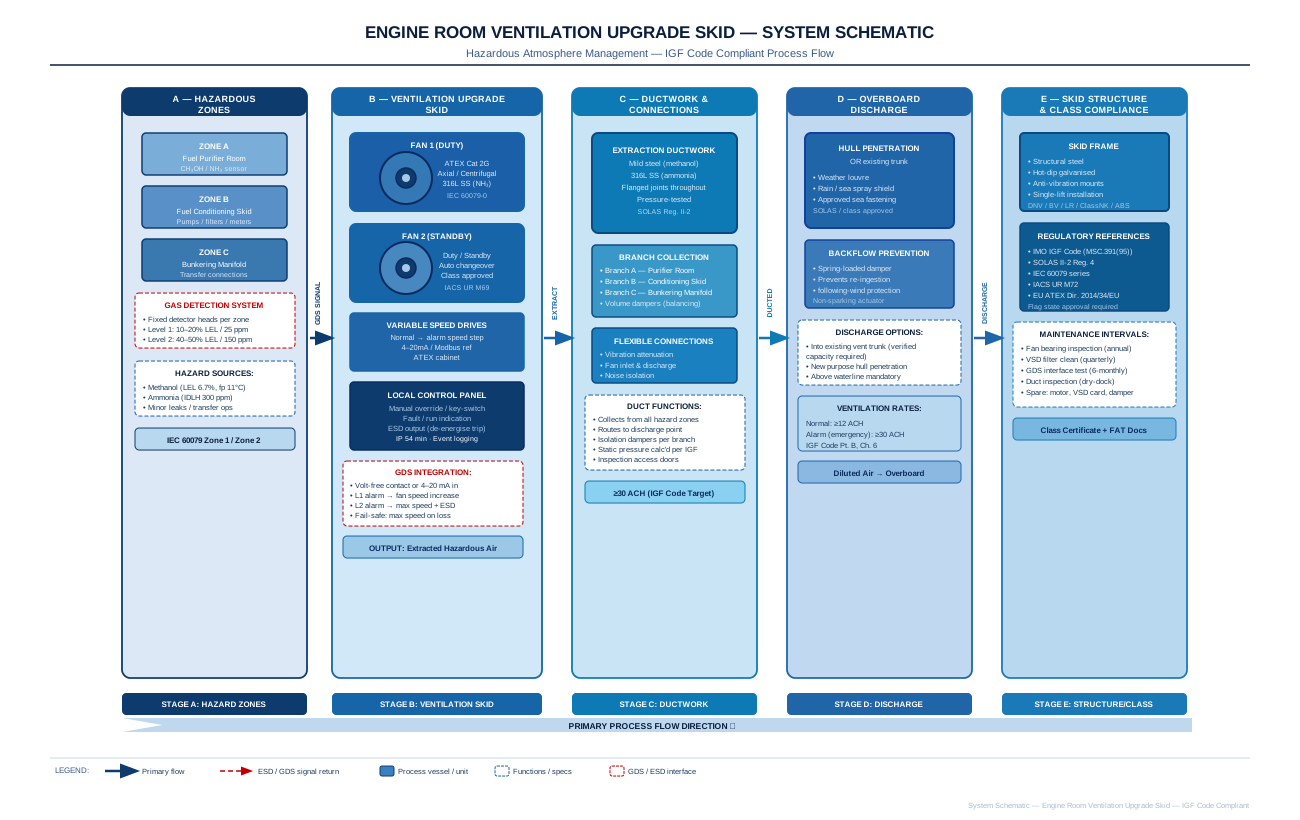
The mechanical friction–assisted ventilation upgrade process involves the following stages:
- Fuel purifier room, fuel conditioning skid location, and bunkering manifold area are designated as high-risk extraction zones.
- Zone classification performed per IEC 60079 and the vessel’s Hazardous Area Drawing.
- One or two explosion-proof (ATEX Category 2G) axial or centrifugal fans draw from the defined hazardous zones.
- For ammonia service, 316L stainless steel non-sparking construction is used throughout.
- Variable Speed Drives (VSDs) enable continuous modulation between normal operating ventilation rate and full emergency dilution speed.
- Speed ramp is triggered automatically on receipt of a gas detection alarm signal.
- The Local Control Panel receives gas detection signals (volt-free contact or 4–20 mA) from the vessel’s fixed GDS.
- Pre-programmed logic issues fan speed commands, ESD relay outputs, and alarm activations in response to Level 1 and Level 2 alarm thresholds.
- Extraction branches from each hazardous zone are collected via flanged mild steel or 316L SS ductwork.
- Discharge is to an existing overboard exhaust trunk or to a new dedicated hull penetration with weather louvre and backflow prevention damper.
- At Level 2 gas detection, the control panel issues an ESD output to close upstream fuel supply ESD valves, isolating the fuel system from the hazardous zone.
- Fail-safe design: de-energise-to-trip configuration ensures valves close on loss of power or signal.
Operational Advantages:
This modular ventilation upgrade approach represents a practical and regulatory-compliant solution for shipowners converting existing vessels to methanol or ammonia fuel, or for new builds requiring supplemental extraction above what the baseline engine room ventilation can provide. The skid integrates directly with the vessel’s existing gas detection infrastructure and requires no full HVAC replacement.
The following considerations are key to understanding this technology and its potential applications:
Key Advantages:
- No engine room HVAC system replacement required — targeted supplemental extraction only
- Automatic emergency dilution mode on GDS alarm — no manual intervention needed
- Factory-built and pre-commissioned — minimal installation time in shipyard
- Compatible with all major classification societies (DNV, BV, LR, ClassNK, ABS)
- Suitable for both methanol (ATEX) and ammonia (316L SS non-sparking) service
- IGF Code Part B (methanol) and Part C (ammonia, interim guidelines MSC-MEPC.2/Circ.19) mandate defined air change rates in fuel machinery spaces.
- Classification societies recognise packaged skid solutions as a compliant route to meeting ventilation requirements without infrastructure replacement.
- Discharged material (diluted vapour) must meet atmospheric dispersion requirements per flag state and class.
- Continuous operation — not batch-dependent; integrated with normal machinery space ventilation regime.
- Normal mode: ≥12 ACH minimum; alarm mode (GDS Level 1): intermediate step; alarm mode (Level 2): ≥30 ACH + ESD.
- Regular maintenance is required for fan bearings, VSD filters, duct seals, and functional testing of the GDS interface.
Challenges and Considerations:
- Sizing must account for the specific hazardous zone volumes and worst-case leak scenarios for the fuel in service.
- Ductwork routing through existing engine room structure may require structural surveys and penetration approvals.
- ATEX boundary integrity must be maintained at all new cable and duct penetrations into the hazardous zone.
Future Outlook:
- Growing adoption expected as the fleet transitions to methanol, ammonia, and hydrogen fuels under IMO decarbonisation targets.
- Development of IMO-standardised ventilation guidelines for each alternative fuel type is anticipated to clarify requirements further.
- Integration with smart monitoring platforms and voyage data recorders to provide continuous compliance evidence.
Strategic Role in Sustainable Shipping:
This ventilation upgrade skid approach represents a targeted, cost-effective alternative to full engine room HVAC replacement, aligning with the maritime industry’s goals of enabling alternative fuel adoption while maintaining the highest standards of crew safety and environmental protection.
We can provide the following engineering services associated with the design and installation of a ventilation upgrade skid.
- Feasibility Study and Concept Design:
- Evaluation of space availability and weight considerations
- Preliminary process flow diagrams
- Conceptual layout designs
- Initial cost estimates and project timeline
- Detailed Engineering Design:
- Process engineering and equipment sizing
- Piping and Instrumentation Diagrams (P&IDs)
- 3D modeling of the equipment layout
- Electrical system design and integration
- Equipment Specification and Procurement Support:
- Development of technical specifications for major equipment
- Vendor evaluation and selection assistance
- Review of vendor documentation and drawings
- Structural Modifications Design:
- Reinforcement designs for existing structures if required
- Finite Element Analysis (FEA) for critical structural components
- Integration Engineering:
- Interface design with existing ship systems (e.g., power, water)
- Modification of existing piping systems
- Safety and Risk Engineering:
- Failure Mode and Effects Analysis (FMEA)
- Regulatory Compliance and Classification:
- Liaison with classification societies
- Preparation of documentation for class approval
- Development of procedures to meet regulatory requirements
- Installation Planning:
- Development of detailed installation procedures
- Creation of work packages for shipyard or offshore installation
- Lift plans for major equipment
- Installation sequence optimization
- Commissioning and Start-up Support:
- Development of commissioning procedures
- Supervision of installation and commissioning activities
- Performance of system tests and trials
- Troubleshooting and optimization support
- Documentation and Training:
- Preparation of operating and maintenance manuals
- Development of crew training programs
- Environmental Impact Assessment:
- Analysis of the thermal waste treatment system’s environmental benefits
- Support for environmental permit applications
- Project Management:
- Overall project scheduling and coordination
- Cost control and progress reporting
- Quality assurance and control
- Lifecycle Support:
- Development of maintenance and inspection schedules
- Optimization studies for long-term operation
- Technical support for system upgrades or modifications
- Feasibility Study and Concept Design:
This ventilation upgrade skid for hazardous atmosphere management represents a targeted, cost-effective, and classification society-approvable approach to IGF Code compliance, enabling safe adoption of methanol and ammonia fuels within existing machinery space envelopes.