
The BWM Suite just got a significant upgrade. Alongside the three core compliance calculators — D-2, Exchange, and Cost — we’re now shipping six new engineering tools designed for the people who actually operate, specify, and certify ballast water management systems.
These aren’t compliance checkers. They won’t tell you pass or fail in isolation. What they will do is answer the harder questions that sit behind the certificate: what’s really happening in your tanks, under your specific conditions, on your specific route?
Getting started
The BWMS Suite is live at https://bwms.ingeniat.eu — no signup required.
Demo account (frontend login):
[email protected]/admin123— admin role
What’s new
- TRO Decay & Neutralisation Planner — For operators running electrochlorination or ozone systems. Enter your initial dose, salinity, temperature, and hold time, and the tool maps out exactly when your ballast will drop below the 0.1 mg/L TRO discharge limit — and how much sodium thiosulfate or bisulfite you need if it won’t. Includes a 48-hour decay curve.
- UV Dose Calculator — For UV-based BWMS operators and BWMS specifiers. This one models the actual dose your system will deliver given lamp age, UV transmittance of the water, flow rate, and reactor geometry — then checks it against the D-2 required doses for bacteria, zooplankton, and the hardier algal cysts. It also tells you the maximum flow rate your system can handle while staying compliant.
- Type-Approval Envelope Analyser — The tool that answers “but will my BWMS work in these waters?” Every type-approved BWMS is certified over a specific band of salinity, temperature, and turbidity. This analyser overlays your route’s actual water quality parameters against that certified envelope and tells you exactly where you fall outside it — which matters when flag states ask for technical justification.
- Log-Reduction Uncertainty Propagation — Built for BWMS manufacturers and technical reviewers. Two systems can both be certified at 99.9% log reduction and have wildly different statistical margins. This tool propagates the measurement uncertainty from the type-approval test report through to the discharge concentration, giving you a probability of exceedance and a classification: Robust, Marginal, or High Risk.
- Tank Residual & Sediment Compliance Check — For shipowners on bulk carriers, tankers, or any vessel with tanks that can’t be pumped completely dry. It blends the treated ballast with the unpumpable residual — which still contains organisms at source concentration — and tells you whether the mix stays within D-2 limits at discharge. It also calculates the maximum allowable residual volume for your tank geometry.
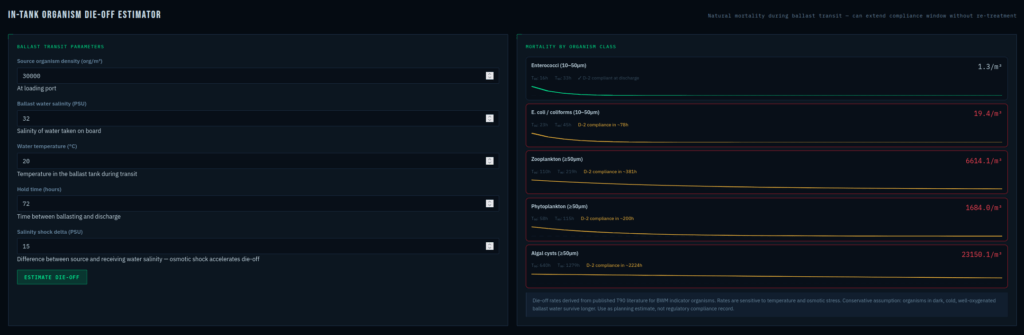
- In-Tank Die-Off Estimator — The voyage planning tool. For each organism class — Enterococci, E. coli, zooplankton, phytoplankton, algal cysts — it applies first-order decay kinetics with temperature and salinity shock modifiers to estimate how many organisms survive to discharge. Algal cysts are effectively immortal. Everything else has a half-life. Now you can model it.
A note on the die-off estimator
The die-off estimator carries a prominent disclaimer: it is a planning tool, not a compliance record. No port state control authority in the world accepts natural mortality as a substitute for type-approved treatment or exchange. The tool exists to help you understand whether a longer voyage gives you a practical safety margin, not to game the system.
All six tools are client-side — calculations run entirely in the browser. They’re available now in the TOOLS section of the BWM Suite alongside the existing D-2, Exchange, and Cost calculators.