
For shipowners, technical directors, and retrofit decision-makers evaluating the next major investment.
Vacuum-based waste collection systems can be described as “particularly advantageous in ships where minimizing water usage and maintaining high hygiene standards are critical.” That sentence is accurate — but it doesn’t tell a shipowner anything about whether the case holds for their fleet. This post breaks the case open into six concrete reasons, with a worked example to ground the water-savings argument.
Reason 1 — Water savings that compound across the fleet
The headline advantage. Vacuum toilets typically flush with 0.5–1.2 L per use, versus 4–6 L for a conventional gravity marine toilet. (Verify against your selected equipment; figures vary by manufacturer and class ruleset.) That 3–5 L delta sounds modest until you scale it across a vessel.
Worked example — a 3,000-passenger cruise ship on a 7-day voyage:
| Variable | Value |
|---|---|
| Pax + crew | ~4,200 |
| Toilet uses per person per day | ~6 |
| Days at sea | 7 |
| Total flushes per voyage | ~176,000 |
| Water saved per flush (vacuum vs. gravity) | 3 L |
| Freshwater saved per voyage | ~530 m³ |
For a ship completing 50–75 voyages a year, that is 25,000–40,000 m³ of freshwater production avoided — fuel saved in the evaporator or reverse-osmosis plant, bunker days deferred, and a measurable line item in any sustainability report.
Reason 2 — Smaller-diameter piping frees up the ship
Vacuum collection runs on DN50 (50 mm) lines, compared with DN100 (100 mm) or larger for gravity soil stacks. Roughly one-quarter of the cross-sectional area means:
- Smaller plumbing shafts, freeing area for revenue cabins or technical spaces.
- Fewer and smaller structural penetrations through watertight bulkheads and decks.
- Lighter topweight — PVC vacuum lines weigh a fraction of cast-iron soil pipe over the same run.
- Easier routing through congested compartments where a gravity fall gradient is impractical.
For a newbuild, this is design freedom. For a retrofit, it is often the difference between a feasible and an infeasible project — vacuum can reach fixtures that gravity cannot.
Reason 3 — A sealed system with no odor path
A gravity toilet depends on a water-filled P-trap to block sewer gas. On a ship, where vibrations, siphonage, and evaporation all work against that trap, odor complaints are a routine source of maintenance tickets. A vacuum system operates below atmospheric pressure; there is no positive-pressure gas path back into the cabin, and no trap to evaporate dry during lay-up. Cabin air quality complaints drop accordingly.
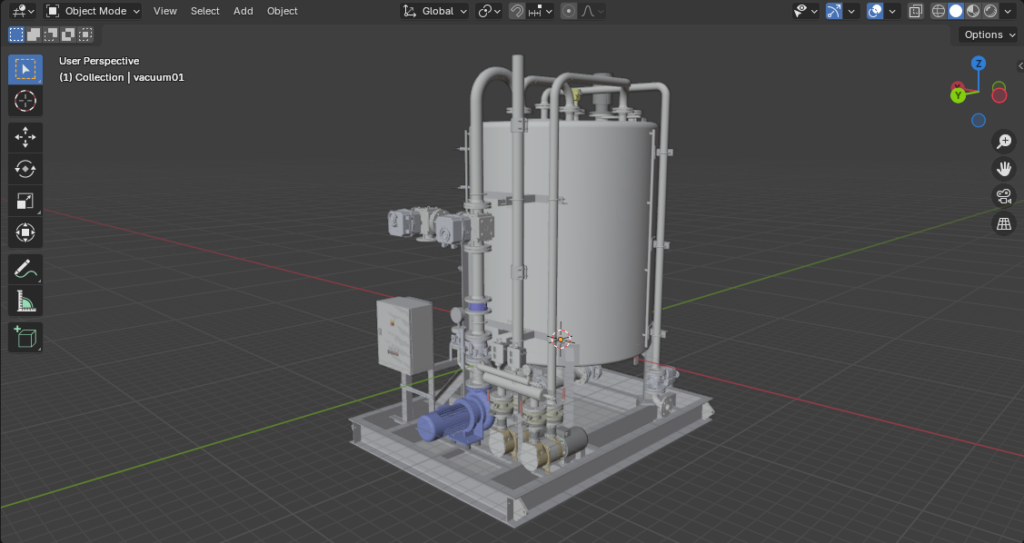
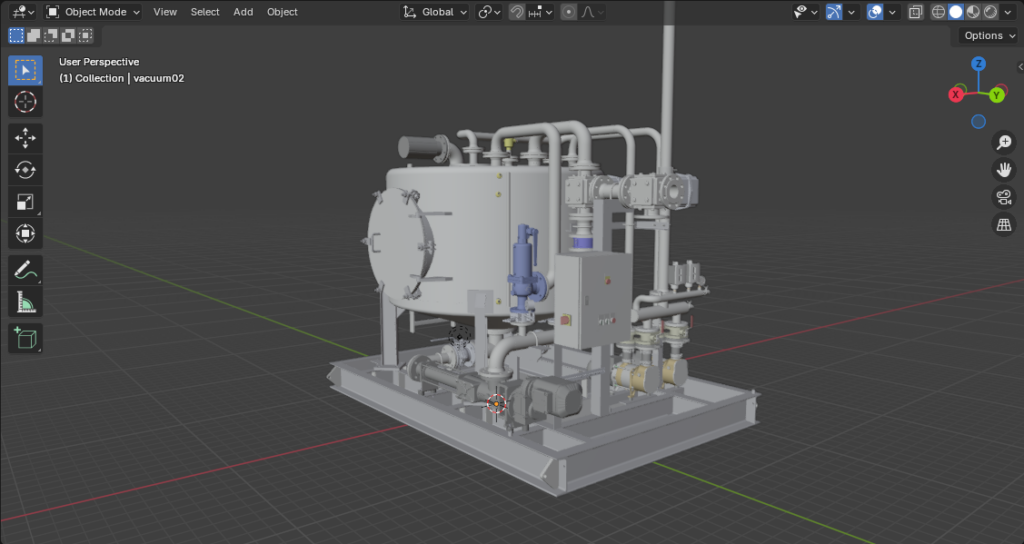
The utilization of vacuum-based waste collection systems typically provides the following advantages:
A. Water Efficiency:
- Vacuum toilets use a fraction of the water required by traditional toilets, significantly reducing the overall water consumption and wastewater generation onboard.
B. Flexible Installation:
- The vacuum system’s ability to transport waste over long distances and through complex routing paths makes it ideal for modern ship designs, where space is often constrained.
C. Improved Hygiene:
- The rapid removal of waste reduces the risk of odor and contamination, contributing to better onboard hygiene and living conditions.
D. Environmental Compliance:
- By reducing wastewater volume and improving waste management efficiency, the system helps ships comply with international environmental regulations, such as MARPOL Annex IV, which governs the discharge of sewage from ships.
E. Space Efficiency:
- Smaller pipe diameters and flexible routing allow for more efficient use of space, which is particularly valuable in the confined environment of a ship.
Reason 4 — Routing flexibility for complex vessel geometry
Vacuum lines can rise, fall, loop, and turn without losing performance. A gravity system needs a continuous fall toward the discharge, often forcing long horizontal runs to find the lowest point on each deck. On ships with split levels, mezzanines, and dispersed amenity spaces — cruise ships, expedition vessels, large ferries — vacuum’s indifference to direction lets designers put fixtures where passengers are, not where plumbing falls.
Reason 5 — Single-direction flow reduces blockage
Vacuum lines transport waste at velocities typically above 3 m/s. Combined with the absence of standing water seals, this substantially reduces the settling, paper accumulation, and grease buildups that plague gravity systems. The result is fewer blocked-fixture calls for the technical crew and fewer unscheduled maintenance windows in guest areas — directly relevant on cruise ships where a blocked toilet in a public area is a service-recovery event.
Reason 6 — Cleaner integration with MARPOL Annex IV
Vacuum collection does not change the regulatory regime — discharge rules under MARPOL Annex IV still apply — but it produces more concentrated blackwater with less flush-water dilution. That simplifies holding-tank sizing, makes Sewage Treatment Plant (STP) loading more predictable, and supports compliance in special areas (Baltic, North Sea, Antarctic, Polar) where discharge is restricted. Concentrated influent also reduces the STP’s hydraulic loading, allowing a smaller treatment plant to handle the same waste load.
When gravity still wins
Vacuum is not the right answer for every vessel. Cases where gravity collection remains the better choice:
- Small coastal vessels and workboats — fixture counts under ~20, short pipe runs, low passenger turnover. The capex premium is hard to recover.
- Strictly cost-sensitive newbuilds — fishing vessels, small general cargo, certain offshore support vessels where capex discipline dominates operational metrics.
- Vessels already optimized for gravity — a ship built around a gravity soil-and-vent system, with no operational pain, is rarely worth the retrofit.
The decision framework is roughly: fixture count × water cost × crew hours saved × installation flexibility > vacuum capex premium.
A practical first step
Before specifying, request a feasibility study that covers fixture inventory, pipe routing options, vacuum station sizing, STP integration, and class/flag review.
For shipowners: the right next step is usually a single-vessel pilot — a newbuild specification change, or a targeted retrofit on a deck with chronic plumbing issues — so the case can be validated on your own operational data before fleet rollout.
Vacuum-based waste collection systems are commonly used on a variety of ships, including cruise ships, ferries, naval vessels, and large commercial vessels. They are particularly advantageous in ships where minimizing water usage and maintaining high hygiene standards are critical, such as passenger ships and offshore platforms. Further information regarding the installation of vacuum-based waste collection systems can be found through the following link.