
Structural Design Training for Offshore Container Engineers
An introductory article for engineering teams new to—or returning to—offshore container certification.
The Problem Everyone Recognises and Nobody Talks About
You have a container to certify. You know DNV 2.7-1 exists. You know EN 12079 is relevant. You have a spreadsheet that someone’s been maintaining since 2014, and you’re not entirely sure all the load case combinations are correct. The fabricator is waiting. Procurement is asking when it’ll be done. You open the standard and realise it assumes you already know what it’s talking about.
This is not a gap in competence. It is a gap in tooling and training. DNV 2.7-1 is a well-structured standard — but it is dense, and its clauses reference each other in ways that assume a level of prior exposure that most engineers outside of dedicated container fab don’t have. The standard doesn’t teach you to use it. It tells you what to do. The gap between those two things is where projects stall, where errors survive into fabrication, and where engineers spend hours doing work that should take minutes.
We built the pieces to close that gap. This article introduces what we’ve put together — and why it works the way it does.
What We Offer: Two Components, One Workflow
The programme consists of two integrated components:
- The Handbook — a structured reference and training manual written for working engineers, not for auditors sitting exams
- The Design Tool — a browser-based calculation engine that replaces sprawling spreadsheets with a purpose-built, standards-referenced system
Used together, they take you from a set of design inputs to an audit-ready calculation report — grounded in the actual clauses of DNV 2.7-1 and EN 12079-2.
The Handbook: How Standards Work, Not Just What They Say
Most references explain what the standard requires. The Handbook explains how to actually do the work.
It covers the full scope of DNV 2.7-1 in a sequence that mirrors how an engineer actually approaches a new project:
Introduction and certification routes. Type Approval versus Unit Certification — what each one commits you to, which documents drive which costs, and how to choose. This is where most engineers waste time at the start of a project by pursuing the wrong route.
Design basis and load cases. DNV 2.7-1 defines three mandatory load cases — LC-1 Lifting, LC-2 Stacking, LC-3 Fork-lift Transport. The Handbook walks through each one: the physical situation being modelled, the load combination logic, which standard clauses govern, and which member checks each case requires. It is not a restatement of the standard. It is the applied engineering interpretation.
Structural member design. Which members need to be checked under which load cases. How deflection limits are applied (L/300 under test load, not working load). How to assess combined stresses across membrane and bending components.
Pad eyes, lifting sets, and sling calculations. Annex C of DNV 2.7-1 is one of the densest sections in the standard. The Handbook extracts exactly what a working engineer needs: pad eye geometry requirements, sling angle behaviour, reference to CB 1301/EIFA for rigging hardware selection, and how the Safe Working Load (SWL) interacts with the minimum breaking load (MBF) requirement of 4× SWL.
Materials and weld requirements. What EN 10204 3.1 and 3.2 actually mean in practice, and which documents fabricators must supply before manufacturing begins.
Manufacturing and testing. What gets verified at which stage. What a Type Test Programme must contain. How the ITP functions as a living document throughout fabrication.
Marking and data plates. IMDG requirements, DNV plate specifications, TARE and Payload fields, and what happens to existing containers when a new edition of the standard is issued.
The Handbook is written to be read before you’re under deadline pressure — but structured enough to be used as a reference during a live project.
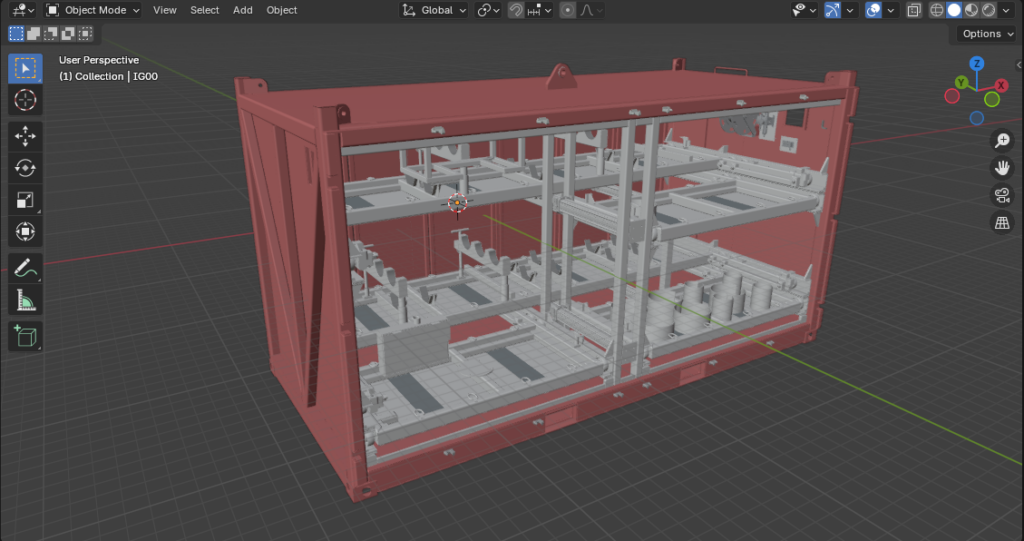
The Design Tool: Calculation You Can Actually Audit
The design tool exists because spreadsheets are not fit for purpose here. Not because they can’t do the maths — but because they cannot show their work, cannot prevent unit conversion errors, cannot flag a sling angle that violates Annex C, and cannot generate output that survives an auditor’s request to trace a result back to a specific clause.
The DNV 2.7-1 Offshore Container Design Compliance Tool is a standalone, browser-based structural design calculator for engineers involved in the certification of offshore containers under DNVGL-ST-E271 and EN 12079. It replaces error-prone spreadsheets with a purpose-built, standards-referenced calculation engine that produces audit-ready results.
What the tool does:
- Iterate rapidly on design parameters before committing to fabrication
- Perform all three load case checks (LC-1 Lifting, LC-2 Stacking, LC-3 Floor) required by DNVGL-ST-E271
- Check structural members, pad eyes, and lifting sets in accordance with EN 12079-2
- Generate a full calculation report traceable to specific standard clauses
How it works: You enter geometry, materials, and load inputs. The engine runs the applicable clause checks against your inputs. Results are presented as a structured calculation report — tabulated, clause-referenced, and exportable.
This is not a drawing tool or a CAD system. It is a calculation engine. It produces the numerical evidence that your design meets the standard — the document an auditor, a client, or a DNV reviewer can trace and verify.
Who This Is For
The programme is built for three audiences:
Engineers new to offshore container certification — who have structural or mechanical engineering backgrounds and need to understand what DNV 2.7-1 actually requires, in a usable sequence.
Experienced engineers returning to offshore work after time in other sectors — who know engineering fundamentals but need to reacquaint themselves with the specific clauses and conventions of this standard.
Engineering firms and procurement teams — who want their engineers to have a reliable reference and calculation tool without investing in expensive standalone software licences or spending weeks rebuilding institutional knowledge from scratch.
How to Use This Programme
You do not need to read the Handbook cover to cover before touching the tool. The two components are designed to be used in the sequence that matches how you actually work:
- Read the certification route section. Decide which route applies to your project.
- Use the Handbook’s load case guidance to establish your design basis and inputs.
- Enter your parameters into the Design Tool and run the three mandatory checks.
- Cross-reference the calculation output against the relevant Handbook clauses to verify your understanding.
- Use the checklist section of the Handbook to build your document package for submission.
The tool and the manual reinforce each other. That is intentional.
Moving Forward
If your organisation has ongoing container certification work, the programme gives your engineers a repeatable, auditable workflow — not another spreadsheet they hope is right.
If you are an individual engineer trying to get up to speed, it gives you a structured path in that does not require access to a colleague who already knows the answer.
The next step is to engage. Reach out to discuss training format, team access, or bespoke versions for specific container types. The content can be adapted for in-house programmes or used as standalone self-paced learning.
Certification is not complicated when the standard is explained clearly. This programme exists because it has not been explained clearly enough — until now.
Find out more, fill in your contact details below and we will come back to you as soon as possible.