
There is a particular kind of professional frustration that anyone who has worked on an offshore fabrication project will recognize. You are a qualified engineer — welding inspector, procurement lead, project quality manager — and you are spending the better part of your afternoon reformatting a certificate that arrived as a scanned PDF into a register that should have been updated yesterday, cross-referencing a heat number against a purchase order you have already checked twice, and drafting a non-conformance report for a deviation you identified six hours ago but haven’t had time to write up properly.
The inspection itself took twenty minutes. The paperwork will take two hours.
This is not an efficiency problem unique to a single project or company. It is structural. Maritime and offshore projects are, by design, documentation-intensive. Classification societies require it. Client quality systems require it. Regulatory frameworks require it. The documentation is not bureaucratic overhead that could be streamlined away — it is the evidence record that proves the physical asset was built correctly. You cannot eliminate it. But you can stop doing it manually.
The Document Burden Is Not Random — It Follows Predictable Patterns
What makes maritime project workflows particularly well-suited to AI automation is that the documentation burden is not random. It concentrates in a small number of recurring, structured workflows that happen on virtually every project:
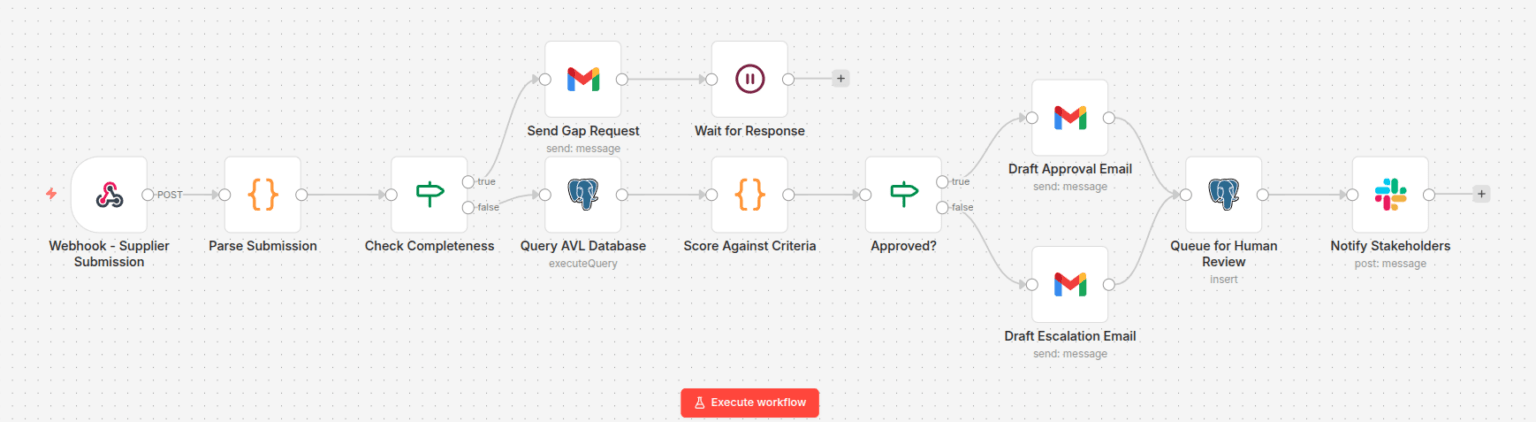
- A new supplier needs to be qualified. Their submission arrives — a capability pack, some certificates, a completed PQQ — and someone has to read it, check it against the AVL criteria, verify the cert expiry dates, score the response, and either approve or request missing information. It is the same process for the fifth vendor as it was for the first.
- A delivery of structural plate arrives at the fabrication yard. The material test reports need to be read, the heat numbers checked against the order, the mechanical and chemical properties verified against the specification, and the results logged in the OQE register. If there’s a deviation, a non-conformance needs to be raised. Every delivery, every time.
- A weld is completed. The joint needs to be inspected, the result recorded against the weld register, the welder qualification verified as applicable to the procedure and position, and the NDT request issued if required. Hundreds of times across a single project.
- A Factory Acceptance Test is coming up. A test procedure needs to be prepared, witnesses notified with the correct advance notice, results recorded during the test against the acceptance criteria, punch list items captured, and the whole thing compiled into a signed FAT dossier afterwards.
And at the end of it all, someone has to build the handover package — the final documentation dossier that proves all of the above actually happened in accordance with the requirements. These are not complex judgement calls. They are structured, rule-governed information processing tasks that happen to be executed by people because, until recently, there was no practical alternative.
What an Agent Actually Does — and What It Doesn’t
It is worth being precise about what an AI agent is in this context, because the term carries a lot of noise.
An agent is not a chatbot you ask questions. It is a system that monitors for a trigger — a file uploaded, a form submitted, a deadline passed — and then executes a defined sequence of actions: reading the input, extracting the relevant data, checking it against known requirements, generating a structured output, and routing that output to the right place. It can use tools: it can read documents, query registers, send notifications, update databases, and draft communications.
What it does not do is make engineering judgements. It does not decide whether a deviation is acceptable. It does not approve a non-conformance. It does not release equipment for shipment. Every critical decision point is a human gate — the agent prepares the information, presents it clearly, and waits for the engineer or QA manager to act. The human workload shifts from data processing to decision-making, which is what the role is supposed to involve.
This distinction matters for maritime applications in particular. Classification society requirements, contractual hold points, and safety-critical sign-off procedures all depend on qualified humans taking responsibility for specific decisions. An agent does not threaten that — it makes it more reliable, because the information presented at each decision gate is complete, verified, and consistently formatted, rather than assembled under time pressure by someone who has been doing data entry for three hours.
The Five Workflows Where the Gains Are Largest
Based on where documentation hours actually accumulate across offshore fabrication and procurement projects, five workflows account for the majority of the recoverable time:
- Supplier qualification and onboarding. A typical offshore project qualifies between 40 and 120 vendors. At three to five hours of QA and procurement time per vendor for intake, review, and correspondence, that is 120 to 600 hours on a workflow that is almost entirely rule-based. An agent handles the intake, completeness check, scoring, gap requests, and register update. The engineer reviews the output and approves or escalates.
- Material certification and OQE traceability. Reading, extracting, matching, and logging material test reports is the single most time-consuming routine task in project quality management. On a large structural fabrication scope, there may be hundreds of material line items, each requiring certificate verification. An agent processes each certificate on arrival, flags deviations immediately, and maintains the heat number register continuously — so the OQE dossier is built throughout the project, not compiled in the final week.
- Production and welding inspection records. Site QA teams generate large volumes of inspection records daily. The administrative burden of processing those records — posting results to the weld register, verifying welder qualifications, issuing NDT requests, tracking rejection rates — can consume half an inspector’s working day. An agent absorbs that burden, leaving the inspector to inspect.
- FAT coordination and documentation. Factory acceptance tests are high-stakes events with significant coordination overhead. Procedure preparation, witness notifications, real-time result recording, punch list management, and dossier compilation are all structured workflows that an agent can execute reliably, freeing the supervising engineer to focus on the test itself.
- Final documentation and handover. The handover dossier problem is almost universal in offshore projects: it is compiled under pressure at close-out because no one systematically maintained the document register throughout execution. An agent running from project mobilization — monitoring document receipt, filing accepted records to the correct dossier section, maintaining a live completeness index — means the handover package is effectively built in real time. There is no final-week scramble because there is nothing left to compile.
The Practical Reality of Deployment
One of the barriers to adoption in engineering-led industries is the assumption that deploying an AI system requires a significant IT infrastructure project. In practice, the opposite is true for agent-based tools.
Each agent is configured to the client’s existing procedures and document formats — it does not require a new quality management system or a change to established workflows. It connects to the tools already in use: email, shared drives, Telegram or Slack, existing Excel-based registers.
Deployment takes days, not months. The cost of a first agent — custom-configured, knowledge-base loaded, and integrated with one communication channel — is in the range of a few days of professional engineering time.
The relevant comparison is not the cost of the agent against the cost of doing nothing. It is the cost of the agent against the cost of the engineering and QA hours currently being consumed by the workflow it replaces — hours that, on a day-rate project, carry a direct charge to the project budget.
What This Means for the Industry
Maritime and offshore is not an early adopter of new technology. There are good reasons for that — the consequences of failure are severe, regulatory frameworks are demanding, and the industry has learned to be sceptical of tools that promise transformation but require wholesale change to embed.
AI agents of the kind described here do not require wholesale change. They operate within existing workflows, on existing documents, against existing standards. They do not replace the engineer or the inspector or the quality manager — they remove the administrative burden that currently prevents those professionals from doing their jobs properly.
The projects that will move first are those where project management has done the honest calculation: how many engineering and QA hours per month are being consumed by OQE logging, certificate chasing, NCR formatting, and register maintenance? What is the day-rate cost of those hours? What would it take to redirect that capacity to the work that actually requires a qualified person to do it?
The answer, in most cases, is one week and one agent.
Ingeniat provides engineering, project management, and digitalization services to the maritime and offshore industry. Our AI agent practice configures and deploys custom agents for maritime and offshore project workflows, typically operational within seven days. For a scoping conversation, contact us or download our informational brochure.