
The Recent MARPOL Annex V Amendments: A Regulatory Transformation for Small Vessels
Recent amendments adopted by the International Maritime Organization under MARPOL Annex V have reshaped the compliance landscape for commercial vessels of 100 gross tonnes and above. Adopted through IMO Resolution MEPC.360(79) and entering into force on 1 May 2024, these amendments lowered the Garbage Record Book threshold from 400 GT to 100 GT, bringing a significantly larger cohort of smaller vessels within structured regulatory oversight. The 100 to 399 GT segment represents the newly captured population — vessels that carried no such documentation obligation prior to the amendment.
This regulatory expansion has brought thousands of smaller commercial vessels into scope: fishing vessels operating under coastal fishing licences, coastal freighters serving regional trade routes, offshore support craft engaged in wind farm installation and maintenance, workboats and tugs providing port and terminal services, and small commercial operators transporting cargo across short-sea shipping routes. These vessels share a common characteristic — they were designed and crewed for operational efficiency rather than regulatory compliance infrastructure.
The consequences of inadequate MARPOL Annex V documentation have become increasingly tangible. Paris MOU, Tokyo MOU, and United States Coast Guard Port State Control data regularly identify garbage documentation deficiencies among frequently cited violation categories. The outcomes extend beyond administrative inconvenience: vessels face inspection delays, detention notices, financial penalties, and reputational damage that affects charter eligibility and insurance premiums.
The Digital Garbage Record Book has been developed specifically to address this compliance gap. It provides structured MARPOL Annex V documentation for vessels in the 100 to 399 GT segment without imposing administrative burdens incompatible with lean crewing arrangements and intermittent connectivity patterns.
Understanding the Compliance Gap: Why Traditional Documentation Falls Short
Paper-based Garbage Record Books served adequately in an earlier regulatory environment. Recent amendments and heightened inspection scrutiny have introduced documentation expectations that exceed the practical reliability of manual record systems.
Documentation Accuracy and Verification
Manual entry introduces preventable errors that accumulate into compliance risk. Officers may record incorrect garbage category codes, approximate positions without GPS verification, produce handwriting that becomes illegible over time, or omit required signatures. Port State Control officers reviewing paper records during inspections frequently identify these deficiencies, which accumulate into documented compliance gaps that follow vessels across trading patterns.
Audit Trail Integrity
Paper documentation provides limited evidentiary strength. Signatures may be challenged as authentic. Alterations or corrections cannot be independently verified. There exists no cryptographic timestamp assurance to support chronological integrity during dispute resolution or legal proceedings. The burden of proving compliance falls entirely on the vessel’s documentation, which may lack corroborating verification mechanisms.
Shore-Side Visibility Limitations
Fleet managers, Designated Persons Ashore, and compliance officers receive no operational visibility into documentation patterns until physical inspections occur. Compliance gaps are discovered reactively — often at the point of inspection when correction is no longer possible. This reactive posture transforms compliance from a manageable operational function into a recurring inspection risk.
Physical Document Vulnerabilities
Paper records remain vulnerable to loss, damage, and destruction. Water intrusion, fire, and misplacement during crew changes or vessel sales create documentation gaps that cannot be retrospectively reconstructed. MARPOL Annex V requires Garbage Record Books to be retained onboard for a minimum of two years following the last entry, a requirement that becomes impossible to satisfy when foundational documents have been compromised.
Zonal Regulatory Context
Paper Garbage Record Books provide no contextual guidance regarding discharge restrictions that vary across regulatory zones. MARPOL Annex V establishes different requirements inside Special Areas, Polar Waters, and coastal state jurisdictions. Without integrated reference data, officers must memorise regulatory distinctions that affect every discharge decision.
—
Digital Garbage Record Book: Purpose-Built for the 100–399 GT Segment
The Digital Garbage Record Book is engineered specifically for vessels operating between 100 and 399 gross tonnes. It is not an adapted enterprise maritime ERP module, nor is it a scaled-down compliance add-on developed for larger fleets and retrospectively positioned for the small-vessel market. The system has been designed around the operational reality characteristic of this segment:
- Lean crews with limited administrative capacity
- Intermittent or absent internet connectivity
- Limited onboard IT infrastructure
- Multi-language officer teams
- High operational tempo with multiple daily tasks
The design objective is straightforward: deliver structured MARPOL Annex V compliance documentation without increasing crew workload beyond existing operational demands.
Guided Entry Workflow: Compliance Built Into the Recording Process
The Digital Garbage Record Book replaces manual free-text entries with a structured digital workflow that enforces MARPOL requirements at the point of data capture. Each garbage disposal event follows a sequential completion sequence:
- Garbage Category Selection — Officers select from a visual, plain-language interface presenting all MARPOL Annex V categories.
- Volume Estimation — The system provides assistive volume estimation based on standard container sizes.
- Disposal Method Confirmation — Officers confirm the selected disposal method, with the system cross-referencing against zonal restrictions that may prohibit specific discharge approaches.
- Automatic Position Capture — GPS coordinates are captured automatically from the device. Manual position entry remains available with audit trail documentation.
- Officer Authentication — Digital sign-off is completed through biometric authentication or secure PIN entry.
- Invalid or incomplete entries are blocked before they become compliance risks. The workflow enforces MARPOL Annex V logic so that individual officers need not memorise regulatory distinctions affecting discharge permissions.
Automatic Position Capture and Geofencing Integration
Every garbage disposal entry captures precise positional data:
- Coordinated Universal Time timestamp
- Latitude and longitude derived from device GPS
- Optional manual position entry with mandatory justification and audit record
The system implements geofencing functionality that maps MARPOL Annex V Special Areas, Polar Waters, and coastal state jurisdiction limits against vessel position. When an officer initiates a garbage entry, the system cross-references the selected discharge type against applicable zonal restrictions and provides real-time guidance regarding compliance requirements.
Position accuracy becomes defensible documentation rather than estimated approximation. This capability addresses a persistent source of PSC deficiencies: position recording errors associated with garbage documentation findings.
Digital Signature and Tamper-Evident Architecture
Each entry becomes immutable upon officer authentication through a multi-layer security architecture:
- Authentication Layer — Biometric identification or secure PIN entry establishes officer identity.
- Hash Verification — SHA-256 cryptographic hashing creates a mathematical fingerprint for each completed entry.
- Timestamp Assurance — Immutable timestamps provide verifiable chronological ordering compared to handwritten entries.
Once signed, records cannot be altered without creating a traceable audit event. This architecture provides enhanced evidentiary integrity compared to traditional handwritten documentation and aligns with modern digital recordkeeping expectations.
Offline-First Architecture: Compliance Without Connectivity Dependency
Connectivity constraints are endemic to the sub-400 GT segment.
The Digital Garbage Record Book has been engineered to function fully without internet connectivity:
- All entry functionality operates locally
- A synchronization engine queues completed records
- Automatic synchronization occurs upon connectivity restoration
- Conflict-resolution architecture handles concurrent modifications
Compliance documentation does not depend on bandwidth availability.
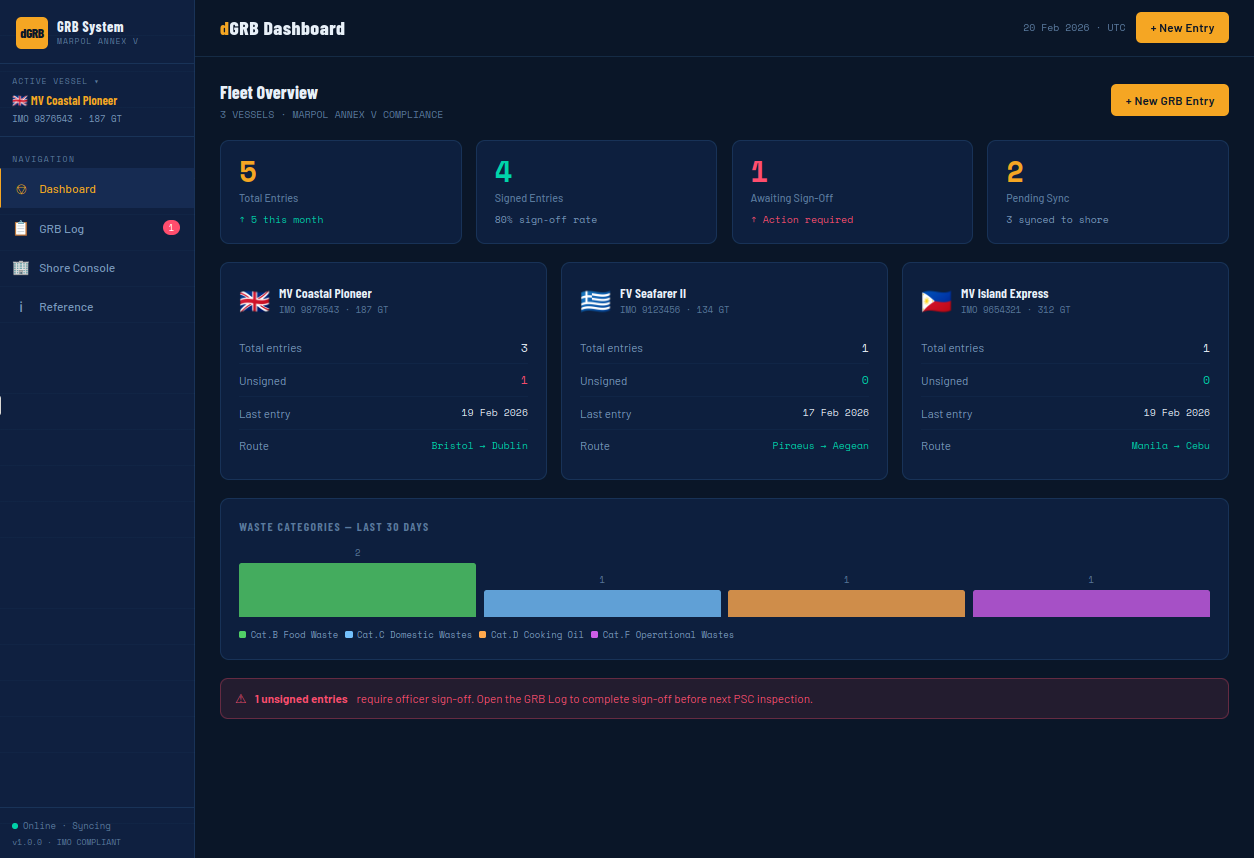
Shore-Side Fleet Compliance Dashboard: Real-Time Operational Visibility
For fleet managers, Designated Persons Ashore, and compliance officers, the Digital Garbage Record Book provides centralised oversight across all vessels in the fleet:
- Live Vessel Dashboard — Active vessels display with recent garbage entry activity.
- Automated Alert System — Configurable alerts notify shore-side personnel of overdue entries or unusual disposal frequency.
- Cross-Vessel Reporting — Aggregate reporting enables identification of anomalies across fleet patterns.
- Pattern-Based Anomaly Detection — The system identifies entries or patterns that deviate from established fleet baselines, surfacing potential documentation issues before inspections occur.
This capability transforms compliance from a reactive documentation exercise into a proactive management function.
Port State Control Inspection Mode
When a Port State Control officer boards for inspection, the Digital Garbage Record Book provides streamlined access to documentation:
- On-Device Viewing — All entries are accessible directly on the officer’s device.
- Structured Export — PDF export functionality generates documentation in IMO-aligned layout formats.
- Signature Verification — Digital signatures include cryptographic verification confirming entry integrity.
- Chronological Presentation — Entries are presented in time-ordered sequence.
Inspection becomes a structured procedural review rather than a documentation dispute.
Secure Cloud Retention: Eliminating Physical Storage Risk
All synchronized records are retained within encrypted cloud infrastructure:
- End-to-end encryption protects data in transit and at rest
- Role-based access control limits visibility to authorised personnel
- Two-year onboard retention requirement under MARPOL Annex V is satisfied, with extended seven-year cloud archival available for fleet compliance and evidentiary purposes
- GDPR-compliant data handling addresses privacy regulatory requirements
Physical storage risks are eliminated.
Strategic Positioning
The MARPOL Annex V amendments have created a structural compliance challenge in the 100 to 399 gross tonne segment. Thousands of vessels now face documentation requirements that demand structured recordkeeping without necessarily having dedicated compliance departments.
The Digital Garbage Record Book addresses this requirement while respecting the operational constraints that define small-vessel commercial shipping.
—
Request a Demonstration
A guided entry can be completed in under two minutes.
See the workflow from an officer’s perspective.
Review the dashboard from a DPA standpoint.
Evaluate the inspection presentation mode.
**Schedule a technical demonstration today.**