
Here’s the condensed, elaborated service-focused version:
FuelEU Maritime Compliance & Advisory Services
FuelEU Maritime (Regulation (EU) 2023/1805), in force from 1 January 2025, represents a structural shift in how the European Union regulates maritime decarbonisation. Where previous frameworks such as CII and EEXI focus on carbon intensity metrics and design efficiency, FuelEU Maritime imposes binding limits on the absolute greenhouse gas intensity of energy used onboard applicable ships — measured on a well-to-wake basis that captures emissions across the entire fuel lifecycle, from production and transportation through to combustion. This well-to-wake methodology fundamentally changes the compliance calculus, because the regulatory burden is no longer determined solely by what fuel is burned onboard, but by how that fuel was produced and supplied.
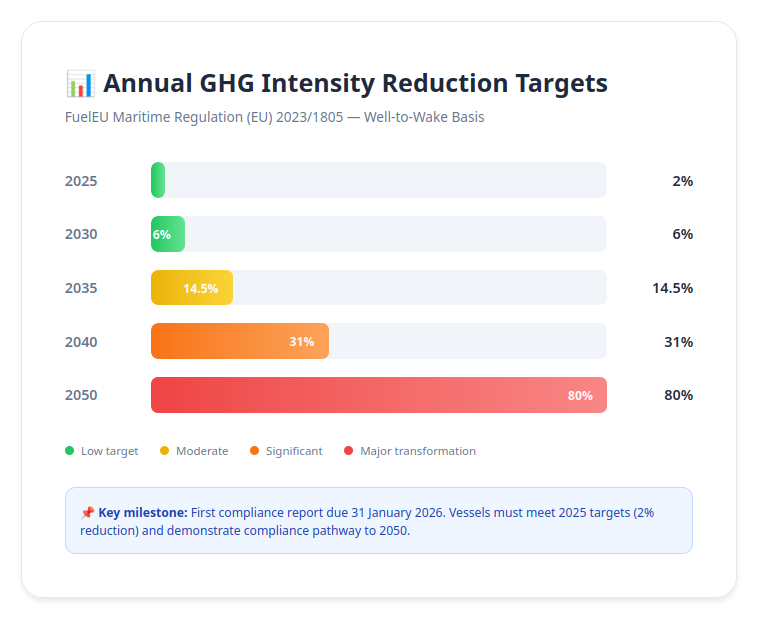
The regulation requires progressive reductions in GHG intensity from 2% below the 2020 baseline in 2025, stepping up incrementally to 80% by 2050. First compliance reports are due 31 January 2026, meaning exposure assessment and compliance planning cannot be deferred.
What Our Services Cover
FuelEU Maritime applies to all commercial ships of 5,000 GT and above calling at EU and EEA ports, regardless of flag state. Geographic coverage mirrors the EU MRV framework: 100% of energy used on intra-EEA voyages and during port calls, and 50% of energy used on voyages arriving from or departing to non-EEA ports. This partial geographic coverage, combined with a well-to-wake measurement methodology, creates a compliance environment of considerably greater complexity than conventional fuel-based regulations.
Our services begin with a detailed energy use baseline, segmenting fleet consumption data by voyage type and port call to determine FuelEU-applicable energy volumes. This baseline is then assessed against the applicable GHG intensity threshold for each compliance year, producing a quantified compliance gap expressed in grams of CO₂ equivalent per megajoule of energy used. Unlike EU ETS, which monetises total emissions, FuelEU Maritime penalises intensity — meaning that fuel selection, fuel sourcing pathway, and energy efficiency all interact in determining compliance status.
Fuel pathway analysis is a central element of our services. The well-to-wake methodology means that two vessels burning identical fuels onboard may face different compliance outcomes depending on the verified upstream emissions intensity of their fuel supply chains. LNG, for instance, carries methane slip penalties under well-to-wake accounting that may significantly erode its apparent emissions benefit relative to conventional marine fuels. Biofuels, green methanol, and ammonia each carry distinct well-to-wake profiles that must be verified against the regulation’s lifecycle assessment criteria. Our services include detailed fuel pathway evaluation, helping owners and operators identify fuel strategies that deliver genuine, verifiable GHG intensity reductions rather than nominal compliance.
The regulation also introduces flexibility mechanisms that our services are structured to navigate. Vessels that outperform their annual GHG intensity target generate a compliance surplus that can be banked for future years or pooled with other vessels under the same or different companies. Vessels that fall short of their target face a financial penalty, but may also draw on banked surpluses or pool compliance with better-performing vessels to avoid direct penalty exposure. Our services include surplus and deficit modelling across fleet portfolios, identification of pooling opportunities, and evaluation of the financial trade-offs between fuel switching, efficiency investment, and penalty acceptance under different carbon price and fuel cost scenarios.
Interaction with Other Regulatory Frameworks
FuelEU Maritime does not operate in isolation. In European waters, it overlaps directly with EU ETS carbon pricing, CII operational rating obligations, and ECA sulphur and NOx requirements. The interaction between FuelEU and EU ETS is particularly complex: a fuel switch that reduces well-to-wake GHG intensity and improves FuelEU compliance may have a different — and sometimes limited — impact on EU ETS liability, which is based on combustion emissions rather than lifecycle intensity. Similarly, alternative fuels that improve FuelEU performance may introduce new EU ETS exposure through methane or nitrous oxide emissions from 2026. Our services assess fuel and operational decisions across all applicable regulatory frameworks simultaneously, ensuring that compliance gains in one regime are not offset by unmanaged exposures in another.
Outputs and Deliverables
- FuelEU-applicable energy baseline and voyage segmentation analysis
- Annual GHG intensity gap assessment against current and future regulatory thresholds
- Well-to-wake fuel pathway evaluation across conventional and alternative fuel options
- Compliance surplus and deficit modelling at vessel and fleet portfolio level
- Pooling strategy assessment and cross-company pooling opportunity identification
- Financial scenario modelling comparing fuel switching, efficiency retrofit, and penalty cost outcomes
- Cross-regulatory interaction analysis covering EU ETS, CII, EEXI, and ECA obligations
- Compliance documentation support ahead of the 31 January 2026 reporting deadline
Annual GHG intensity reduction targets:
(*) Note: tabular percentages reflect secondary/industry guidance rather than the current codified regulation text.
Actions Required by Affected Parties: Ship owners, operators, and managers must:
A. Submit Monitoring Plans
- Develop comprehensive monitoring plans describing fuel data collection methodology
- Get plans approved by EU-accredited verifiers
- Within 2 months of first EU port call
B. Collect and Report Fuel Data
- Record fuel consumption for every voyage (amount, type, LCV)
- Calculate Well-to-Wake emissions (CO2, CH4, N2O)
- Track electricity consumption from Onshore Power Supply
C. Submit annual FuelEU Report by 31 January each year
- Ensure Verification
- Engage EU-accredited verifiers for compliance verification
- Complete verification by 31 March annually
- Address any audit queries promptly
D. Manage Compliance
- Calculate compliance balance (actual vs. required GHG intensity)
- Utilize flexibility mechanisms (banking, borrowing, pooling)
- Pay penalties by 30 June if non-compliant
- Obtain Document of Compliance before entering EEA ports
E. Critical Consequences up to
- No Document of Compliance = no EEA port access
- Repeat non-compliance may result in port access bans
Strategic Value
FuelEU Maritime accelerates the commercial pressure on fuel transition decisions that many owners had anticipated as a longer-term consideration. The well-to-wake methodology, combined with progressively tightening intensity thresholds and the regulation’s interaction with EU ETS carbon pricing, means that fuel strategy is now simultaneously a compliance matter, a financial risk management matter, and a capital allocation matter. Vessels trading predominantly in EEA waters with high conventional fuel dependency face structurally increasing compliance costs as intensity thresholds tighten through the 2030s. Our services ensure that FuelEU Maritime obligations are addressed through a coherent, forward-looking fuel and operational strategy — not managed reactively as each annual compliance deadline approaches.
What we do: We provide end-to-end FuelEU compliance services for ship owners, operators, and managers:
A. Monitoring Plan Development
- Comprehensive fuel monitoring methodology design
- EU-compliant template preparation
- Verifier coordination and approval support
B. Data Collection & Management
- Voyage-level fuel consumption tracking systems
- Emissions calculation and reporting
- Data quality assurance and audit trail
C. Compliance Calculations
- GHG intensity calculations (Well-to-Wake methodology)
- Compliance balance determination
- Penalty estimation and scenario analysis
D. Reporting Services
- Annual FuelEU Report preparation
- Verification liaison and document submission
- Compliance certificate management
E. Ongoing Compliance Support
- Quarterly compliance health checks
- Regulatory updates and deadline reminders
- Support for auditor queries