Engineering and Project Management
 

ECA Zone Compliance Advisory Services

Emission Control Areas, commonly referred to as ECAs, are geographically defined maritime zones established under the international legal framework of MARPOL Annex VI, administered by the International Maritime Organization. They represent a targeted regulatory mechanism designed to reduce air pollution from ships in regions where emissions from maritime traffic have been shown to significantly affect coastal air quality, public health, and environmentally sensitive ecosystems.

At their core, ECAs are not global standards but geographically intensified regulatory regimes. While all ships worldwide must comply with baseline air emission standards under MARPOL Annex VI, ECAs impose stricter limits within specifically designated waters. These areas are created only after detailed scientific and environmental impact assessments are submitted by member states and approved through the IMO’s Marine Environment Protection Committee. Their establishment therefore reflects both environmental necessity and political consensus among affected coastal states.

The primary pollutants regulated within ECAs are sulphur oxides (SOx) and nitrogen oxides (NOx), though particulate matter emissions are indirectly reduced as a consequence of sulphur control. The regulatory treatment of these pollutants differs significantly, and understanding that distinction is essential.

Sulphur ECAs, often called SECAs, operate through a fuel-based compliance standard. Within these zones, ships must use fuel oil with a sulphur content not exceeding 0.10 percent by mass. Outside these areas, the global sulphur cap, which has been in force since 1 January 2020, permits fuel with up to 0.50 percent sulphur content. The key characteristic of a SOx ECA is that compliance is triggered by geographic entry. Once a vessel crosses the defined boundary coordinates of the zone, it must already be operating on compliant fuel or an approved equivalent method such as an exhaust gas cleaning system, commonly known as a scrubber. There is no distinction based on vessel age or build date; the sulphur requirement applies universally to all ships operating within the zone.

The particularity of SOx ECAs lies in the operational mechanics of compliance. Ships must implement documented fuel changeover procedures prior to entering the area, maintain accurate bunker delivery notes, record changeover times and tank volumes, and be prepared for port state control inspections that may include onboard fuel sampling. In certain jurisdictions, particularly in the United States, enforcement has historically been stringent and may involve significant financial penalties or even criminal liability for deliberate non-compliance. Furthermore, while scrubbers are permitted under MARPOL as an alternative compliance mechanism, some coastal states restrict or prohibit the discharge of open-loop scrubber wash water within their territorial waters or ports. This creates an additional layer of operational complexity beyond the text of the international convention itself.

Nitrogen oxide ECAs function differently. Rather than regulating fuel sulphur content, NOx ECAs regulate engine design and emission performance. The applicable standard is known as Tier III under MARPOL Annex VI. However, Tier III does not apply universally to all ships within the zone. It applies only to marine diesel engines installed on vessels constructed on or after the specific entry-into-force date of that ECA’s NOx designation. For example, in the North American and US Caribbean ECAs, Tier III standards apply to ships constructed on or after 1 January 2016. In the Baltic Sea and North Sea, the requirement applies to ships constructed on or after 1 January 2021. Older ships remain subject to Tier I or Tier II standards and are not retroactively required to upgrade to Tier III solely due to geographic operation.

The technical implication of a NOx ECA is therefore capital-intensive at the newbuild stage rather than operationally triggered at the time of entry. Compliance generally requires the installation of Selective Catalytic Reduction systems, Exhaust Gas Recirculation systems, or equivalent engine technologies capable of meeting the Tier III emission limit. Once installed and certified, compliance is embedded in the ship’s engine configuration and documented in the NOx Technical File. Operational adjustments alone cannot typically achieve Tier III compliance without hardware.

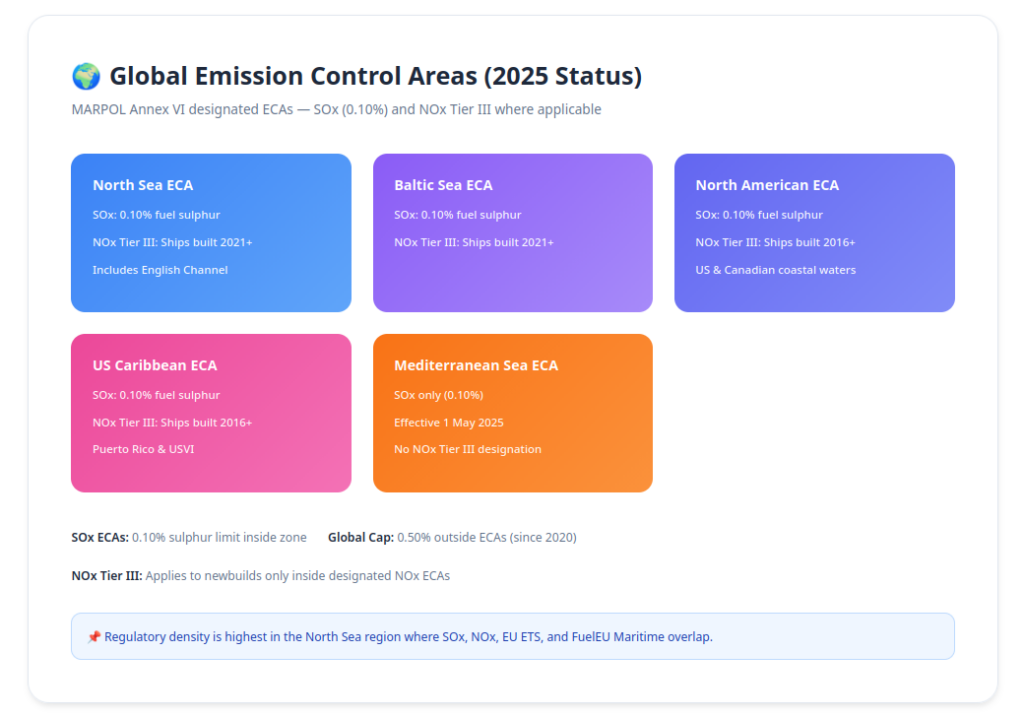
As of 2025, five areas are designated as SOx ECAs: the Baltic Sea, the North Sea including the English Channel, the North American ECA covering most United States and Canadian coastal waters, the US Caribbean ECA covering Puerto Rico and the US Virgin Islands, and the Mediterranean Sea, which becomes effective as a SOx ECA on 1 May 2025. Of these, four areas are also designated as NOx ECAs: the North American, US Caribbean, Baltic Sea, and North Sea regions. The Mediterranean is designated solely for sulphur control and does not currently impose Tier III NOx requirements.

Geographically, ECA boundaries are defined by precise coordinate lists rather than by simple coastal descriptions. In some cases, such as the North American ECA, the zone extends up to 200 nautical miles from the coastline, significantly expanding the area of regulatory exposure. In basin-specific regions such as the Baltic Sea, the boundaries follow the natural contours of the enclosed sea. Entry into these zones automatically activates compliance obligations, making voyage planning and fuel management critical components of operational control.

Another particularity of ECAs is their interaction with other regulatory regimes. While ECAs themselves are command-and-control measures focused on specific air pollutants, they increasingly overlap geographically with carbon-related regulations such as the EU Emissions Trading System and FuelEU Maritime within European waters. In high-density regulatory areas such as the North Sea, a vessel may simultaneously face sulphur limits, Tier III NOx requirements for eligible ships, EU carbon pricing obligations, and fuel greenhouse gas intensity targets. This layered regulatory environment elevates compliance from a purely technical matter to a strategic commercial consideration.

It is important to clarify what ECAs are not. They are not carbon pricing systems, they do not establish efficiency ratings like CII, and they do not create tradable allowances. They are geographically bounded environmental protection mechanisms designed to reduce specific air pollutants with immediate local health and ecological impacts. Their enforcement is direct and tangible, typically through inspection, documentation review, and sampling rather than through market mechanisms.

Strategically, ECAs affect fuel procurement strategy, retrofit decisions, charterparty cost allocation, and asset valuation. A vessel trading predominantly within ECA waters experiences structurally different operating economics compared to a vessel trading globally outside such zones. The expansion of ECA coverage, particularly with the inclusion of the Mediterranean Sea, signals a continued regulatory tightening trend rather than stabilization. For shipowners and operators, ECAs therefore represent not merely a compliance requirement, but a structural operational constraint that must be incorporated into long-term fleet planning and capital allocation decisions.


Current SOx ECAs (Sulphur Limit: 0.10% m/m fuel sulphur):

  • Baltic Sea

  • North Sea (including English Channel)

  • North American ECA (US & Canada)

  • US Caribbean ECA (Puerto Rico & USVI)

  • Mediterranean Sea (effective 1 May 2025)

Outside ECAs, the global sulphur cap is 0.50% m/m.


NOx ECAs (Tier III Standards Apply):

Tier III NOx standards apply only to:

  • Ships constructed on or after the ECA’s Tier III entry date

  • When operating inside a designated NOx ECA

NOx ECAs:

  • North American ECA (2016+ newbuilds)

  • US Caribbean ECA (2016+ newbuilds)

  • Baltic Sea (2021+ newbuilds)

  • North Sea (2021+ newbuilds)

The Mediterranean is not a NOx ECA.


Key Pollutants Controlled:

  • SOx — via fuel sulphur limits or exhaust gas cleaning systems (scrubbers)

  • NOx — via engine design and after-treatment systems

  • Particulate matter — indirectly reduced through sulphur limits


Regulatory Framework:

Compliance governed by:

  • MARPOL Annex VI

  • Flag State implementation

  • Port State Control enforcement

  • EU Sulphur Directive (European waters)

  • US Clean Air Act (North American ECA)

Key documentation includes:

  • Bunker Delivery Notes (BDNs)

  • Fuel changeover logs

  • NOx Technical File

  • EGCS monitoring records

  • Fuel Oil Non-Availability Report (where applicable)


Compliance Timeline Highlights

RequirementStatus
0.10% sulphur in SECAsIn force
Global 0.50% sulphur capSince 1 Jan 2020
NOx Tier III (NA & Caribbean)Ships built 2016+
NOx Tier III (Baltic & North Sea)Ships built 2021+
Mediterranean SOx ECAEffective 1 May 2025


What we do: We provide comprehensive ECA compliance advisory services:

A. Regulatory Mapping

  • Identify applicable ECAs for your trading routes
  • Determine specific requirements per zone
  • Create route-based compliance checklists

B. Fuel Strategy

  • MGO vs. LSFO vs. scrubber analysis
  • Compliant fuel sourcing guidance
  • Fuel switching procedures

C. Technology Assessment

  • Scrubber (EGCS) feasibility studies
  • LNG/dual-fuel conversion analysis
  • NOx reduction technology options

D. Documentation & Audits

  • SOPs for ECA operations
  • Compliance audit preparation
  • Record-keeping systems

Ensure your operations are ECA-compliant across all trading routes.