
A process guide for shipyards, design houses, and classification society surveyors — the practical companion to the Ingeniat installation article.
A vacuum waste collection system on a commercial vessel is, by the time it reaches sea trials, a network of several hundred to several thousand fixtures, kilometres of small-bore piping, one or more vacuum pump stations, and a control/alarm layer that the crew has to trust for the next 25 years of operation. Getting there is a structured process — and the projects that go smoothly are the ones that respect the phasing.
This post walks the lifecycle in six phases, with the deliverables and pitfalls that engineers actually need to know.
Phase 1 — Feasibility
The purpose of the feasibility stage is to answer one question: is this vessel a candidate, and at what order-of-magnitude cost?
Inputs:
- Fixture inventory — every toilet, pantry sink, scupper, galley drain, and clinical/lab drain that will connect to the system. For a cruise ship this runs into the thousands; for a ferry, hundreds; for a commercial vessel, dozens.
- Spatial survey — existing or planned general arrangement, including structural members, tanks, and other services in candidate riser shafts.
- Discharge target — sewage treatment plant, holding tank, or direct overboard where permitted.
- Operational profile — peak loading patterns (theatre intervals, meal service, shift changes), cruise length, water cost basis.
Deliverables: a feasibility report with a recommended system architecture, a fixture count, a vacuum pump duty estimate, a routing strategy, and a class-A order-of-magnitude cost.
Pitfall: underestimating peak demand. A 3,000-passenger cruise ship at embarkation can produce a flush surge far exceeding the steady-state design figure. The feasibility stage is where surge handling needs to be quantified — not after the basic design is done.
Phase 2 — Basic design
The basic design translates the feasibility concept into a buildable system architecture. Key activities:
- Riser diagrams — vertical and horizontal pipe routing across decks, with penetration locations, valve positions, and vacuum pump station placement. This is the document that class and the yard will work from.
- Vacuum station sizing — pump type (claw, liquid-ring, or rotary vane), pump count, and redundancy philosophy. N+1 redundancy (one operational spare) is common practice for the duty pumps on passenger ships; confirm against the specific class ruleset and owner’s redundancy philosophy.
- Materials selection — pipe material (PVC, PP, stainless), jointing method, valve types. Material choice affects chemical resistance, fire rating, and class approval scope.
- STP integration — discharge interface with the sewage treatment plant or holding tank, including flow rates, solids handling, and backflow prevention.
- Control philosophy — alarm and monitoring scope (line vacuum, pump status, holding-tank levels), integration with the ship’s Integrated Automation System (IAS).
Deliverables: a basic design package — riser diagrams, pump station datasheets, materials list, control philosophy document, and updated cost estimate at class-B accuracy.
Phase 3 — Class and flag review
Before detailed engineering begins in earnest, the basic design goes to the classification society and flag administration for review. The questions they will ask:
- MARPOL Annex IV compliance — holding-tank capacity relative to voyage profile and special-area discharge constraints. (Verify the exact figures against the current MARPOL Annex IV text and any regional special-area rules applicable to the vessel’s trading pattern.)
- IACS framework requirements — classification society rules on sanitary system design, pipe penetrations, and pump redundancy. (Specific Unified Requirements vary by class; engage the class society early to confirm scope.)
- Flag-state specific rules — some flag states have additional requirements for passenger vessels or vessels trading in special areas.
- Fire and safety — pipe material fire ratings, particularly for piping that passes through accommodation and public spaces.
Deliverable: class-approved basic design documentation with any conditions or revisions flagged for detailed engineering.
Pitfall: leaving class engagement too late. Class comments that arrive after detailed engineering is complete can force costly redesigns, particularly on pipe routing.
Phase 4 — Detailed engineering
Detailed engineering is where the system becomes a fully specified procurement and installation package.
- Isometric drawings — fabrication-ready pipe drawings with dimensions, fittings, supports, and weld/solvent joint details.
- Support spacing and structural integration — pipe support design to class requirements, accommodation of thermal expansion, isolation from noise and vibration transmission into accommodation spaces.
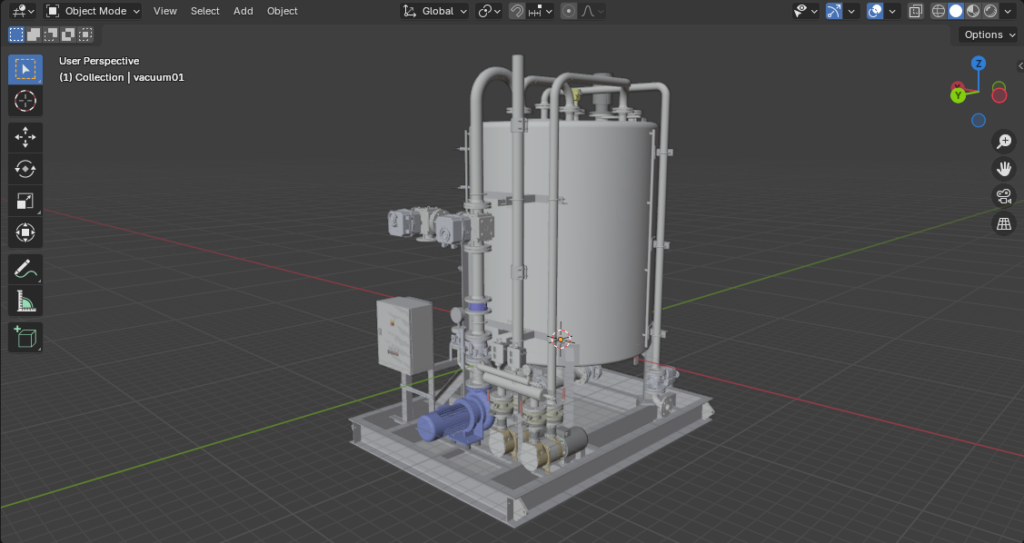
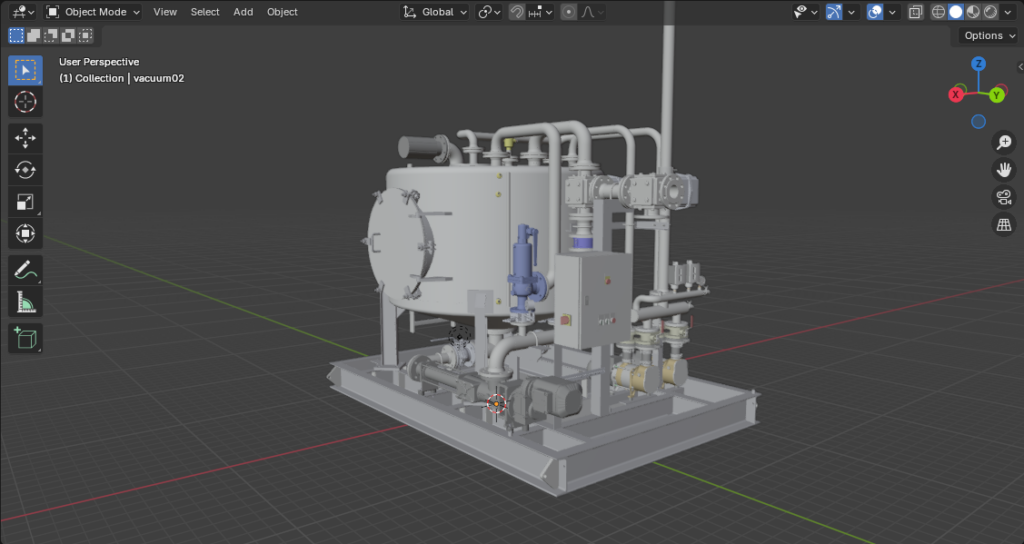
- Pump room layout — vacuum pump station footprint, ventilation, drainage, access for maintenance, noise treatment. Vacuum pumps are loud; acoustic enclosure design matters on passenger ships.
- Valve and instrumentation list — every interface valve, isolation valve, check valve, vacuum sensor, level sensor, and pressure indicator.
- Cable schedule and I/O list — for integration with the IAS.
- Sea-trial specification — the test plan that will be executed at the yard and during sea trials.
Deliverables: a procurement-ready detailed engineering package sufficient for yard fabrication and class approval-for-construction.
Phase 5 — Installation at yard
Yard installation is sequenced against the rest of the ship’s outfitting. Practical considerations:
- Pre-fabrication — pipe spools pre-fabricated off the critical path reduce yard labour hours and improve quality.
- Sequence with other outfitting — vacuum piping often competes with HVAC, electrical, and fire services for shaft space. Coordination between disciplines is non-negotiable.
- Penetration management — every structural penetration is a class item; the yard tracks these in a single register.
- Hydrostatic and leak testing — line-by-line testing as installation progresses, with a final system-wide vacuum integrity test.
- Pump commissioning — pump performance verification against the duty point, vacuum stability test, alarm and interlock testing.
- Sea trials — full-system functional test under realistic loading. For cruise ships, this often includes a load test simulating peak embarkation surge.
Deliverable: a commissioned, class-approved system handed over to the owner’s technical team for trials acceptance.
Phase 6 — Handover
The handover phase determines whether the system performs reliably for the next two decades or generates a steady stream of warranty calls.
- Crew training — technical crew trained on pump operation, fault diagnosis, routine maintenance, and emergency procedures.
- Maintenance manual — task lists, intervals, consumables, recommended spares.
- Spare parts schedule — agreed minimum onboard spares, including interface valves, vacuum pump spares, and critical sensors.
- As-built documentation — final drawings reflecting the installed configuration, including any yard-driven changes.
- Class and flag deliverables — final certifications, test records, and statutory documentation.
Pitfall: treating handover as an admin task. The first year of operation is when most design and installation issues surface; a structured handover sets up the technical team to handle them rather than escalate them.
Common pitfalls across all phases
A short list of issues that surface repeatedly across projects:
| Pitfall | Where it bites |
|---|---|
| Underestimating peak loading | Theatre intervals, embarkation, meal service surges overwhelm pump station capacity |
| Single-pump dependency | Redundancy specified in basic design but cut in procurement to save capex |
| Vacuum station noise | Acoustic treatment deferred to commissioning; complaint-driven retrofit on a passenger ship |
| Pipe material substitution | Cost-saving change to non-class-approved material; rework at commissioning |
| Class engagement too late | Major routing changes required after detailed design is complete |
| Inadequate training | Crew unable to diagnose interface valve faults; unnecessary service calls or avoidable blockages |
Where this leads
For shipyards, design houses, and owner’s engineering teams scoping a real project, the next step is a structured feasibility study and basic design package — exactly the scope Ingeniat’s engineering services cover.
For class surveyors reviewing a project in flight, the most valuable early-stage conversations are on redundancy philosophy, peak-loading assumptions, and MARPOL Annex IV holding-tank sizing — getting those aligned at the basic design stage prevents rework downstream.
Vacuum-based waste collection systems are commonly used on a variety of ships, including cruise ships, ferries, naval vessels, and large commercial vessels. They are particularly advantageous in ships where minimizing water usage and maintaining high hygiene standards are critical, such as passenger ships and offshore platforms. Further information regarding the installation of vacuum-based waste collection systems can be found through the following link.