
A field guide for cruise operators, ferry operators, naval procurement teams, and offshore platform managers.
Ingeniat’s overview of vacuum-based waste collection names the vessel categories where the technology is most commonly adopted: cruise ships, ferries, naval vessels, and large commercial vessels, with offshore platforms as a frequent adjacent case. The taxonomy is correct — but the more useful question for a procurement or engineering team is why each segment adopts it, and where the case is strong versus marginal.
This post walks through the operational drivers behind each vessel type.
Cruise ships — the canonical use case
Cruise ships are where vacuum collection became marine-industry standard, and they remain the highest-density deployment. A modern 3,000- to 6,000-passenger ship can carry 2,000 to 5,000+ toilet and collection fixtures, distributed across 8–15 passenger decks with multiple galleys, food courts, and crew areas.
Operational drivers:
- Fixture density — too many simultaneous users for a gravity system to handle reliably, especially during embarkation, meal service, and theatre intervals.
- Premium hygiene expectation — guest complaints about odor or blockage carry direct revenue impact.
- Service-recovery cost — a blocked toilet in a public area is a service-recovery event; vacuum’s higher flow velocities reduce this risk meaningfully.
- Water economics — multiplied across thousands of fixtures and 50+ voyages a year, freshwater savings justify the capex premium.
For cruise operators, vacuum is now baseline specification for newbuilds and a strong candidate for retrofit on the most plumbing-stressed ships in the fleet.
Ferries — high turnover, short turnaround
Ro-pax and ro-ro passenger ferries operate a different rhythm from cruise ships: short crossings (often under 4 hours), high passenger turnover, and tight turnaround windows in port. Vacuum collection suits this profile well.
- Peak surge handling — 1,500 passengers disembarking simultaneously produces a flush surge that gravity systems buffer poorly. Vacuum’s small-bore piping and pump station reserve tank absorb the peak.
- Vibration tolerance — vacuum lines, typically PVC or polypropylene, are not dependent on solvent-welded joints at every fitting and tolerate hull flex better than rigid cast-iron soil stacks.
- Food and beverage volume — many ferries have substantial self-service restaurants generating peak galley drainage alongside restroom surges; vacuum integrates these more cleanly than gravity.
Vessel sizes vary widely, from 500-passenger inter-island ferries to 2,000+ passenger ro-pax on long routes. The business case scales with passenger volume and crossing frequency.
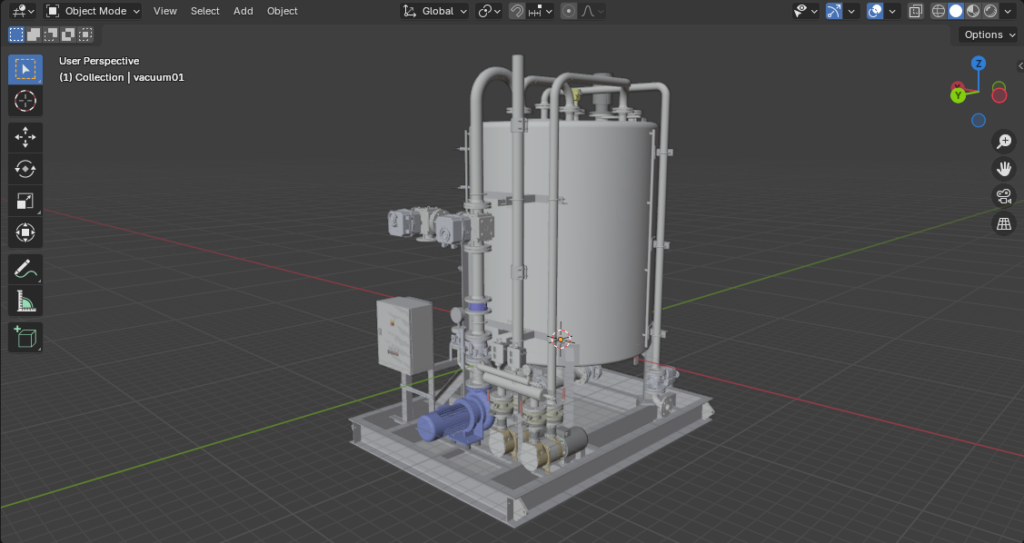
Naval vessels — driven by shock, deployment, and welfare
Warships and auxiliaries adopt vacuum collection for reasons that don’t appear on a cruise operator’s spreadsheet.
- Shock resistance — vacuum systems have fewer rigid, large-bore vertical penetrations, which reduces the structural shock path compared with gravity soil stacks. (Industry-cited; verify against classification society shock requirements for the specific class.)
- Water discipline on deployment — long deployments with limited replenishment make every litre of freshwater production matter; vacuum reduces per-capita consumption substantially.
- NBC decontamination compatibility — vacuum systems can be configured to route waste to a centralized collection point for processing, simplifying decontamination protocols after exposure events. (Operational practice varies by navy; this is one cited advantage, not a universal specification.)
- Crew welfare standards — modern navies compete with civilian employers for skilled crews; cabin-grade sanitary systems are now part of the welfare baseline.
Smaller patrol boats and fast attack craft often still use gravity or hybrid systems; the case strengthens with vessel size and crew count.
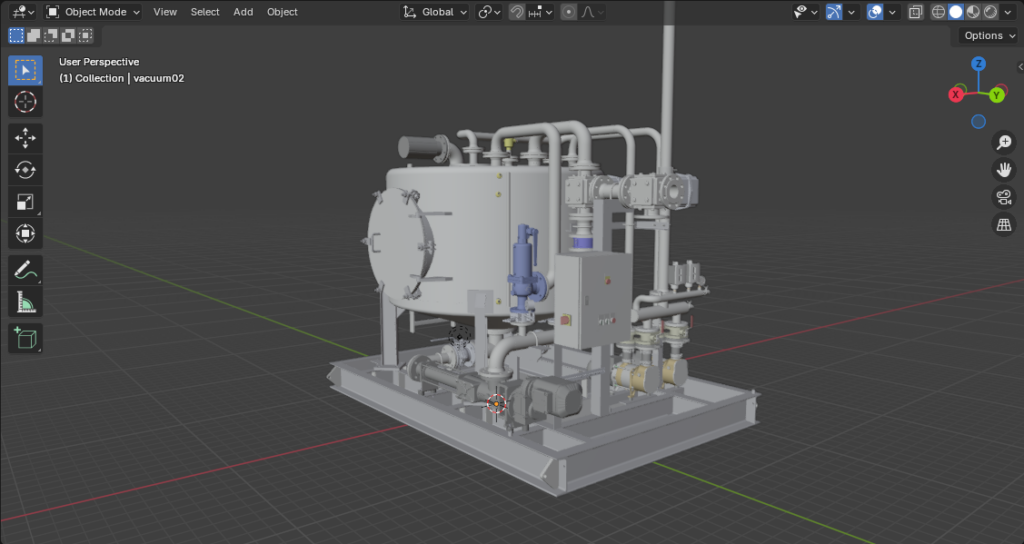
Offshore platforms and FPSOs
Offshore platforms — fixed production platforms, semi-submersibles, drillships, and FPSOs — share many shipboard constraints without the option of returning to port for waste removal. Crews of 100–200 personnel occupy compact accommodation blocks where plumbing space is at a premium.
- Vertical riser constraints — minimal headroom between decks and crowded module interiors make small-bore, direction-independent piping a strong fit.
- Zero or restricted discharge regimes — many offshore installations operate under zero-discharge or strictly controlled discharge rules; vacuum’s more concentrated blackwater simplifies holding-tank and treatment design.
- Modular accommodation — temporary or relocatable living quarters can be connected to the host platform’s vacuum network without gravity-fall constraints.
For greenfield platforms and major refurbishments, vacuum is increasingly the default.
Large commercial vessels — emerging, not standard
This is the segment where Ingeniat’s overview is most aspirational. A typical commercial cargo ship (bulk carrier, container ship, tanker) carries a crew of 20–25 with a relatively small number of fixtures. The capex premium for vacuum is hard to recover against the modest savings.
Where the case is shifting:
- Crew welfare as a recruitment lever — flag states and classification societies are raising crew accommodation standards. Better sanitary systems are part of that baseline.
- Larger accommodation blocks — some modern cruise-ferry hybrids, expedition cruise vessels, and large offshore construction vessels blur the line between “commercial” and “passenger” and increasingly specify vacuum.
- Sustainability reporting — fleet-level water and waste KPIs in Sea Cargo Charter and similar frameworks make even modest per-vessel savings worth tracking.
For pure commercial cargo, vacuum remains a minority choice. The trend line points toward gradual adoption as crew standards and reporting pressure rise.
Quick-reference table
| Vessel type | Typical fixture count | Vacuum case |
|---|---|---|
| Cruise ship (3,000+ pax) | 2,000–5,000+ | Strong — baseline standard |
| Ro-pax ferry (1,000–2,000 pax) | 200–800 | Strong — handles turnover surges |
| Smaller ferries (<500 pax) | 50–200 | Moderate — case-by-case |
| Naval frigate / auxiliary | 100–400 | Strong on shock + water discipline |
| Small patrol craft | 20–60 | Weak — gravity or hybrid often suffices |
| Offshore platform / FPSO | 50–200 | Strong — zero-discharge friendly |
| Commercial cargo (bulk, container, tanker) | 20–40 | Weak today — emerging as crew standards rise |
| Expedition cruise | 100–400 | Strong — combines cruise and offshore drivers |
Where this leads
For procurement and engineering teams in any of the “strong” segments above, the next step is a vessel-specific feasibility study covering fixture inventory, pipe routing, vacuum station sizing, STP integration, and class/flag review.
For teams in the “weak” or “moderate” categories, the case is best made on a single vessel first — a pilot project that produces your own operational data before any fleet-level decision.
Vacuum-based waste collection systems are commonly used on a variety of ships, including cruise ships, ferries, naval vessels, and large commercial vessels. They are particularly advantageous in ships where minimizing water usage and maintaining high hygiene standards are critical, such as passenger ships and offshore platforms. Further information regarding the installation of vacuum-based waste collection systems can be found through the following link.