
The Jacket Water Heat Recovery Skid for OCCS Solvent Preheating is a compact, purpose-built auxiliary unit designed to harvest low-grade thermal energy from the engine’s jacket water (JW) cooling circuit and redirect it into the Onboard Carbon Capture System (OCCS) process as a pre-heating stage for the rich amine solvent stream. Rather than replacing the primary solvent regeneration heat exchanger, this skid acts as an upstream thermal conditioner — delivering a meaningful temperature boost to the cold rich solvent before it enters the main (exhaust-gas-driven) regeneration heat exchanger. This reduces the thermal duty incumbent on the primary heat source, improving overall cycle efficiency and reducing wear on the high-temperature heat exchange equipment.
Engine coolant circulates continuously through the engine block, absorbing combustion heat to maintain safe operating temperatures. After leaving the engine, this water typically sits in the 75–85 °C range — too cool for effective solvent regeneration, but perfectly suited for pre-heating. The JW enters the skid at temperature element TE-101 (mounted at the engine outlet) and is directed toward the plate heat exchanger via the main supply header. Temperature transmitter TT-102 confirms the supply-side temperature immediately upstream of the heat exchanger. After giving up heat to the solvent, the cooled jacket water exits via the bottom of the plate heat exchanger, its temperature recorded at TT-103, and is returned to the engine’s thermal management circuit.
On the Rich Amine Solvent Side, CO₂-laden (rich) amine solvent arrives at the skid from the base of the absorption column at a relatively low temperature. It enters the plate heat exchanger from the bottom port, absorbs thermal energy from the jacket water flowing on the opposing plate faces, and exits the top port at a meaningfully elevated temperature. Temperature transmitter TT-104 monitors solvent inlet temperature and TT-105 confirms the pre-heated outlet temperature. The warmed rich solvent then continues forward to the main regeneration heat exchanger, entering it with reduced thermal deficit and thus demanding less high-grade heat input for full regeneration.
The heat exchanger is a gasketed or semi-welded plate type, selected for its high surface-area-to-volume ratio and ease of cleaning — both important considerations given amine fouling tendencies. The two fluid streams pass on alternating plate faces in a counter-flow arrangement, maximising the mean temperature difference and therefore thermal transfer efficiency even at the relatively modest 75–85 °C driving temperature available from the jacket water. The exchanger is sized to transfer the maximum allowable heat extraction rate permitted by the engine manufacturer’s thermal management guidelines, ensuring the engine outlet temperature never drops below its minimum operational threshold under any operating condition.
The most critical control element on the skid is the modulating bypass valve MV-101, located on the jacket water supply side. This valve continuously splits the JW flow between two paths: one through the plate heat exchanger (heat extraction path) and one bypassing it entirely, rejoining the cooled return stream before re-entering the engine. By modulating the proportion of flow through each path, the valve governs precisely how much heat is extracted from the engine coolant at any given moment.
This bypass is not merely a convenience — it is a safety-critical engine protection mechanism. All marine engines have a minimum jacket water temperature requirement; if coolant is over-cooled, thermal shock, lube oil viscosity changes, and cylinder condensation risks arise. The modulating valve ensures that heat extraction from the JW circuit is automatically curtailed whenever the jacket water return temperature (measured at TT-103) approaches the engine’s lower operating setpoint, protecting engine integrity at all times.
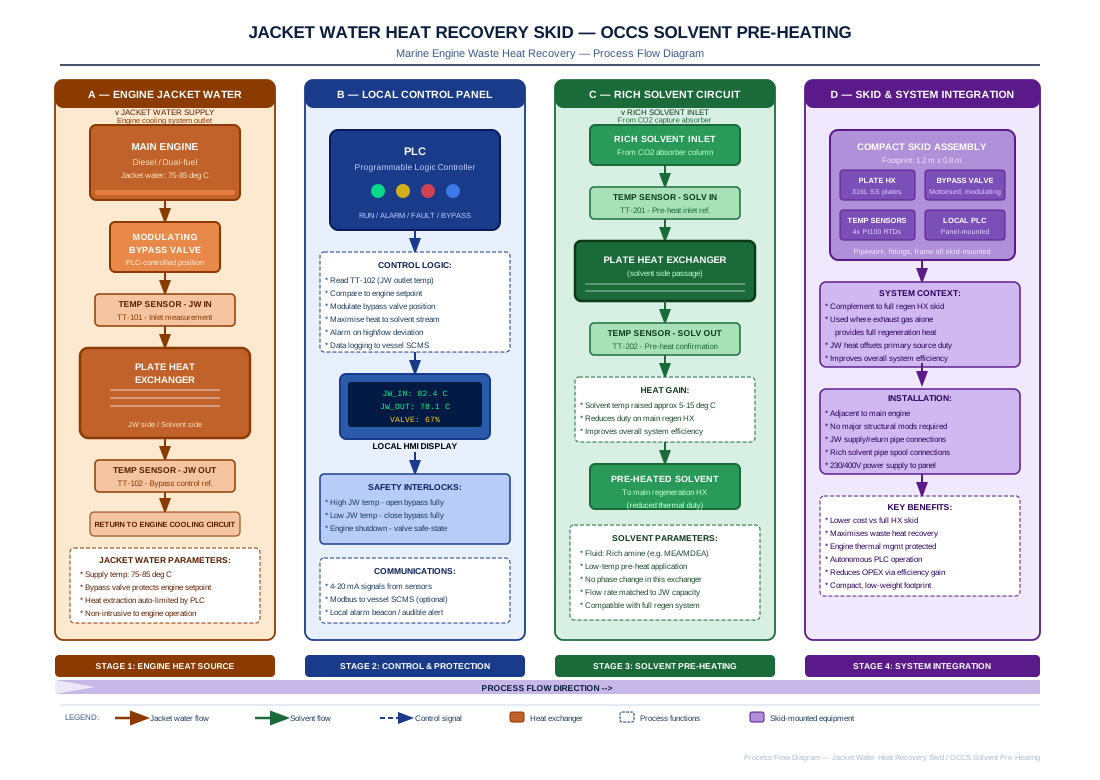
A dedicated local PLC (PLC-101), housed within the skid’s integrated control panel, executes a simple but robust control loop. The primary controlled variable is the jacket water outlet temperature measured at TT-103. The PLC compares this measurement against the configured engine setpoint and drives the position of modulating valve MV-101 to maintain the outlet temperature within the acceptable band — acting as a temperature-override controller that limits heat extraction before the engine operating envelope is breached.
Under normal conditions where the JW outlet temperature is comfortably above the engine minimum setpoint, the valve directs maximum permitted flow through the plate heat exchanger, maximising heat recovery into the solvent stream. As conditions change (varying engine load, varying solvent inlet temperature), the PLC continuously adjusts valve position to balance maximum heat extraction against engine protection.
The entire assembly — heat exchanger, bypass valve, all temperature instrumentation, interconnecting pipework, and the local control panel — is mounted on a compact structural skid of approximately 1.2 m × 0.8 m footprint. This small envelope allows the skid to be positioned directly adjacent to the main engine in the engine room without requiring structural deck modifications or significant re-routing of major pipework runs. Connections to the jacket water circuit and to the OCCS solvent loop are made via flanged termination points at the skid boundary. The skid is designed for minimal commissioning time: pre-wired, pre-piped, hydrostatically tested, and delivered as a factory-assembled unit ready for hook-up on arrival.
Besides jacket water-driven heat recovery systems, we can design and retrofit a broad range of equipment suitable for handling steam, or any other hot fluid, in heating or energy efficiency improvement applications, considering the following scope of supply.
- Feasibility Study and Concept Design:
- Evaluation of space availability and weight considerations
- Preliminary process flow diagrams
- Conceptual layout designs
- Initial cost estimates and project timeline
- Detailed Engineering Design:
- Process engineering and equipment sizing
- Piping and Instrumentation Diagrams (P&IDs)
- 3D modeling of the equipment layout
- Electrical system design and integration
- Equipment Specification and Procurement Support:
- Development of technical specifications for major equipment
- Vendor evaluation and selection assistance
- Review of vendor documentation and drawings
- Structural Modifications Design:
- Reinforcement designs for existing structures if required
- Finite Element Analysis (FEA) for critical structural components
- Integration Engineering:
- Interface design with existing ship systems (e.g., power, water)
- Modification of existing piping systems
- Safety and Risk Engineering:
- Failure Mode and Effects Analysis (FMEA)
- Regulatory Compliance and Classification:
- Liaison with classification societies
- Preparation of documentation for class approval
- Development of procedures to meet regulatory requirements
- Installation Planning:
- Development of detailed installation procedures
- Creation of work packages for shipyard or offshore installation
- Lift plans for major equipment
- Installation sequence optimization
- Commissioning and Start-up Support:
- Development of commissioning procedures
- Supervision of installation and commissioning activities
- Performance of system tests and trials
- Troubleshooting and optimization support
- Documentation and Training:
- Preparation of operating and maintenance manuals
- Development of crew training programs
- Environmental Impact Assessment:
- Analysis of the collection system’s environmental benefits
- Support for environmental permit applications
- Project Management:
- Overall project scheduling and coordination
- Cost control and progress reporting
- Quality assurance and control
- Lifecycle Support:
- Development of maintenance and inspection schedules
- Optimization studies for long-term operation
- Technical support for system upgrades or modifications
- Feasibility Study and Concept Design: