
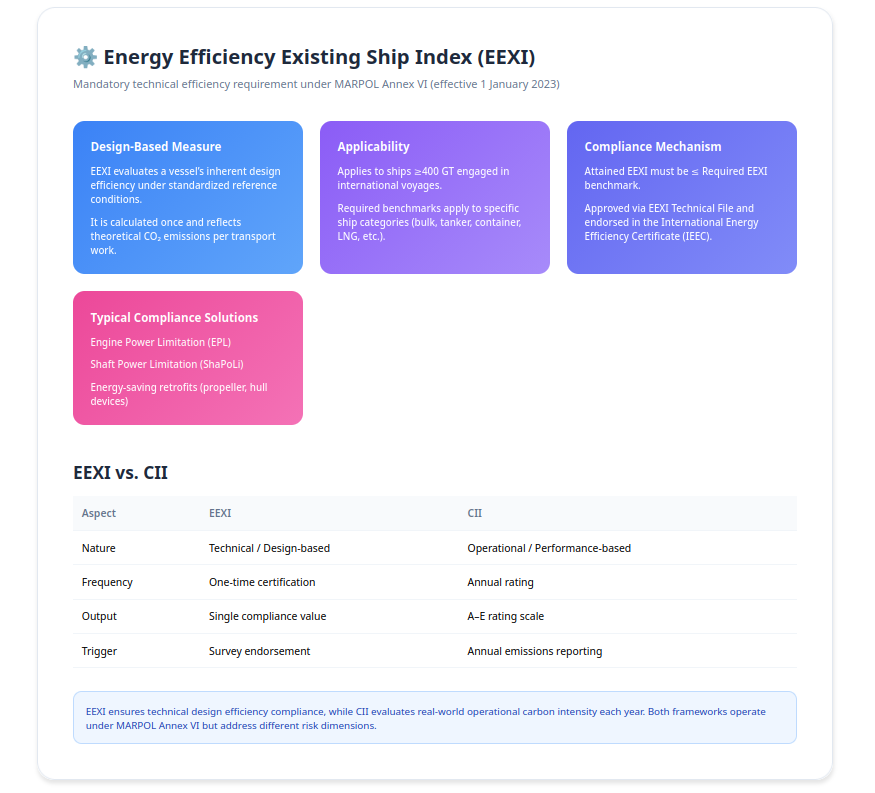
The Energy Efficiency Existing Ship Index is a mandatory technical compliance requirement under MARPOL Annex VI that entered into force on 1 January 2023. Unlike CII, which evaluates ongoing operational performance, EEXI is a one-time assessment of a vessel’s inherent design efficiency under standardised reference conditions. Once verified, compliance is reflected in the vessel’s International Energy Efficiency Certificate and does not require annual recalculation unless substantial modifications affecting energy efficiency are made.
What Our Services Cover
EEXI applies to ships of 400 GT and above on international voyages across defined vessel categories including bulk carriers, tankers, gas carriers, container ships, general cargo ships, and LNG carriers among others. Compliance was required at the first annual, intermediate, or renewal survey on or after 1 January 2023, meaning any vessel that has not yet confirmed its EEXI status carries unresolved regulatory exposure.
The attained EEXI is a calculated measure of theoretical CO₂ emissions per unit of transport work, derived from main engine power settings, specific fuel consumption of main and auxiliary engines, fuel carbon factors, reference speed, and cargo capacity. This attained value must meet or fall below the required EEXI threshold prescribed for the vessel’s type and size band — thresholds built from the same reference lines used for the Energy Efficiency Design Index applied to newbuildings.
Our services cover the full EEXI compliance process: technical file preparation and verification, calculation review, engagement with recognised organisations and classification societies, and identification of the most appropriate compliance pathway where attained values exceed required thresholds. For many older vessels — particularly those with high installed engine power relative to modern benchmarks — the primary compliance solution is Engine Power Limitation or Shaft Power Limitation. While these measures are effective in achieving the required calculated value, they carry operational implications that must be carefully assessed. Our services include evaluation of the downstream effects of power limitation on maneuverability, weather routing capability, and commercial speed commitments, ensuring that compliance decisions do not create unmanaged operational or contractual risk.
EEXI and CII: Understanding the Interaction
EEXI and CII are complementary but distinct regulatory instruments, and our services address both in an integrated manner. EEXI establishes whether a vessel is technically permitted to operate from a design efficiency standpoint — it is a threshold, not a rating. CII then governs whether the vessel’s actual operational deployment remains compliant year by year, producing an A to E rating with escalating consequences for sustained underperformance. A vessel may achieve EEXI compliance through power limitation while simultaneously finding that the same power restriction improves its CII trajectory by constraining fuel consumption. Conversely, power limitation may conflict with commercial speed requirements in ways that affect cargo capacity utilisation and therefore worsen the CII denominator. Our services are structured to evaluate these interactions holistically rather than treating each regulation in isolation.
Outputs and Deliverables
- EEXI Technical File preparation, review, and verification support
- Attained versus required EEXI calculation and gap assessment
- Compliance pathway evaluation including Engine Power Limitation, Shaft Power Limitation, and efficiency retrofit options
- Operational impact assessment of power limitation measures
- IEEC endorsement support through classification society engagement
- Integrated EEXI and CII interaction analysis to ensure compliance decisions are commercially and operationally sound
Strategic Value
EEXI compliance is not simply a certification exercise. For vessels with high installed power — particularly container ships and certain tanker segments — the choice of compliance pathway has lasting implications for operational flexibility, charter competitiveness, and CII performance. Our services ensure that compliance is achieved not merely on paper, but in a manner that preserves commercial viability and integrates cleanly into the vessel’s broader regulatory and operational profile.
What we do: We provide comprehensive EEXI compliance advisory and technical support services.
A. EEXI Calculation and Technical File Preparation
- We conduct detailed technical data collection, including engine specifications, sea trial data, reference speed validation, and fuel consumption parameters. We prepare or verify the EEXI Technical File in accordance with IMO guidelines and coordinate with classification societies for approval.
B. Gap Assessment
- We compare attained EEXI values against required benchmarks and identify compliance margins or shortfalls. Where gaps exist, we quantify the magnitude of adjustment required and evaluate alternative compliance pathways, including engine power limitation scenarios and technical modifications.
C. Improvement Measures
- Where modification is necessary, we assess options such as Engine Power Limitation, Shaft Power Limitation, propeller upgrades, hull efficiency devices, and other energy-saving technologies. Each option is evaluated for technical feasibility, operational impact, and cost-effectiveness.
D. Certification Support
- We support coordination with recognized organizations during survey attendance, facilitate documentation review, and ensure endorsement of the International Energy Efficiency Certificate.
In summary, EEXI is a foundational technical compliance requirement that establishes whether a vessel’s design efficiency meets internationally mandated standards. While it is not an annual rating system, its implications for engine power availability, commercial speed, and operational flexibility are significant. Proper technical assessment ensures compliance without unintended operational constraints.